In this week’s newsletter, we cut through the complexity of Heidegger’s Being and Time with philosopher Simon Critchley, take a page out of design writer Lila Allen’s media diet, and more.
Good morning!
I first met the British philosopher Simon Critchley—the guest on our latest episode of Time Sensitive and the first-ever repeat guest on the show—in late 2019, just a few months before the pandemic. Over the strange and disorienting year that followed, we became close friends, frequently meeting for drinks or dinner at our favorite neighborhood haunts in Brooklyn (shout-out to The Long Island Bar, Henry Public, and Hibino). I fondly remember spending Thanksgiving dinner in 2020 together, too, just the two of us over a meat pie I’d ordered from M. Wells, which Simon said was the best-tasting meat pie he’d ever had (high praise, coming from a Liverpudlian!). I’ve often thought about what an unusual gift it was to live through that period with a philosopher friend close by.
So I was particularly glad to get him back into the studio for a conversation. We cover a lot of ground—mainly his new book, Heidegger Thinking: ‘Being and Time’ Explained (also included in this week’s “Three Things,” below), which takes on Martin Heidegger’s 1927 magnum opus, as well as poetry and failure, anxiety versus fear, soccer, David Bowie, memory and memorials, and much more.
The final stretch of our conversation has stayed with me. We talk about giving up what Simon calls “the fantasy of mastery”: accepting weakness, accepting limits, accepting that the people we love—and we ourselves—will someday die. While it might sound morbid, it’s actually quite the opposite. Simon argues that accepting our finitude, rather than trying to outrun or resist it, may actually set the conditions for a freer, fuller life. In other words, it’s important to have—here, I’m liberally using the great title of a 2011 Julian Barnes novel—the sense of an ending. Your ending.
It’s an idea that gets at something I’ve thought about for much of my life: that an awareness of our impermanence need not diminish the experience of living. It can heighten it. To understand that our time is limited is also to understand that how we spend it, whom we spend it with, what we pay attention to, and what we choose to make and leave behind matters.
—Spencer
P.S. I’d be remiss here not to thank the Danish entrepreneur and consultant Christian Madsbjerg (the guest on Ep. 27), author of Look: How to Pay Attention in a Distracted World, who first introduced me to Simon all those years ago.

“The point is to accept your limitation. You’re not going to live forever. And if you could accept that, to learn how to die, then you could become free.”
Listen to Ep. 159 with Simon Critchley at timesensitive.fm or wherever you get your podcasts
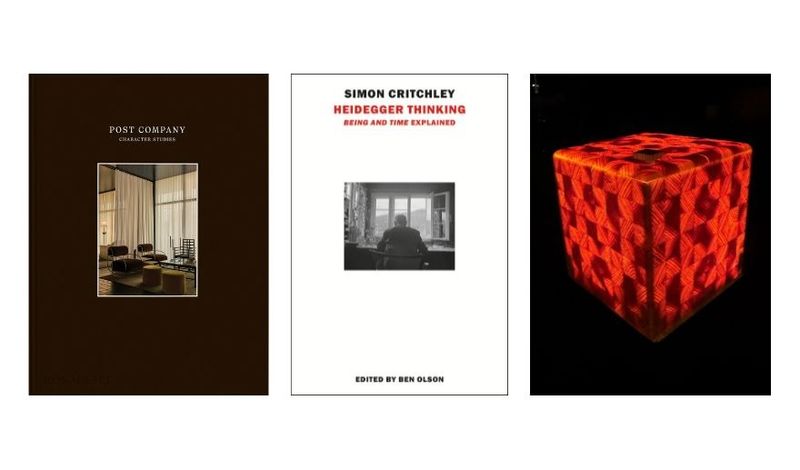
Post Company: Character Studies by Lila Allen
Antique cast-iron candelabras and rush-seat ladderback chairs imbue the Hudson Valley hospitality outpost Inness with its pared-back, Shaker-esque feel, while zebra-print doors and crimson ceiling tassels set the sultry-meets-surreal mood of the restaurant at the Lafayette Hotel in San Diego. It might surprise some that both of these projects are the handiwork of a singular entity, the Brooklyn- and Jackson, Wyoming–based design and interiors firm Post Company, whose first monograph, Post Company: Character Studies (Monacelli), is out this week. Those familiar with the studio’s oeuvre, though, can quickly identify the telltale signs of their workmanship: a room with unusual ease, an attuned material sensibility, and a warmth that emanates from the inside out. Written by Lila Allen (the subject of this week’s “Media Diet,” below) with editorial direction by The Slowdown, the book expounds on these defining qualities, or what foreword author Sam Calagione—of Dogfish Head Brewery, whose Dogfish Inn was the firm’s first commission—calls its “superpowers.” This compendium of 16 projects across the U.S. underscores Post Company’s respect for history, embrace of the effects of time (as Allen writes in her intro, “patina is part of the plan”), and rigorous, iterative process that treats each space, as the title suggests, as its own character: richly layered and complex, surprising in the best of ways, and altogether unforgettable. —Emily Jiang
Heidegger Thinking by Simon Critchley
“Reading [Martin] Heidegger’s Being and Time can change one’s life,” begins the preamble to philosopher Simon Critchley’s latest book, Heidegger Thinking: ‘Being and Time’ Explained (New York Review Books). From there, he sets out to reveal how that might happen. Across 18 chapters, Critchley (the guest on Eps. 42 and 159 of Time Sensitive) deciphers what he considers “the most important philosophical book of the last century,” known for its baroque, impenetrable language and vast influence that spans figures including Theodor Adorno, Hannah Arendt, and Jean-Paul Sartre. Building on his 2020 podcast series, Apply-Degger, Heidegger Thinking is neither pop philosophy nor reserved for ivory-tower intelligentsia; rather, it’s a valiant and nuanced expedition into the architecture of Heidegger’s ideas through clear-eyed, accessible language. Harnessing his almost 40 years of reading and teaching the tome, Critchley nimbly and wryly cuts through the German philosopher’s abstruse language to help readers meaningfully engage with the text and, in turn, rediscover their sense of wonder and willingness to question. If we do so, Critchley writes, “everything changes in terms of how we think of the world, ourselves, and others.” —E.J.
“Catalogue de Lumière: Series Two”
An improvisatory approach powers the drummer, percussionist, composer, and visual artist Billy Martin (Ep. 131), a member of the genre-defying, jazz-meets-funk trio Medeski Martin & Wood. With “Catalogue de Lumière Series Two,” Martin has taken his experimental instincts beyond music, painting, or drawing and into a new realm: light sculptures. His enigmatic new collection of 25 pieces handcrafted from longleaf pine possesses a deep reverence for the turpentine-scented material, known for its particular sensitivity to light’s passage. After carving the resinous wood—which he salvaged from floorboards pulled out of an old building in New York City’s SoHo neighborhood—he slowly pieces each sculpture together over several months, strip by strip, as with a puzzle, allowing its distinct character to reveal itself to him gradually. Whether a finished work resembles the red-hot magma of a volcanic explosion, a fiery sunset, or warm embers aglow on a winter’s night, Martin revels in not knowing the shape or mood each will take. “The wood already holds a kind of memory,” he writes in the show notes for “Reliquaries of Light,” a private exhibition opening Oct. 17 at his Englewood, New Jersey, studio. “I’m not trying to put a message into it as much as bring something out.” —Olivia Aylmer
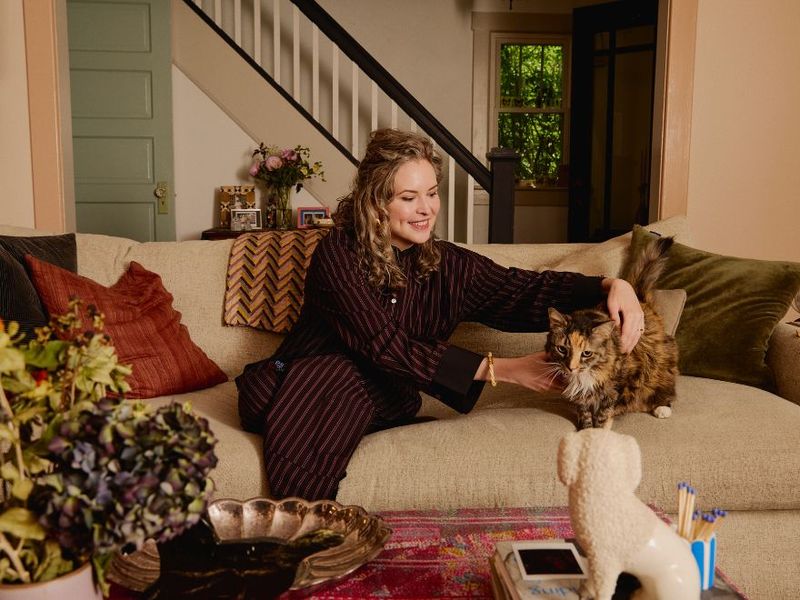
Writer and editor Lila Allen lovingly refers to Wrong House, the publication she launched via Substack last year, as a place for “design writing with guts.” By that she means “both in that I want writing with feeling,” she says, “but I also am sort of gut renovating what a design publication can be.” With offbeat issue themes like “No Thoughts, Just Vibes” (on emotional interiors) and “The Kitchen Sink” (on the joy of everyday objects), the irreverent publication marks Allen’s leap into independent media after building her career at old-guard outlets including Metropolis and Architectural Digest. “I just looked around and was like, ‘Why am I not attempting to create a platform that I would enjoy reading that also serves writers who I love working with?’”
Here, Allen tells us about authoring the design firm Post Company’s first monograph, which she collaborated with The Slowdown on; the podcast that’s accompanied her mornings for 14 years; and her unapologetic affection for soda.
How do you start your mornings?
I split my time between my primary home in Stone Ridge, in the Hudson Valley, and the city. When I’m in Stone Ridge, I usually get breakfast with my husband [Rob] at Hash, a little café down the road, which is a really charming tradition. For the twelve years we’ve been married, we’ve never had schedules that lined up, because he was a kindergarten teacher and would leave at the crack of dawn. Now we have mornings together, so it’s really sweet. When I’m in the city, I try to go for a walk and get coffee at The Jolly Goat in Hell’s Kitchen, and then I work out of The Malin Chelsea.
Tell us about your work on Post Company’s first monograph. Did you learn anything about the firm that surprised or stayed with you?
The job came to me in that bardo between frenetic full-time employment and figuring out the new rhythm of my life, and who I was going to be when I wasn’t attached to a capital-M, capital-I “Media Institution” anymore. To be honest, I was a little tender at the time, so it was a real reset and pleasure to write this. It was a lot of sitting with myself, and truly becoming a writer again—not just an editor.
I wrote about ninety percent of it from Inness, which is one of the properties in the book, and just a few miles down the road from my house. One thing that stuck with me at a molecular level was getting to see how these guys [Ruben Caldwell, Jou-Yie Chou, and Leigh Salem] have built their business, refined what they’re good at, and found new ways to explore and reinvent themselves again and again. That was what I learned the most from it: that in running a creative business, change is incremental, but progress is cumulative. It’s a good thing to remember all the time, but for me in that moment, it was a lesson I needed.
Where do you get your news from?
I float in and out of having a daily print subscription to The New York Times. In an “on” time, Rob and I will bring a copy of the paper to breakfast and flip through it. Weirdly, the business section has always been my favorite part of the paper. It’s good to know the larger economic factors that are pulling the strings on everything else that’s happening. I might get some side eyes for this, but I do scan the New York Post just to see how they’re framing stories and what kind of rhetoric is being used. I do enjoy a Page Six column from time to time. I will occasionally look at The Wall Street Journal and The Atlantic.
It’s been about a year since you launched Wrong House. What led you to create it and how has it evolved since?
When I shifted to independent work, I paused to really look at how discourse is happening around design right now. It’s an interesting moment: You have these characters like Dan Rosen, who emerged into design media kind of through a side door. Though I believe he actually has a fair amount of formal training in design itself, he’s coming into this world through comedy rather than the traditional channels. There’s also David Michon of For Scale, who has a distinctive voice and can be pretty damn funny. Emma Apple Chozick has a lot of fire in her belly, and her videos are tremendously entertaining. It felt like there was an appetite for more media that’s fun and irreverent and has something to say. In general, people seem to “get” the Wrong House ethos pretty quickly, which affirms my hunch that folks are hungry for this kind of thing.
Any favorite newsletters?
Robert Khederian deserves some kind of medal for Second Story, his wonderfully well-researched Substack. His deep-dives into historic New York City architecture teach me so much. He recently covered the Home Club, an early example of cooperative housing.
Rachel Karten’s Link in Bio is also very good. Though it’s about the business of social media, the information she presents actually reflects the dynamics of the whole brand/content ecosystem; it’s something I think editors should keep tabs on. My friend Kel Rakowski runs an exceptional Substack about creativity called Popular. She has great resources in there—things like lists of free courses, unexpected places for sourcing cool imagery, journaling exercises, and prompts for getting out of whatever rut you’re in.
Any favorite podcasts?
I have listened to the Stuff You Should Know podcast for fourteen years as my get-out-of-bed-in-the-morning podcast. It’s the right tone for me to halfway pay attention to as I’m rubbing the crusties out of my eyes.
If I’m in go-to-sleep mode or can’t-sleep mode, and trying to calm my brain down, I listen to the Secular Buddhism podcast. The posting is somewhat irregular, but there are great archives. The guy that hosts it [Noah Rasheta] is a former Mormon. He doesn’t talk about that much, but I do appreciate that he is willing to discuss the challenges in his own life and how this philosophy helps him reframe his thinking. It’s a good reminder for quelling my own anxieties.
Then, if I’m fully awake and I’m driving or cleaning, I’m listening to more of a narrative podcast, like Behind the Bastards. Each episode focuses on a single bad guy from history. One that I love is the Thomas Kinkade saga—he’s the guy who did those very chintzy, pseudo-religious paintings that you used to see in malls. Turns out, not a great dude! I also listen to the Business of Home podcast to keep tabs on the design industry—and enjoy the banter between executive editor Fred Nicolaus and host Dennis Scully.
What are some of your favorite magazines?
I still look at AD all the time, because they do get really spectacular homes in there, and it’s important to know the big decorating moves that will eventually trickle down to the rest of us. The World of Interiors, I love. I think Emily Tobin is a genius. The fabric shoot they did last summer—where they dressed up all these people as teapots and candelabras and stuff—is still living rent-free in my brain. We definitely need more wackadoo editorial like that in the design space.
I have also been paying more attention to Pale Blue. They are very good scouts for talent. It happens all the time—I’ll find somebody, a woodworker or sculptor maybe, and I’m like, “Oh, I’ve never heard of this person.” Then I look and inevitably, they have just run a story on them. They’re on top of it.
What book are you currently reading?
A friend just gave me a copy of A Sand County Almanac: And Sketches Here and There by Aldo Leopold, which is one of those great texts of the modern environmental movement I’ve never gotten around to reading.
I also just bought a copy of Andrew Sean Greer’s Less after listening to him on How I Write. He gave some pretty amazing advice there, so I want to see how it applies in his own writing—which, by the way, won a Pulitzer.
Any guilty pleasures?
I’m a big soda drinker. Diet Coke; Cheerwine, which is a North Carolina super cherry soda that I actually order special for us; Dr. Pepper. It’s all good. I don’t know when drinking a Diet Coke every day became the moral equivalent of smoking a full pack of Marlboros, but I reject it.
This interview was conducted by Emily Jiang. It has been condensed and edited.
Our handpicked guide to culture across the internet.
As A.I. companies begin hiring philosophers, Simon Critchley (the guest on Ep. 159 of Time Sensitive) argues that our human capacity to find meaning through mortality and discern what’s worth remembering matters more than ever. [The New York Times]
The news of Theaster Gates (Ep. 143) acquiring the family-run porcelain manufacturer Pickard China, the last of its kind in the U.S., further cements the Chicago-based artist and ceramicist’s commitment to cultural restoration and preservation. [NPR]
James Frey (Ep 135) intriguingly describes his forthcoming novel, Never Ever, out next May, as “a love letter to a ghost” and “a poem for the brokenhearted.” [People]
During a Fast Company–hosted conversation, Flamingo Estate founder Richard Christiansen (Ep. 124) fervently calls for a return to daily moments of ceremony to counteract a culture of optimized speed, which he calls “the enemy of intimacy.” [Instagram]
On Oct. 24 in New York City, photographer Tina Barney (Ep. 87) and critic Vince Aletti will discuss Fashion, a new Aperture monograph and solo exhibition highlighting the sartorial threads of her practice over five decades. [Olney Gleason]
Correction: The “Textile Alchemy: The Art of Reiko Sudō and Nuno” write-up in last week’s “Three Things” noted that it was on view at the new Peter Zumthor–designed LACMA building. While it is on LACMA’s campus, the exhibition itself is on view in the Renzo Piano–designed Lynda and Stewart Resnick Exhibition Pavilion. The text has been updated in our archive for accuracy.