In this week’s newsletter, we reconnect with our inner child through Lidewij Edelkoort and Philip Fimmano, stop by Es Devlin’s new London exhibition, and more.
Good morning!
For the latest episode of Time Sensitive, I met the legendary chef, author, artist, and educator Jacques Pépin at his home and studio in Madison, Connecticut, where he has lived and worked for decades.
It’s difficult to fully comprehend the scale of Jacques’s influence. At 90, he has spent more than 75 years in the kitchen, beginning as an apprentice in France at age 13 before coming to the United States in 1959. Across more than 30 cookbooks (including, most recently, Jacques Pépin Complete Techniques), hundreds of television programs, countless classes and demonstrations, and decades spent teaching, he has shaped how generations of people cook and think about food.
I got a small, unexpected glimpse of just how far that influence reaches when I told my dad that I would be interviewing Jacques for the show. He mentioned that my mom, who passed away in 1989, had taken a cooking class with Jacques at the Broadmoor Hotel in Colorado Springs sometime in the ’80s. I’d never heard this before. My dad said she learned a tremendous amount from him, and that the techniques Jacques taught her shaped the way she cooked afterward. Later, he texted me a photo of a book Jacques had signed to my mom and my aunt. I suppose that, long before I ever met Jacques, some small part of him had made its way into my own childhood, through the food my mom prepared for our family.
What I find so compelling about Jacques is the simplicity of his approach. His lessons can seem almost elemental: how to hold a knife, make an omelet, use what you have, cook for other people. But simplicity at this level is hard-won. Behind a seemingly effortless gesture are decades of repetition, attention, and refinement. As the hotelier Ian Schrager (Ep. 100) once told me, quoting (or perhaps misquoting) Leonardo da Vinci, “Simplicity is the ultimate sophistication.” Jacques embodies what that means in practice: knowing something so deeply that you can strip away everything extraneous and get to its essence.
There’s a generosity to this approach, too. Jacques takes a lifetime of knowledge and makes it useful and accessible for others to carry forward. The lesson isn’t simply in doing something extraordinarily well, but in being able to communicate what you know clearly enough that another person can understand it, practice it, and eventually make it their own.
That spirit runs throughout our conversation, particularly in Jacques’s notion of “taste memory”: the tastes, smells, textures, techniques, and sensations we accumulate over a lifetime. We talk about his childhood in Bourg-en-Bresse, France; his early training in Parisian kitchens and subsequent move to America; the 1974 car accident that changed the course of his life; and his steadfast belief that “everyone is equal in the eyes of the stove.”
But I keep coming back to my mom taking that class more than 40 years ago. Craft moves through the world this way: person to person, hand to hand. In Japan, there’s a term for this—denshō—which refers to the act of transmitting lore, wisdom, and craft techniques from the past, typically taught orally or through hands-on demonstration. Often, this can occur without our realizing it. Sometimes, not even intending to, we pass our know-how along.
—Spencer
P.S. I’m pleased to share that our Time Sensitive episodes featuring Theaster Gates (Ep. 143, Season 12) and Sheila Hicks (Ep. 153, Season 13) have each been selected as finalists in the 2026 Signal Awards, which recognizes culture-shaping podcasts. This means we’re now in the running for a Listener’s Choice honor, voted on by the public. We’d be grateful if you’d consider voting for us by Oct. 15 in both the Arts & Culture and Interview or Talk Show categories.
“People will probably remember me not for the very complicated or extensive recipes that I do, but something simpler. Even showing you how to cut a lemon the right way.”
Listen to Ep. 158 with Jacques Pépin at timesensitive.fm or wherever you get your podcasts
“Es Devlin: Other Worlds” at the Design Museum, London
British artist Es Devlin’s exuberant vision—cultivated since childhood, when she would handmake everything from family holiday gifts to gerbil runs—has long been her calling card. Over the past three decades, she’s put her stamp on stage sets for the likes of Bad Bunny, Lady Gaga, and, most recently, Olivia Rodrigo, for her “Unraveled” tour, and drawn admiration from curator Hans Ulrich Obrist (the guest on Ep. 146 of Time Sensitive) and even theoretical physicist Carlo Rovelli. For her landmark exhibition “Other Worlds,” on view through April 4, 2027, at the Design Museum in London, Devlin embraces the full range of her practice, which spans live performance, sculpture, light, and music. At the heart of the gallery space, her circular “30-year desk” gathers 5,000 objects and 30 revolving models from her archive, immersing viewers in some of her major pop cultural contributions, including the London 2012 Olympic closing ceremony and the electric 2022 Super Bowl halftime show, for which she collaborated with Dr. Dre to reconstruct the California city of Compton. Of her uncompromisingly more-is-more approach, she recently told The Guardian, “I think you actually achieve greater depth if you expand your line of inquiry.” —Olivia Aylmer
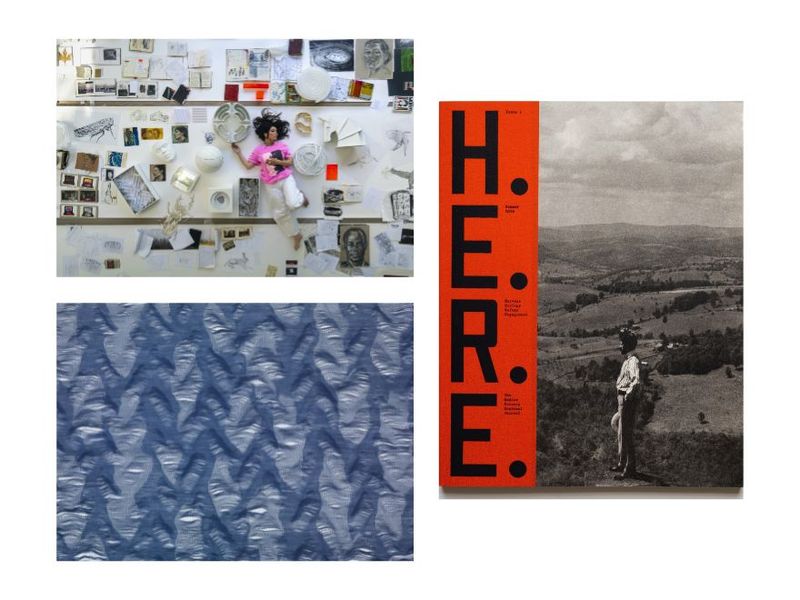
H.E.R.E. Journal
“I remember so clearly when I pulled off the Taconic Parkway, breathing and smelling the grass, smelling the air, and what it did to my nervous system,” H.E.R.E. Journal editor Ann Marie Gardner says about her decision to decamp from New York City to the Hudson Valley. Recently launched by The Understory, a nonprofit supporting ecological and social resilience along the Hudson River, the biannual publication emphasizes the region’s singular character, exploring it, as Gardner writes in her opening note, “from every angle: its views, its pain, its weather, its wildlife, its history, ecology, geology, and people.” For its inaugural issue, photographer Carla Rhodes marvels at the flying squirrels that share her home, author Leila Philip follows beavers and eels to understand the hidden life of rivers, and Potawatomi botanist Robin Wall Kimmerer speaks about her new grassroots initiative, Plant, Baby, Plant. Rather than shy away from the region’s challenges, the journal faces them head on: In Issue 1, for example, H.E.R.E. staff break down the Hudson’s homelessness crisis through a series of infographics designed in house. A project born out of curiosity and deep care, the journal possesses a refreshing clarity of purpose, with all proceeds going toward local conservation efforts. —Emily Jiang
“Textile Alchemy: The Art of Reiko Sudō and Nuno” at LACMA
Japanese designer Reiko Sudō’s fabrics often conjure surprising imagery—the time-worn patina of a burnt pot, handmade Mexican bark paper, molten metal—that’s reminiscent of a vividly compact haiku (as it happens, her poet father’s form of choice). On view now through March 7, 2027, at the new Peter Zumthor–designed LACMA building, “Textile Alchemy” marks the most in-depth survey of Sudō’s practice to date, traversing the output of her transformative collective, Nuno (“cloth,” in Japanese), which she’s helmed for nearly 40 years. The lasting relationships she’s nurtured with artisans and small workshops, via her extensive travels to remote regions of Japan, reverberate throughout the exhibition, which includes a replica of her 1984 Nuno shop for visitors to touch and take home her wearable art works. Alongside this showcase of 100-plus limited-edition textiles, tools, and behind-the-scenes ephemera, her permanent offering of shimmering, light-protective, faintly chrome-layered curtains in the David Geffen Galleries means a tactile piece of her perspective will always shine there. —O.A.
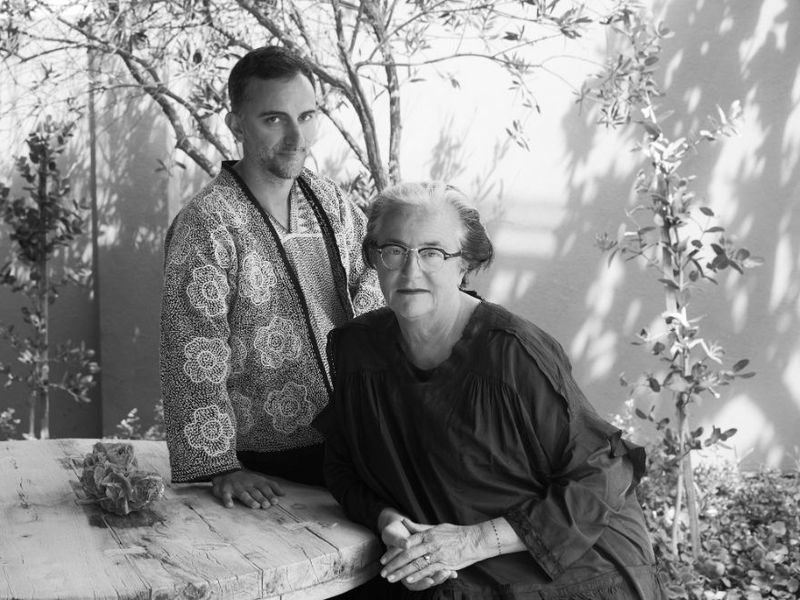
The unbridled wonder, wide-eyed zeal, and boundless creativity of childhood is so often lost to mundane routines, external expectations, and the world’s stark, often unsettling realities. In their exhibition “Inner Child: Playing With Design,” on view from Oct. 10 through April 11 at Artipelag in Stockholm, co-curators Lidewij Edelkoort (the guest on Ep. 29 of Time Sensitive) and Philip Fimmano celebrate artists and designers who have fiercely clung to those qualities and poured them into their creations. Prizing the analog and the improvised, the brightly colored and the out of the box, the exhibition convenes more than 100 makers from around the world alongside their whimsical creations, including a collection of cardboard furniture pieces by British furniture designer Max Lamb, with some bearing the artwork of his son; multihued building-block sculptures by British artist and designer Yinka Ilori; and animal-shaped furniture by Ukrainian architect and designer Victoria Yakusha.
Here, Edelkoort and Fimmano discuss what they see as a trend toward more childlike expressions in contemporary design and interiors, their decision to collaborate with two children on the exhibition design, and how they’ve found healing through curating the show.
Li, this exhibition was born out of your prediction of a shift toward more childlike expressions in design and interiors. Why do you think that shift is happening now? Is it nostalgia? Loneliness? A need for comfort and tactility?
LIDEWIJ EDELKOORT: All of the above. People are afraid and angry and more stunned with the world situation every day, and the fear for what is coming, economically and with A.I. and so on. This stagnates culture, stagnates creativity, stagnates progress, and so a certain return to the inner child, to feeling like a child, experiencing like a child, is like a renewing. It’s like a rebirth. It’s like a renaissance, and I think it’s very much needed.
It’s really beautiful, especially in this time when our attention is so commodified. We often think of children as having short attention spans, but now it’s the adults whose attention spans are splintered. Whose work are you most excited to share?
PHILIP FIMMANO: It’s very hard [to choose]. Li might say Max [Lamb] was a very important starting point for our thinking process. He was the biggest example of someone taking a technique that children have, which is playing with cardboard boxes, and transforming it into a sustainable statement, which is about making furniture that can be constantly reshaped and repaired, without the need to start again.
LE: For me, it’s also personally very interesting because, as a kid, I made everything from cardboard myself, because I was born after the war, in 1950, and there were no toys. I wanted to be a mature adult, so I started to make everything, like a record player and records out of cardboard, and I could listen to the music. I feel very drawn, therefore, to this step because it’s like connecting with my childhood.
PF: I very much like the oldest artist, Agnès Debizet. She’s 69. She’s a French ceramicist who makes furniture by rolling out the clay as if you’re rolling out a piece of bread with a rolling pin, and then she cuts holes into it before it gets shaped into furniture.
The youngest people in the show—apart from Kiki [van Eijk] and Joost [van Bleiswijk]’s children [Ko and Puk] who helped us design the sets for the display—we have a mother [Charlotte Grün] and daughter [Nina Verberne] who are working on creating cardboard still lifes for the exhibition.
LE: [Nina] is 9. Her mother made the vases a bit too strict, so I asked her to make them more improvised. She asked her daughter to help her to sort of “damage” the image and make it much more interesting.
How did this collaboration with Kiki and Joost come about, and what were some of your favorite ideas that their kids brought to the table?
LE: I know them very well. They’re friends, and I’ve known the kids from a young age and how creative they are. We briefed [the kids] with all the boards and everything, which were in the works, and they started to work.
Ko, the little one, decided to make a “Cuddletopia,” he called it. He [designed] a landscape of islands covered by brown felt and fringed with teddy bears. And then, on top, will be the artist’s work. It’s going to be hilarious.
And Puk did something very wonderful, because in the papier-mâché room we have a very difficult platform ceiling. We were wondering what could be done, not to hide it, but make it look better. He came up with this idea of a planetarium. They made many planets. There’s going to be two round podiums, and we will have these planets above this papier-mâché stuff. Often, when you see papier mâché, you think of primitive design and the beginning of time, but now it will also become cosmic.
PF: When you give in to listening to kids, you realize that they come up with ideas you would never yourself do, and especially as very precise curators as we are, usually we make everything very aesthetic and very perfect. This taught us to let go.
LE: Especially Philip, who is the aesthete of aesthetes. [Laughter]
PF: It’s a very uplifting scenography. It’s not like saying we’re going to get some children’s drawings and blow them up and make a wallpaper. This is handing over to the kids the agency to design themselves. They really took it seriously. They asked for royalties straight away. [Laughter] They said, “What is my design fee?”
Li, you’ve said that curating this exhibition was almost like therapy. In what ways did you both find healing through this process?
LE: In the beginning, you don’t really acknowledge that this is happening. You’re just working, working, and every morning you check your news in your feeds, and [you’re getting] more terrible news every day. Then, suddenly, getting really into the work, we started to realize that we were doing better than we were before, and that our mood was lifted. It was infectious. At one point, Philip and I spoke about it together. After two months, we said, “What is happening? It’s really crazy that we feel so good when we should feel so bad.”
PF: Even for the teams that we’re working with—we pretend that we’re the only two big kids, but then, for example, the restaurant in the museum is going to be doing afternoon tea and crazy pizzas with smiley faces on them. These are adults that never get to do much creatively. They also rediscovered their inner child just through the subject matter. I think everyone we’re working with feels that way.
LE: We hope that the audience is going to experience this as well, because we imagine, if you walk from one room to the other and you really observe all the differences and the details and the amazing design features, that when you go out, you must be jumping for joy, and that you’ll want to go home quickly to start a sculpture or get some Play-Doh, do something.
PF: It’s an alternative emotional landscape, a parallel universe of sorts. Especially since we started in late November, early December [2024], just before the new administration, the attacks on Venezuela and Iran later, all of the ICE stuff. All of this was happening. This was a total antidote to the suffering that we were [seeing] at that time. But then what happened is, as I started to speak to the designers one by one, I realized that each of them has always fostered their inner child. In fact, each of them, in a way, confirmed that what we were thinking was actually an international movement.
It makes sense given the time we’re living in. Our childhood selves are almost like this home, this—
LE: Sanctuary.
Sanctuary that we can retreat to.
LE: Even in the book, there’s a lot of data on how being in touch with your [inner] child is good for your brain, it’s good for your health, it’s good for your overall outlook on life. How, if you have the right education, you can thrive on this innate creativity that is installed in you.
What is something each of you admires about your childhood self?
PF: So many layers of analog learning developed my artistic skills, my aesthetic eye, my creativity. It all came from drawing, playing, imagining, building documentaries, magazines, all of these different things. I had a very tactile and interactive childhood, which designed the inroads to my brain.
LE: Our parents were leaving us be, which not all children have. I didn’t have to go to preschool because I was such a “self-employed” kid that they didn’t have to bring me to school. They didn’t hear me the whole day because I was making houses, making huts, making test tents, cooking milk, rolling cigarettes with tobacco from my toy shop. I was making all these things from cardboard. I was just living in imagination. It was an amazing childhood, and whatever I learned and lived there is still in me. It cultivated in me an unbridled sense of creativity.
This interview was conducted by Emily Jiang. It has been condensed and edited.
Our handpicked guide to culture across the internet.
A who’s who of former Time Sensitive guests, including Elizabeth Alexander (Ep. 52), Theaster Gates (Ep. 143), Sheila Hicks (Ep. 153), Noah Horowitz (Ep. 144), Rashid Johnson (Ep. 25), Sarah Lewis (Ep. 117), Trevor Paglen (Ep. 49), Annabelle Selldorf (Ep. 104), and Hank Willis Thomas (Ep. 83), all appear on this year’s TIME100 Art list. [Time]
Ghetto Gastro’s Jon Gray (Ep. 2) has launched a new Bronx-based fragrance line called Gray Manor: A House of the Senses that makes aromas “built to nourish like a memorable dish.” [Instagram]
Marcela Valdes profiles novelist Min Jin Lee (Ep. 102)—whose latest book, American Hagwon, a decade in the works, was just released—chronicling how she went from a “nearly mute” Korean-immigrant wallflower to one of the most vital fiction writers of our time. [The New York Times]
On Oct. 23, Maria Popova (Ep. 154) will mark 20 years of her mind-expanding website and newsletter The Marginalian with a live reading featuring friends from across her orbit, including Debbie Millman (Ep. 51), plus a “Museum of Delights.” [Saratoga Performing Arts Center]
In a recently resurfaced clip, artist and filmmaker Arthur Jafa, whose first U.S. survey recently opened at the New Museum, remarks, “I exist in this tension between what I’m in a position to do now, what I aspire to do now, and the fact that it’s an idea I had thirty years ago.” [Instagram]