In our latest issue: Peter Zumthor’s LACMA building, David Prior, Handmade Utopia, and more.
Good morning!
While in Los Angeles the other week, I finally visited Peter Zumthor’s new LACMA building, which opened this past April. Incredibly moved by the experience, it inspired my inner architecture critic. I thought I’d write about it here.
Critics have likened this 347,500-square-foot behemoth to a freeway overpass, a “blob,” and an “amoebic pancake.” But I don’t see any of those—except, from certain angles, perhaps a bit of the first. To me, this extravagant $724 million building is closer to an airport terminal, and I mean that as a compliment. It’s one large, airy, highly tactile vessel, its galleries serving as gateways. A sprawling, soaring, ambitious, imperfect, complex, and contradictory promenade suspended 30 feet above ground, the building is pure Los Angeles. From numerous vantage points, it makes art of its home city.
Zumthor, as usual, has created a heightened intensity of space—one that, at times, results in an overwhelming, confounding art-viewing experience. While it’s easy to get lost, I think that’s partly the point. This is a liminal space made for wandering and, like an airport, designed for movement, anticipation, and departure.
Inside are some of the most beautiful galleries I’ve ever seen. Even if I’m sure the space presents a quagmire for the curators, the LACMA collection breathes and sings here. Unexpected juxtapositions surprise, delight, and astound. Pigmented concrete walls elegantly punctuate the interior. Shimmering metallic curtains produce various spectral effects throughout the day.
Some have argued that the building lacks the obsessive refinement of Zumthor’s smaller, more intimate projects. Perhaps. But expecting that same artisanal precision at this scale misunderstands what the project is trying to be. This is a looser, more playful Zumthor, and it’s all the better for it.
I understand why, to certain eyes, the wing may appear more like a billionaire’s lair than a museum—and yes, it is indeed, as Edwin Heathcote has written in the Financial Times, “insanely expensive and over-engineered”—but I found it inviting, not imposing. Brawny and heavy as this concrete-and-glass megalith is, there’s a refreshing lightness to it. This is architecture that uplifts.
Being there brought me back to a pilgrimage I made nearly a decade ago to Zumthor’s Allmannajuvet Mine Museum, in Norway. Its trio of shedlike, zinc-roofed structures atop wood supports elicited a floating feeling in me. The new LACMA, concrete colossus that it is, somehow manages to achieve a similarly visceral, dreamlike sensation.
—Spencer
“I want to continue, until I can’t anymore, to discover, to move forward, to question.”
From Season 13: Listen to Ep. 156 with Dries Van Noten at timesensitive.fm or wherever you get your podcasts
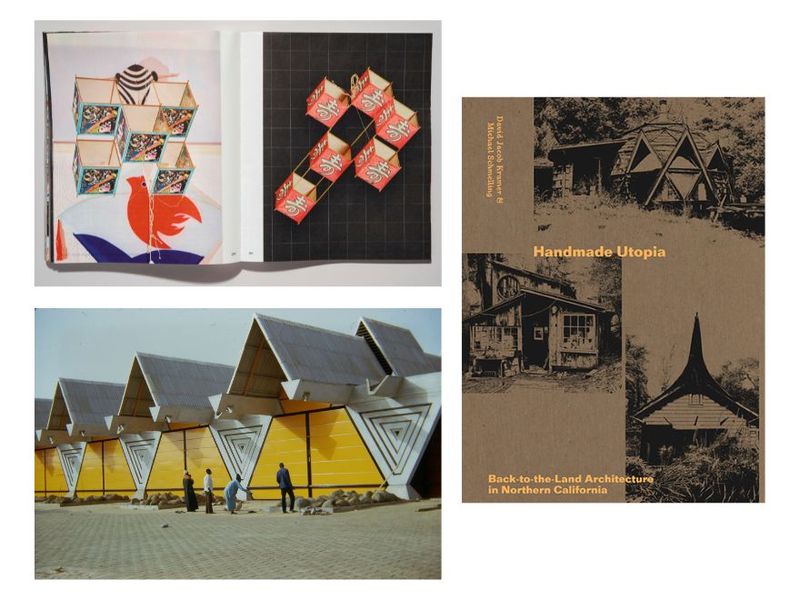
Mr. Goodman: The Kiteman
If ever there were a true tako kichi—a Japanese term for someone with a deep, verging-on-absurd passion for kites—it would be 82-year-old Malcolm Goodman. During his lifetime, the English engineer turned kite fanatic has amassed well over 1,000 kites from more than 50 countries, and even served as kite adviser to China in the 1970s. The new book Mr. Goodman: The Kiteman, created by Dutch creative collective Kite Club in collaboration with textile company Maharam, catalogues more than 280 flyable artworks from Goodman’s collection. Organized by complexity of form of flight, its beautifully uncut, sewn-together pages begin with a leaf (the origin of all kite-flying, according to Goodman) and continue on to pieces such as a black-and-white Chinese crane kite (which he named Rodney) and a Japanese kite that once spanned an entire ceiling in his home. As the book clearly demonstrates, Goodman’s trove is more than just a collection; it is, as design historian Emily King puts it in the introduction, a “record of a singular adventure in kiting,” one that has taken him from the Normandy coast to the Indonesian island of North Sulawesi. Though extensive in quantity and expansive in breadth, the assemblage’s underlying sentiment can perhaps be understood from one kite alone—a yakko dako given to him by Tokyo-based master kite maker Kouhei Doi that bears the inscription: “To English Kite Crazy Mr. Goodman.” —Emily Jiang
Handmade Utopia: Back-to-the-Land Architecture in Northern California
Deep in the woods of Northern California, echoes of an audacious, youth-led 1960s and ’70s countercultural experiment continue to reverberate through dozens of still-standing homes, handcrafted and imbued with irreverence. Even more extraordinary are the owners themselves, who pursued an ahead-of-their-time vision for a D.I.Y. existence rooted in ecology, ingenuity, and one another. For the immersive new title Handmade Utopia (Edition Patrick Frey/D.A.P.), five years in the making and out Sept. 1, writer David Jacob Kramer and photographer Michael Schmelling earned the trust of more than 30 back-to-the-land participants, now in their seventies and eighties, to produce personality-driven oral histories and soulful portraits alongside rare ephemera. Far from a nostalgia trip, Schmelling says, “These people are still there, very much engaged, and, in some cases, still working on their homes. We wanted to see what life was like for them in the moment and now.” While their movement went largely underdocumented (by design, for safety) and faced sensationalized media coverage for decades, these 496 pages, imbued with aliveness and agency, recognize the ongoing relevance of asking if—and how—there are better ways to live. “More than anything,” Kramer says, he was curious about “people willing to actually enact that impulse all the way and be somewhat uncompromising, for as long as possible, in achieving it.” —Olivia Aylmer
“Architects of Liberation: Modernism in Western Africa” at MoMA
What are the possibilities of architecture in a newly independent nation? What are its limitations? These are the two central questions that the exhibition “Architects of Liberation,” on view at New York’s Museum of Modern Art through Jan. 2, seems to propose and contend with. Co-organized by MoMA curator Martino Stierli and art history and African studies scholar Ikem Stanley Okoye, the sprawling exhibition walks visitors through the myriad visions of potential and self-determination following 1960, the “Year of Africa,” when 17 countries gained independence from their colonial rulers. Highlighting seven countries in particular—Benin, Cameroon, the Ivory Coast, Ghana, Nigeria, Senegal, and Togo—the show examines the built environments that composed these visions, from the arresting, aluminum-clad La Pyramide in Abidjan, Ivory Coast, to the cosmopolitan Hôtel de la Paix in Lomé, Togo. Some architects adopted or adapted the modernist lexicon to fit an African cultural and climatic context; others wholly reinvented it. British-Nigerian architect Alan Vaughan-Richards, for example, married modernist techniques with Indigenous materials and building practices, while Ivorian architect Jean Léon experimented with biomorphic elements, exemplified by his circa 1978 spaceship-esque auditorium. More than a mere survey of innovative infrastructure, “Architects of Liberation” chronicles the naissance of an entirely new architectural language, one fueled by the fervor of newfound freedom. —E.J.
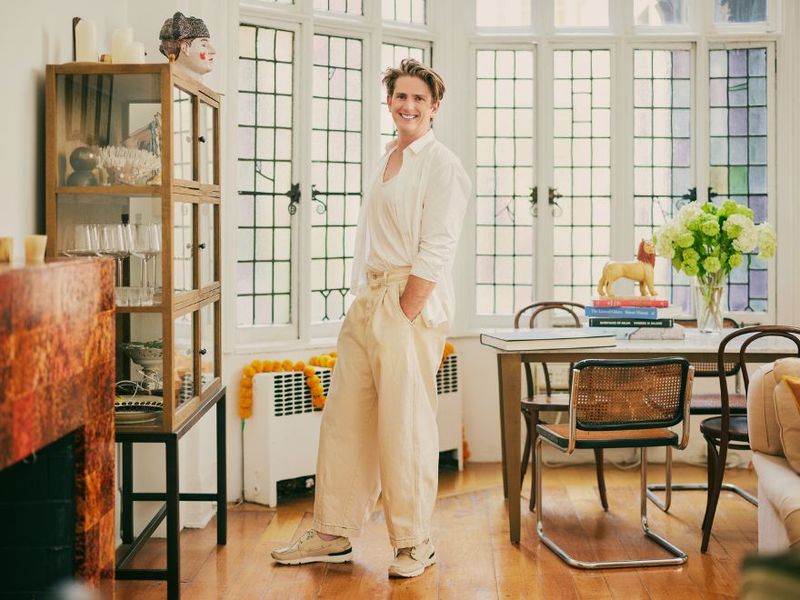
Australia-born travel expert David Prior has lived many lives, from his work as a writer and contributing international editor at Condé Nast Traveler to founding his own bespoke luxury travel and media company, Prior, in 2018. With the recent launch of his first podcast, Traveling Through, he’s fittingly entering new terrain yet again, drawing on his affinity for off-the-beaten-path locales and his curiosity about the travel habits of tastemakers such as fashion designer and entrepreneur Jenna Lyons, New Yorker editor David Remnick, and chef Andy Baraghani.
Here, we speak with Prior about his forthcoming book, which explores his travels through specific cultural and thematic lenses; his tradition of bringing home his favorite light sources as souvenirs; and his recent entry into the Substack-verse.
How do you start your mornings?
It depends where I am. I’m roughly a third on the road, a third in Milan, a third in New York. I usually grab a coffee and go walking, and I catch up on earlier time zones. Once I’m in the day, it never stops.
In Milan, I putter around in my vegetable and citrus gardens and greenhouse. Then I take myself off to Cucchi, the classic café in my neighborhood. I always have a double‑strength cappuccino because it resembles a flat white, which is my Australian version.
The only constant wherever I am is coffee. I hate to be so predictable, but it’s the truth. I’m usually trying to get over some jet lag.
Where do you get your news?
I read The New York Times, The Sydney Morning Herald, La Repubblica, and The Guardian—U.S., U.K., and Australia editions.
Do you subscribe to any newsletters?
I started a Substack two weeks ago, which is very strange because we have the [Prior] newsletter—which has more than 50,000 subscribers—but I wanted a space to speak about some of the things that have come up in my podcast. I’ve really been enjoying it. It still has that sense of community and people are supportive, and it doesn’t feel like a nasty environment the way a lot of social media platforms do.
I subscribe to Why Is This Interesting by Noah Brier and Colin Nagy. I think Colin’s really clever and knows travel very well, so he’s always pretty astute. Louis Cheslaw [who] does Wardrobe, I remember he used to be an intern for Pilar Guzmán when I was at Condé Nast Traveler, and it’s been fun to see him grow.
I really like what Monica Mendal does with So There’s This Place... She reminds me of the kinds of stories and service I used to do when I was at a magazine. My friend Maria Shollenbarger, who’s also an editor at HTSI—I think she’s a great writer, and it’s been great to see her a bit more unleashed. And Tina Brown’s Fresh Hell—she gives me this nostalgic sense, and when she’s on a tear, it’s the best.
What podcasts do you listen to?
I listen to The Rest Is Politics, the U.K. version. I also listen to Time Sensitive. I was joking recently with Spencer that he did what I think is the definitive, best interview with Deborah Needleman [Ep. 66], who is also my friend.
Then there’s this podcast called Hidden Forces by Demetri Kofinas. It’s not a conspiracy theory podcast, but it’s about geopolitics and the kinds of things that you perhaps don’t see in the news—the forces that are moving things around. It’s an interesting perspective. I listen to Desert Island Discs, too, which is so old-school; it was the podcast before the podcast. That was a little bit of an inspiration for me, in the sense that I’m trying to pluck stories out of people, ones that are more emotional, less reported.
What are your favorite publications?
I stay up to date with the travel magazines because I have to, and also because a lot of my contemporaries and friends are the editors‑in‑chief or the top editors now. I am reading Mark Guiducci’s Vanity Fair. He’s clever and it’s exactly what I hoped he would do.
My friend Martina Mondadori, here in Milan, has a great magazine called Cabana. I think it’s remarkable what she’s done. I love Divia Thani at Condé Nast Traveler. I love Jacqui Gifford at Travel + Leisure. If I’m reading a newspaper physically, I’ll always go for the Financial Times on the weekend. There’s something so clever about that salmon pink because it can locate me wherever I am.
What books have you read recently? Are there any you’re excited to pick up?
I’m reading a lot about Italian food, even though I know the subject very well. I’m reading about religion in India—William Dalrymple’s Nine Lives: In Search of the Sacred in Modern India. I’m reading about cultural festivals in Spain, very anthropological ones, and about biodiversity in Australia.
I’m reading [British novelist and travel writer] Bruce Chatwin’s The Songlines, which is a classic travel book about Australia. I just finished I Eat the Stars by my friend Sarah Wilson—her Substack is really amazing. She initially became well known as the editor of Cosmopolitan in Australia when she was 19, then she did all sorts of things in media, and created I Quit Sugar, a hugely popular cookbook out of Sydney, which was the vanguard of everyone quitting sugar. She’s a really thoughtful person and a brilliant brain, and she’s now become one of these experts on societal collapse. She also knows how to live an optimistic life. She has very few possessions; she’s always hiking. She’s in this world of thinkers about the future.
Do you have any guilty pleasures?
I don’t feel guilty about pleasure, really ever, to be honest. One thing I will say—my one concession to diva‑dom—is I try to fly business class, if it’s a long flight. I grew up thinking the ultimate decadent sign of moral decay would be to fly business class. But I’m getting a little older, and my back is getting a little sore. I do feel guilty about that. I don’t say it’s a pleasure, because I absolutely hate flying. I hate airports. I really am not a fan, ironically—I can’t bear it all, so I just make it as painless as possible.
What treasures or mementos do you like to bring back from your travels?
I love light sources, little lanterns from different places. Sometimes I’ll get an alabaster one from Egypt, or paper lanterns from Nepal, or little filigree ones from India. It’s probably not the most kosher thing to do, it can be a little risky, but I do collect seeds from different places and then I plant them in the garden. If I find a particular type of zucchini or tomato, or nasturtium—I found these amazing pale white, creamy nasturtiums—that’s quite a fun thing for me to get.
What’s next for you?
Along with doing a second season of Traveling Through, I have a book coming out at the end of 2027. It’s a lot of my work—the photo work, a lot of the collages. It will be quite visual, but there’s still a lot of writing. The chapters I’m working on are about traveling through a particular place, with a particular theme, where I think it’s the most powerful version you can experience, or at least the lens, the doorway. There’s a universality to it.
This interview was conducted by Dalya Benor. It has been condensed and edited.
Our handpicked guide to culture across the internet.
A new monograph edited by Dries Van Noten (the guest on Ep. 156 of Time Sensitive) builds upon his foundation’s inaugural exhibition in Venice, with an essay on craftsmanship by Glenn Adamson (Ep. 50). [Fondazione Dries Van Noten]
Artist Camille Henrot’s (Ep. 140) Commedia dell’arte—a madcap, modern-day reinterpretation of the Italian Renaissance theater form, co-curated by Performa’s RoseLee Goldberg (Ep. 24) and Aspen Art Museum’s Eliza Ryan—makes its New York premiere from Sept. 23–26. [L’Alliance New York]
In a refreshing interview, the Italian fashion designer–philosopher Brunello Cucinelli, now 72, offers his soulful perspective on how to build a business with longevity by prioritizing humanity, hyperfocused work, and necessary daily pauses. [The Wall Street Journal]
On her Reclaiming podcast, Monica Lewinsky speaks with writer Siri Hustvedt (Ep. 54) about putting language to her lived experience of grief and loss, as chronicled in Ghost Stories, Hustvedt’s elegiac memoir published earlier this year. [Apple Podcasts]
In a conversation for Apartamento magazine’s latest issue, self-taught Japanese ceramicist Kazunori Hamana underscores the risk of overvaluing digital forms of self-worth at the expense of “real life time,” in all its raw texture. [Instagram]