In this week’s newsletter, we get candid about money with the Pulitzer Prize–winning data journalist and illustrator Mona Chalabi; go deep with curator Su Wu about her new book, Mesoamerican Modern; and more.
Good morning!
I’ve long admired the work of Mona Chalabi, whose striking, hand-drawn illustrations make complex numbers and figures feel personal, tangible, and deeply human. Her work stops you in your tracks, encouraging you to look more closely, question what you think you know, and consider the real lives behind the numbers. On our latest episode of Time Sensitive, she and I discuss her forthcoming book, Ten Lives: How What We Have Shapes Who We Are, and the complicated ways money impacts our identities, relationships, ambitions, and sense of security.
As Time Sensitive listeners may know, I rarely bring my own experiences into interviews, but doing so this time felt particularly fitting for a conversation about a subject so many of us tend to avoid discussing openly and directly. Anything less would have felt like a cop-out. During our conversation, I found myself recalling an exercise from a class I took as a freshman at Dickinson College. Early on in the semester—I recall it being the first day—our professor drew a horizontal line across the blackboard, with “poor” at the left end and “rich” at the other, and asked each of us to mark where we thought we fell. I placed myself at the right end, the only student to do so. Most of my classmates positioned themselves somewhere around the middle.
The exercise has stayed with me all these years, in part because it revealed just how uncomfortable we can be with acknowledging our own financial circumstances and the advantages we may have had, and how easily we hide behind vague notions of being “middle class” or “upper middle class.” As Mona pointed out, the exercise might have looked very different had there been actual numbers on the board. But numbers, too, only tell part of the story. Behind every financial circumstance is a more complicated and nuanced history—of privilege and disadvantage, opportunity and hardship, work and circumstance, luck and loss—that rarely fits neatly along a line.
One thing I’ve been thinking about since our recording is just how deeply our views of money shape our relationship with time. How much of our lives do we spend chasing some imagined future security or success, rather than appreciating what we have in the present? And how do we know when we have enough? Mona’s book, which we also feature in this week’s “Three Things,” below, opens up these kinds of questions without pretending there are easy answers.
Also in this issue, we share an excerpt from a live conversation I had the other week with the Mexico City–based curator and writer Su Wu about her remarkable new book, Mesoamerican Modern, which I can’t recommend highly enough. It was a fascinating discussion about Mexico, architecture, language, cultural memory, and the ways we understand and interpret history. Su has a beautiful, expansive way of thinking about design, craft, and the built environment, and her book offers a compelling invitation to reconsider the stories we tell about architecture, whose ideas and histories we choose to recognize, and how the past continues to shape the present.
—Spencer

“The things that we choose to spend our money on, it’s so revealing of your character. It says, ‘What do you value in life? What matters to you? Who are you as a person?’”
Listen to Ep. 161 with Mona Chalabi at timesensitive.fm or wherever you get your podcasts
Ten Lives: How What We Have Shapes Who We Are by Mona Chalabi
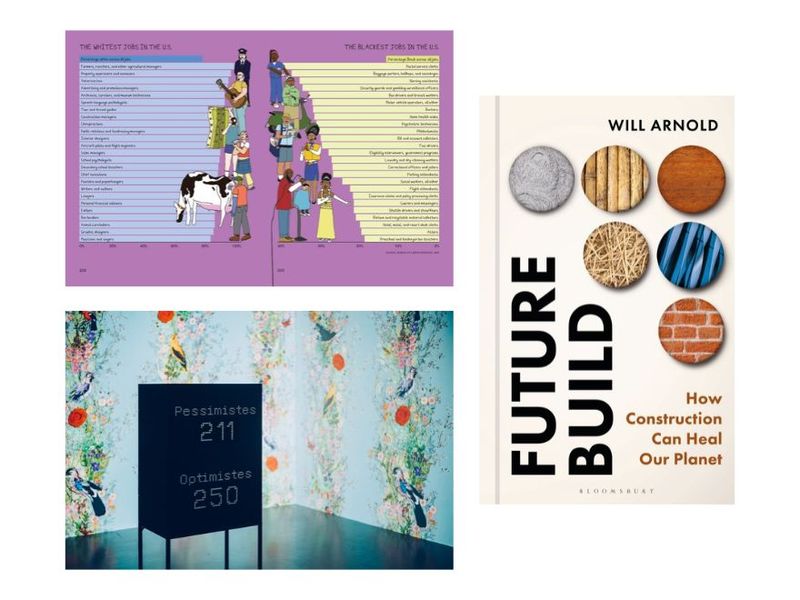
As a child growing up in East London, Mona Chalabi (Ep. 161) was taught to avoid staring or snooping, lest it make strangers uncomfortable. Yet when it comes to her work as a data journalist and illustrator, she has built her career out of looking—closely, critically, and fearlessly—at the economic, environmental, and political forces shaping our world. In her debut book, Ten Lives: How What We Have Shapes Who We Are (Random House), out Nov. 10, she turns her perceptive gaze toward money: a loaded topic all too often “politely” talked around while avoiding the thornier ways it tangles with identity, inheritance, upbringing, perceived safety, and other factors. Through her striking visuals and profiles of 10 people across the financial spectrum, Chalabi tells a larger, emotionally attuned story not merely of class dynamics or systemic inequality, but of how money actually makes us feel. It’s her transparency about its ebbs and flows in her own life, including the disclosure of her advance (“a shitload of money,” in her words, or $850,000, to be exact), that sets this title apart from myriad other money books. Chalabi’s choice to show readers all her cards may, hopefully, embolden readers to do the same. —Olivia Aylmer
Future Build: How Construction Can Heal Our Planet by Will Arnold
Early on in his new book, Future Build (Bloomsbury Sigma), environmentalist and structural engineer Will Arnold recounts a colleague’s up-close encounter with the rocketship-hot kilns at one of the U.K.’s largest cement production plants, writing, “I wondered whether the ground beneath the kiln missed the sensation of cool rainwater.” It’s precisely Arnold’s willingness to reckon, honestly, urgently, and unflinchingly, with the ecological repercussions of construction—down to imagining how the earth itself feels—that expands his readership far beyond his industry peers. Moving steadily from the micro to the macro, he lays out a foundation for how we historically came to rely on aluminum, bricks, concrete, glass, and steel for the structures around us. His push for major shifts in practice draws on his near-decade of experience realizing buildings, from a Taiwanese skyscraper to a Swiss science museum, culminating in an eye-opening project in Rwanda that realigned his focus on the materials themselves. Arnold envisions buildings as burgeoning sites of healing, restoration, and resilience in service of our planet’s future. More than an inside-baseball critique, he offers an invigorating call to action to demand better for how the spaces where we live, work, and learn get built, decision by decision. —O.A.
“Finally, Something Good” at the Gaîté Lyrique
“There’s something almost perverse about being an optimist right now,” writes Stefan Sagmeister (Ep. 8) in his artist’s statement for the exhibition “Finally, Something Good,” on view through April 18, 2027, at the Gaîté Lyrique in Paris. “Culture has decided that pessimism is the serious position, that to acknowledge improvement is to be naïve, or worse, complicit.” This exhibition, then, is his carefully researched objection to that characterization. Against the backdrop of near-apocalyptic headlines about the natural disasters and political calamities of our time, Sagmeister spins data from the United Nations, the World Bank, and other global databases into visually striking designs that demonstrate that, over the long-term, most aspects of humanity—including access to food and healthcare, conflict, migration, and happiness—have changed for the better. Many of his works interweave data visualizations with classical brushstrokes, bridging past and present: a 19th-century Hans Huber painting of a pregnant Henrietta Maria, former Queen consort of England, is paired with graphics of maternal mortality rates in the U.K.; a circa 1890 William R.C. Watson painting of cows merges with statistics on global agricultural land use and calorie supply. As a whole, the exhibition serves as an all-too-rare yet critical reminder that, despite nonlinear or stagnating progress, we have reason—and data—to stay hopeful. —Emily Jiang
What, exactly, does the term “Mesoamerican” mean? In Su Wu’s vivid new book, Mesoamerican Modern (Phaidon), a first-of-its-kind survey of 16 culturally significant homes built over the past 78 years, the Mexico City–based curator and writer explores this question by unearthing and honoring the wisdom of Mexico’s earliest civilizations through how it comes alive in modern and contemporary residential architecture. Via in-depth conversations with local architects and designers, alongside photographer Luis Garvan’s more than 400 transportive, serene images of their projects, Wu powerfully shares a fuller picture of this largely underwritten history, reframing it along the way.
To celebrate the launch of the book earlier this month, our editor-in-chief, Spencer Bailey, joined Wu in a live conversation at K’ab Juun, a gallery and store in Manhattan’s Meatpacking District that celebrates contemporary Mexican art and craft. Here, in an excerpt from the talk, the pair discuss Wu’s relationship to Mexico City, embracing the notion of home as a perpetual work in progress, and the importance of giving credit where it’s due.
What was the initial spark for Mesoamerican Modern?
I’ve been working as a curator in Mexico City for ten years, and I’ve had this opportunity to work with so many architects and designers in these other contexts, and to see how their projects and ideas started to be applied to larger scale projects. Mauricio Rocha—who had just completed the extension of [Museo] Anahuacalli in Mexico City—the house that he built for his mother, Graciela Iturbide, this amazing photographer, was the last story that I ever did in my former life as an art journalist. The ideas that are in this book extend beyond residential projects into commercial projects, public spaces, into how chefs are talking about food. It’s this idea that the past is a continuity.
How has your time in Mexico City, during which you’ve become deeply entwined with its creative community, shaped your thinking?
As curators, we tend to be perpetual outsiders—we’re not the ones who make the work; we’re maybe not even necessary to the making of the work, which I think is fine. This is not a lament. That’s a very lucky place to be.
Outsider status.
Outsider status. As [the French philosopher Jacques] Rancière said, in every logic of emancipation, there has to be a third way. I’ve been really fortunate that my third way has been looking at this intersection of craft, design, and art, and I can think of no better place to do that than Mexico. I’ve been interested in thinking about how we can source convention—whether our conventions of beauty, of taste—how we can expand that and give credit to those sources. That’s something that’s very important in thinking about design, especially in the context of Mexico, where the idea of craft is very much tied to the idea of the native. That is, of course, an idea that does not exist without colonization. Many scholars have talked about this, including Mahmood Mamdani.
What this designation does is that it produces an idea in time. It delineates it geographically, it makes a living custom and turns it into a product. I’m not so concerned with the idea of a product, but I’m very interested in value and originality. Of course, there are many types of authorship: anonymous, familial. As curators, we assign a certain value or virtue to notions of originality, of individuality, of genius, and then we deny its merits to entire groups of people. Thinking about where we give credit to ideas has been really important to this book.
Something that really struck me as the terminology turning point in the making of this book was even thinking about the word Mesoamerican. That was this big conversation with Phaidon, like, “No one knows what this word means, that’s going to be this barrier to entry for anyone to even access the ideas of this book.” Because Mesoamerican is not the most commonly used term. The most commonly used terms are “pre-Columbian” and “pre-Hispanic”—those are the terms that people really know. I found that to be so remarkable, because in other places of the world, art is described as “Asian art” or “African art” or “Oceanic art.” It’s only in the Americas that you have this idea of a temporal end, this “before” time of history, this forethought of history.
And pre-Columbian is a massive length of time.
Yes, exactly.
It’s millennia.
It’s a millennium of before time, and this very small after time. But this idea that history ended and there was no resilience and nothing survived the massacres, the epidemics—that felt to me not reflective of what I was experiencing in these conversations with architects [in Mexico].
One of the book’s central provocations is this idea that what we associate with modern architecture has much older roots in the Americas. Frank Lloyd Wright, for example, was pulling from cues that reference things from the ancient times. What have we misunderstood about Mesoamerica, or this idea of pre-Columbian architectural history?
There’s a lot. I didn’t want to impose my desire for the existence of a postcolonial architecture and design on any of the architects I spoke to. This book is very heavily interview-based. For me, what was really important was that these homes are not replicas. They’re not this fateful reproduction of an idea. It’s the possibility that an idea is robust enough to exist in disagreement.
Not all the architects agree as to what Mesoamerica is. One of the classic examples of this is Luis Barragán, Mexico’s only Pritzker Prize–winning architect. He’s the looming figure over modern and contemporary architecture in Mexico. He referenced North African architecture, [the gardens of] Alhambra [in Spain]. Was Luis Barragán a Mesoamerican architect? Everyone felt very strongly, and didn’t agree. Some people were like, “No, Barragán never spoke about the ancient cultures of the Americas in his work.” Other architects would say that he was a master of material, that he understood how light worked at this particular latitude, that he never built outside of Mexico.
One thing that really surprised me was a lot of architects talked about the idea of the void, which is not something that I would have necessarily associated with Mesoamerican architecture. It’s this idea that you don’t need to fill every space. That you need an empty space, and that’s a way of having more of it without needing to build more; that the function of the space is fluid. There have been many architects who have identified the patio or the courtyard as a central defining feature of Mesoamerican homes.
It’s shocking how many spaces in your book have nothing in them. [Laughter]
Exactly, and the architects would say this is not an empty space—this is an open space of possibility. That gets even to our conceptions of value and of use. It’s how we can be of service or how we are needed. That felt to me something very radical to even consider: What are the typologies of rooms or furniture, or what do you need, to have a home?
How are you thinking about time and age in the context of the projects you chose to include?
There were so many projects that were deliberately made to mark the passage of time. Pedro Reyes and Carla Fernández’s house is a great example. The architect Fernanda Canales, her home is made of brick, but she deliberately broke the bricks in half so that this texture of the walls shows the passage of time.
There’s one home in the book, the one I think I fought for the hardest [to include], by a construction worker outside of Teotihuacán. He’s been carving it for the last thirteen years. It might never be finished.
And his father had built the house, right?
His father and his uncle started building it together. There’s no glass in the windows. There’s no running water. For me, it showed a different way of making work, but also there’s this real erudition and irreverence in it.
There’s this beautiful idea running through the book: that a house isn’t necessarily a finished object, but something that continues to evolve because of its use. Yes, there’s the passage of time, but also the weathering, the patina. Having spent so much time in and around these incredible homes, has your definition of home changed?
That’s why I wanted to focus on homes: how one wants to live. We’re chasing this dream of what it might be through the ways that we organize our spaces.
I write about this a little bit in the book, but when I first moved to Mexico, so many years ago, I was at a market and I was returning home. The cab driver pointed at this building, and we were in this notoriously dangerous neighborhood, and he was like, “Es su casa,” and I was like, “No, it’s not. What are you talking about?” It was this awkward, ongoing interaction where he insisted, and I was being awkwardly polite, like, “Oh, no.” I’ve subsequently learned in the making of this book, and from him, that in Mexico City, at least, people will shorten that common phrase—“Mi casa es su casa”—to its logical minimum, and they’ll refer to their own homes as your home, which I find is a characteristic emphasis on courtesy instead of clarity, which I really love about Mexico. So, I hope that a little spark of that is in this book, this idea of es su casa.
This interview was conducted by Spencer Bailey. It has been condensed and edited.
Our handpicked guide to culture across the internet.
Hans Ulrich Obrist (the guest on Ep. 146 of Time Sensitive) has been named the inaugural Visionary Award winner by the architecture and design nonprofit The World Around, for his “enduring commitment to shaping the cultural conversations of our time,” with a dinner celebration scheduled for Nov. 9 at The Wang Contemporary in New York City. [The World Around]
Historian Sarah Lewis (Ep. 117)—a recipient of the 2026 Rabkin Prize, which will support her two books in progress—cites Theaster Gates (Ep. 143) and Hank Willis Thomas (Ep. 83) while discussing artists’ responses to stand-your-ground laws. [The Rabkin Foundation]
An article charting the rapid rise of listening rooms calls OJAS’s Devon Turnbull (Ep. 149) “an O.G. of the movement” and mentions his in-the-works project for The Nigo House in Chiba, Japan, slated to open next spring. [The Hollywood Reporter]
A review of curator Helen Molesworth (Ep. 105) and art historian Susan Dackerman’s new exhibition celebrating 60 years of the L.A. artists’ workshop Gemini G.E.L. hails it as a place for “tinkering outside normal routines or comfort zones.” [Hyperallergic]
British fashion designer Paul Smith (Ep. 109) has just opened a new Upper East Side shop on Madison Avenue that aims to conjure the feeling of stepping inside his characterful, collectibles-filled London home. [Instagram]