Ben Lerner’s Transcription, Hoshinoya’s Nara Prison Hotel in Japan, Claudia Rankine, and more.
Good morning!
Spencer here. Each year, in the months between our two Time Sensitive seasons—January and February and July and August—I try to find time to read a book or two simply for pleasure, because, during the recording season, my reading list is almost entirely for research. Season 13, for example, included a new book about the Antwerp Six with many a Dries Van Noten mention; both Figuring and Traversal by Maria Popova; a forthcoming monograph on Sheila Hicks; a book of poetry by Valerie June; a stack of George Saunders books, including, perhaps most importantly, A Swim in a Pond in the Rain; an out-of-print Alma Allen monograph; and OMA NY: Search Term, featuring the architecture of Shohei Shigematsu.
As soon as the season wrapped, I walked to Greenlight Bookstore in Fort Greene, Brooklyn, one of my local favorites, with the plan of picking up Ben Lerner’s latest novel, Transcription. I haven’t yet interviewed Lerner for the podcast—I’d like to—but as soon as I’d heard about his new novel, I wanted to read it. I’m so glad I did. For me, it really does live up to the hype.
In part a meta-narrative about what it means to conduct and record a conversation, it’s also about how technology, particularly smartphones and screens, has warped the lines between fact and fiction, reality and unreality—with profound consequences. It’s a slim, compact novel that packs a lot into a little, not entirely unlike the iPhone itself. Perhaps that’s exactly its point.
The book’s exquisite cover, designed by Rodrigo Corral and Violet Dine, features an iPhone-size tablet of stone imbued with human fingerprints. It’s a subtle reminder that, if we take a longer view, the device in our pocket is really just a refined composite of earthen matter—a modern-day version of a Paleolithic hand axe. The big difference is that, for almost two decades now, we’ve had these portable screens we can take everywhere with us. Screens that divide and monetize our attention. Screens that dull our senses. Screens that enrapture us, pulling us deep into their hypnotic glow. Screens that have entirely reshaped our world as we know it.Next year, the iPhone will turn 20. What this object has changed is so intimate and personal yet also so vast and universal—and, at this point, practically civilization-wide—that it’s impossible to fully capture or comprehend what has occurred through any straightforward form of reporting or journalism. Fiction can get at the nuance, the subtlety, and—to put it bluntly—the mindfuckery of these devices. Lerner’s dreamlike novel does so mightily. Transcription is the novel of the iPhone age.
After reading it, I have a decidedly different view of the term “screen time,” one that, oddly enough—and perhaps this is an overly optimistic take, but whatever, I tend to be glass half full—gives me hope for future generations, who will better understand this technology and the repercussions of what its overuse does to us individually, socially, and societally. To be clear, I’m no Luddite, and I would argue that the world has made essential, transformational leaps because we have smartphones in our lives. My iPhone tells me I average between four and five hours of screen time a day, after all. But, knowing that I’m happier and much more at ease the less time I spend on it, I do try to limit how much I use it. The hazards of excessive screen time have become more and more clear over the past decade: anxiety, depression, increased stress, inability to focus, poor posture, eye strain, neck and shoulder pain, back pain… I could go on. Lerner’s novel unpacks this pervasive modern-day conundrum we’re all unable to fully escape.
I won’t go too far into the book’s storyline here, but to put it simply, it begins with a narrator who returns to Providence, Rhode Island, where he’d gone to college around the turn of the millennium, to interview his now 90-year-old mentor, Thomas, for what will be the man’s final published interview. The plot unravels when the narrator unexpectedly drops his smartphone—which doubles as his recording device—into a sink, destroying it: “I was experiencing a withdrawal indistinguishable from mild intoxication, the landscape made strange, the stones stonier, by my being suddenly offline, incapable of taking pictures, sending or receiving data packets, sharing my location, getting a MyChart alert or a work email or a small toxic hit of news or shitposting; I was having an unusual experience of presence—more aware of silicate glittering in the asphalt, the little plumes of vapor that were my breath, the articulation of branches and their shadows on the sidewalk—but I was also walking into my past, because this was a landscape so dense with formative memories and events, and because only in the past would I be deviceless.”
Shortly afterward, in Thomas’s home, the narrator is at pains to confess that his phone is dead—and as such, not actually recording. Instead, he flips it over and pretends it’s on. Describing what he calls “the strangeness of being screenless,” he notes, “I was glitching, craving my cellular phone on a cellular level, shamefully unresponsive to the old media that surrounded me: books, paintings, analog photographs, a vinyl record spinning somewhere in my mentor’s house.”
During their long, winding conversation, smartphones naturally come up. “It’s like the device takes you out of the real world, shields you from all the pressures and information,” Thomas, who still uses a landline phone, tells the narrator, “but then it administers this series of subtle sensory inputs and muffled shocks, these mild effects, as compensation for the unmanageable reality it’s made disappear.”
Back in Greenlight Bookstore, browsing the shelves, I also came across The Fullness of Time: Marking the Days by Birdsong, Blooms, Shadows, and Stars, by Cathy Haynes. I’ve only just started reading it, and already it feels like a companion to Lerner’s novel. If Transcription is about how devices fragment our focus and puncture our sense of presence, Haynes’s book asks: What happens when we return our attention to nature’s daily rhythms?
Perhaps there’s a reason these two books found me at the same moment. Neither proposes abandoning technology altogether, and at this stage in human history that’s hardly possible anyway. Instead, both remind us that attention is ultimately a choice. What we do with it quietly shapes who we become.
—Spencer
“For me, the astral plane is occurring as we are in the physical plane. It’s all happening right now. Everything is happening now. All is available now.”
From Season 13: Listen to Ep. 152 with singer-songwriter Valerie June at timesensitive.fm or wherever you get your podcasts
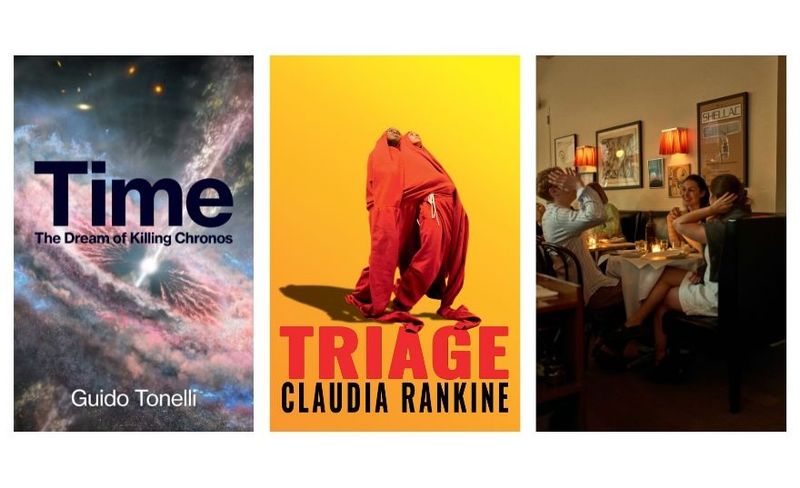
Time: The Dream of Killing Chronos by Guido Tonelli
As a pivotal player in the 2012 discovery of the Higgs boson—the so-called “God particle,” which confirmed the existence of the invisible, universe-wide Higgs energy field—Italian particle physicist Guido Tonelli is no stranger to unknown and intangible realms. Following his books Genesis: The Story of How Everything Began (2021), which chronicles key moments in the creation of the universe, and Matter: The Magnificent Illusion (2025), an examination of the elementary particles that make up everything in existence, Tonelli’s newest title, Time: The Dream of Killing Chronos (Polity), delves into our favorite subject here at The Slowdown: time. In it, he ventures into the far reaches of the cosmos to observe clusters of galaxies, and zooms way in to probe events that occur on a subnuclear scale. It’s in these two vastly disparate realms, he writes, that the “harmonious and constant flow of time which has enchanted us for millennia twists, melts, shatters.” A journey through the expansive history and mystifying physics of temporality, Time draws a line between the phenomenon itself and how we experience it, forcing us to reckon with the fickle, bewildering nature of this omnipresent thing we move through every day. —Emily Jiang
Triage by Claudia Rankine
“We were all struggling with varying degrees of powerlessness and capitulation, strategically, emotionally.” So remarks the unnamed narrator of Triage (Graywolf Press), the just-published book by author and poet Claudia Rankine (the guest on Ep. 60 of Time Sensitive). This genre-expansive narrative follows a central character and her self-proclaimed sister, called “the theorist,” through the ebbs and flows of their unusual friendship, including their “ritual of collapse,” a physical act of dropping to the ground when they meet. Together, they confront the burdens of contemporary existence: “militarized injustice,” the climate crisis, the stripping away of human rights. Rankine, whose work takes shape across multiple forms, including poems, plays, and cultural criticism, intimately understands the alchemical power of words—how we are, at times, defined by them, and how we use them to define ourselves. Here, she also utilizes visuals to craft her theories, drawing on, for instance, artworks of couches and images of rubble from Gaza. Triage unfolds as both a conversation and an act of remembering. Even when witnessing societal deterioration, a willingness to get back up, to survive, remains. As her narrator says at one point, “Maybe collapsing simply was the easiest way to keep from breaking apart.” —Chanice Hughes-Greenberg
Lonnies
Lonnies, a lively new restaurant tucked into a cozy corner of Brooklyn’s tree-lined Boerum Hill neighborhood, revels in small, personal details—whether its on-point playlists (1970s deep cuts one night, early-aughts rock the next), hand-selected by the married owners, Caron Callahan and Sean Rembold, along with head bartender Ryan Gannon, or the silver ketchup-and-mustard caddy, at the ready on each table to zhuzh up their exquisite house cheeseburger and perfectly crisp fries. Since opening in late May, they’ve already established a first-name-basis rapport with many of the locals. Callahan, who also runs her own fashion label, brings a playful and practical eye to the spacious interiors, where a back bar beckons to solo diners and duos alike. Much like its owners, the understated menu, designed alongside executive chef Eddie Acosta, succeeds in not taking itself too seriously, led by seasonally in-tune, simple yet beautifully executed dishes, such as tagliatelle brightened with summer sungolds and sweet corn, brick chicken (a Rembold signature) with chermoula sauce and lemon, and a slice of velvety, classic-in-the-making Basque cheesecake for dessert. As with a well-worn vinyl record whose meaning only deepens each time it’s played, it’s the kind of spot that rewards repeat visits—one where, as Rembold puts it, “people come in on a first date and come in again for their fifth anniversary.” —Olivia Aylmer
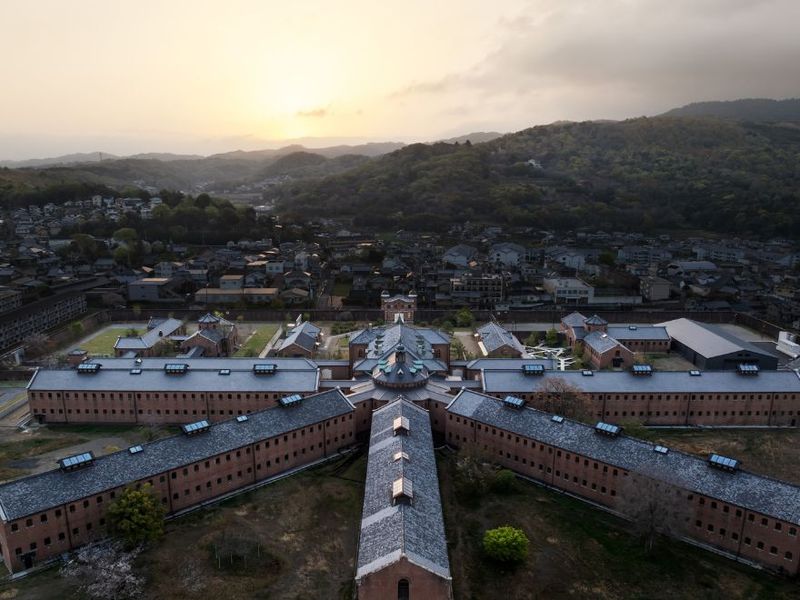
Drawing on the Quaker concept of reflection and spiritual awakening in solitude, the Haviland System prison design, a hub-and-spoke layout, was considered revolutionary when it was introduced at Pennsylvania’s Eastern State Penitentiary in 1829. Japan later adapted it during the country’s opening to the West, known as the Meiji Restoration (1868–1912), including at Nara Prison, since labeled a government-designated Important Cultural Property in that heritage-rich city 45 minutes by train from Kyoto and Osaka. This last of Japan’s “Five Great Prisons of Meiji” still standing reopened last month as a hotel, Hoshinoya Nara Prison.
The striking red-brick structure, originally designed by architect Keijiro Yamashita, offers a compelling argument for adaptive cultural heritage preservation. Rather than shying away from its dark past, the hotel embraces it, welcoming guests through the original wrought-iron main gate, which directly faces the former central guardhouse and radial cell blocks. The obviously institutional geometry makes an architecturally distinct first impression, even before one enters the 48 spacious suites created by connecting former prison cells—named 9-Cell, 10-Cell, and 11-Cell Deluxe. Here, the hand-laid brickwork, exposed beneath original plaster finishes, and meticulously preserved ceiling moldings are deliberately foregrounded. Steel pillars, contemporary lighting, and warm natural wood paneling added during the seven-year transformation gracefully bridge past and present, reflecting the carefully considered adaptation. Carried out by a multidisciplinary team of experts led by Azuma Environmental Architectural Research Institute, in collaboration with Yasui Architects & Engineers, ICE Urban Environmental Lighting Institute, and landscape designer Hiroki Hasegawa, the hotel is a contextual masterwork.
Dining unfolds in semiprivate brick-clad spaces with high windows, each designed to seat up to six guests. Meiji-style breakfasts offer gastronomic glimpses of the country’s first tastes of the West, such as Scotch eggs served with the Worcestershire sauce that Japan once prized as Western-style soy sauce. Dinner highlights Japanese comfort foods like Wagyu shabu-shabu in dashi broth and noodles infused with Yamato tachibana, said to be Japan’s oldest citrus variety. The five-course Gastronomy Chronicle tasting menu celebrates the country’s modernization, from the “Early Development” course with its early Western-style dishes known as yōshoku, to the French classics of “Maturity” featuring widely embraced favorites like braised sole in sauce Albert, followed by “Future” desserts intended to spark conversations around regenerative ingredients. There’s a similarly subtle wink behind hotel activities like the Morning Dumbbell Exercise, which draws on the Meiji-era craze for Western-style physical fitness with deep breathing exercises and gentle stretches using custom dumbbells crafted from local Yoshino cedar.
Elsewhere on these 25-acre grounds, the Nara Prison Museum considers the historical significance of the former prison through art and architecture, examining the role of reform and rehabilitation in Japanese society through exhibitions aimed at challenging perceptions and offering fresh perspectives. A dedicated pathway that connects the hotel directly to the museum—with select areas open only to hotel guests during quiet early-morning and late-evening hours—encourages a deeper engagement with heritage and history. —Cynthia Rosenfeld
Our handpicked guide to culture across the internet.
Volume One of Another World, writer and photographer Chris Wallace’s new culture-forward travel quarterly, traverses Mexico’s Yucatan Peninsula, Hong Kong, and Tangier, and features Nobel prize–winning novelist Orhan Pamuk in Istanbul, Turkey. [Another World]
Kyoto-based publisher Mokusei’s The Eastern Observer, another new place-centric journal, includes multilingual interviews and essays on contemporary art, literature, and culture rooted in Japan and across Asia. [The Eastern Observer]
In a recent joint interview, Debbie Millman (the guest on Ep. 51 of Time Sensitive) and Roxane Gay (Ep. 75), co-owners of the irreverent online literary magazine The Rumpus, talk about learning to trust their own taste and uplifting “voices that might not find a home elsewhere.” [Byline]
On her podcast The Critic and Her Publics, host and author Merve Emre speaks with novelist and interviewer Sheila Heti about the role of personality-driven interviews in the A.I. age. [Apple Podcasts]
Cosmologist and Broadcast magazine editor-in-chief Janna Levin revives her first astronomy professor Joe Patterson’s delightful “Big Apple Sky Calendar,” a freewheeling guide to the atmosphere previously published in his seasonal ’90s zine. [Broadcast]