In this week’s newsletter, we ask rare book dealer Pom Harrington about his refined media intake, flip through Nolan Giles’s new future-forecasting book for the watch brand Ressence, and more.
Good morning!
For good reason, chefs and cooks tend to be among the most truly time-sensitive people I’ve met and interviewed, which is why we’ve had so many of them on Time Sensitive over the past six years. So much of cooking depends upon seconds, minutes, and hours—or, at least, having a highly trained sense of time and timing—and the ability to think fast and slow in tandem.
Eleven Madison Park’s Daniel Humm calls time “the most luxurious ingredient.” For Rita Sodi (Ep. 116), co-owner of the West Village restaurants I Sodi, Via Carota, and The Commerce Inn, her sense of time comes not from the clock but from listening to the food on her pan or in her pot. Thomas Keller and Daniel Boulud both center time within their respective Michelin-starred kitchens and dining rooms, but they also, just as importantly, emphasize blocking off-the-clock time for creativity and refinement—hours that Boulud terms “time sacrifices.” In perhaps my favorite “chef time” nod, Keller keeps Vacheron Constantin wall clocks in the kitchens of The French Laundry and Per Se with the phrase “Sense of Urgency” mounted underneath them.
I love thinking about the kitchen as a metaphor for life, and each of the above chefs—as well as others who have been on the show, including Dan Barber (Ep. 62), Nathan Myhrvold (Ep. 33), and Ruthie Rogers (Ep. 85)—have spoken about this in their own memorable way. In reality, anyone seeking a rich, fulfilling, and meaningful life approaches their days with a sort of chef mindset. After all, our lives are composed of the tools we have access to, the skills and knowledge we accrue, and the “ingredients” we seek out, combine, and “cook”—that is, the company we keep, the communities we engage, the books we read, the media we consume (see rare book dealer Pom Harrington’s “Media Diet” below), the art we view, the music we listen to, the hobbies we take up, and so on. Time and how we spend it is what the good life is all about. Cooking a meal, in a sense, can be viewed as a condensed-time version of that mindset.
To use an even tighter analogy, my friend the Italian architect and designer Paola Navone—whom many of you will recall from our collaborative “Take It or Leave It” exhibition at Milan Design Week two years ago—likes to talk about approaching a creative life as one would make an omelet: Add peppers here, tomatoes there, maybe a mushroom or two, plus a sprinkle of fresh herbs. Don’t like peppers? No problem, whip up a new omelette.
Our latest guest on Time Sensitive, the cook and writer Alison Roman—author of the forthcoming book Something From Nothing, out Nov. 11—understands this vital intersection of cooking, time, and life to a T. Widely celebrated for her New York Times best-selling cookbooks Dining In, Nothing Fancy, and Sweet Enough, Alison has become a household name over the past decade, in large part because there’s an unquestionable flexibility and laidback unpretentiousness to her entire vibe and ethos. Her recipes are at once highly technical, yet also no-fuss. There are years and years of training behind what she does, but at its heart, her practice is—similar to the let-it-be way of Oliver Burkeman (Ep. 137)—one of imperfectionism and improvisation. There’s a directness and a frankness to Alison’s recipes. She knows what she likes, and she finds pleasure in sharing her hyper-specific preferences. I guess you could call it “felt cooking”—her personal, resonant take on the good life.
—Spencer

“The recipes I write are an extremely honest and accurate reflection of where I am in life and what I’m cooking and how I’m eating.”
Listen to Ep. 139 with Alison Roman at timesensitive.fm or wherever you get your podcasts
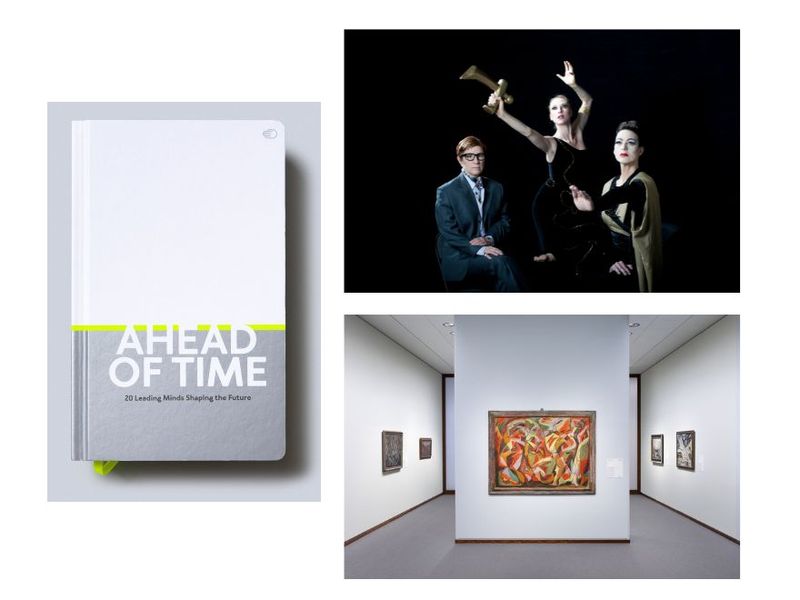
Ahead of Time
No typical horological retrospective, the independent watch brand Ressence’s new book, Ahead of Time (Luster), moves the focus outward from timekeeping to time reflection, philosophization, and projection. Written by British design editor Nolan Giles (check out his excellent Design Considered newsletter) and launched to mark the Antwerp-based brand’s 15th anniversary, the volume brings together long-form conversations with 20 leading creative minds of our time—including OpenAI CEO Sam Altman; former Apple engineer and entrepreneur Tony Fadell (the guest on Ep. 31 of Time Sensitive); architect Daniel Libeskind; Google’s VP of design, Ivy Ross (the guest on Ep. 11 of Time Sensitive); graphic designer Stefan Sagmeister (the guest on Ep. 8 of Time Sensitive); and our very own editor-in-chief, Spencer Bailey—to imagine various versions of our shared future. Offering a wide-angle lens on what’s to come in technology, art, architecture, and beyond, Ahead of Time largely eschews doom and gloom and makes one thing abundantly clear: a future worth having must be approached with an open, rationally optimistic mind.
Martha@BAM—The 1963 Interview
Next week, the spirit of legendary 20th-century choreographer Martha Graham, often called a “Mother of Modern Dance,” will materialize on stage at the Brooklyn Academy of Music. Martha@BAM—The 1963 Interview, part of BAM’s Next Wave Festival, will uncannily revive a 92nd Street Y interview between Graham (embodied by Richard Move, the choreographer, dancer, performer, and professor of Dance at Tisch) and dance critic Walter Terry (played by Tony Award–winning actress and playwright Lisa Kron), alongside former Graham company dancers Catherine Cabeen and PeiJu Chien-Pott. The performance, based on an archival audio recording from 1963, when Graham was on the cusp of turning 70, marks Move’s BAM debut after three decades of devotedly channeling the force-of-nature dance artist and frequent collaborator of Isamu Noguchi. The homage emerged in 1996 at Mother, a cabaret club in New York City’s Meatpacking District, where Move hosted a variety show featuring Martha—brought back to life, if only for a night—interviewing fellow (still-alive) dancers, including Mikhail Baryshnikov, Meredith Monk, and Mark Morris. In a recently published Bomb interview, Move said their reinterpretation of Graham feels akin to a “seizure,” adding, “There’s a strange, What just happened? Meaning, after being on stage there’s a complete presence, a forgetting of oneself.”
“Max Ernst to Dorothea Tanning: Networks of Surrealism” at the Neue Nationalgalerie
One hundred years after the “First Surrealist Manifesto” (1924), the exhibition “Max Ernst to Dorothea Tanning: Networks of Surrealism” at the Neue Nationalgalerie in Berlin, on view through March 1, 2026, offers a new window into the ramified social networks of the 20th-century international art movement. Showcasing works by Surrealists including Leonora Carrington, Salvador Dalí, Max Ernst, Leonor Fini, René Magritte, Joan Miró, and Dorothea Tanning, the show sheds light on how historical events, interpersonal relationships, and various business connections influenced the complex paths taken by these paintings and sculptures—primarily in the 1930s and ’40s, during the Nazi period and the Second World War, when many artists decamped from Paris and other European cities into exile in Mexico and the U.S. Characterized by the museum as “object biographies,” the stories of these works, expertly curated by Maike Steinkamp, Lisa Hackmann, and Sven Haase, are ones of love, loss, persecution, and new beginnings, offering both an intimate view into the lives of their creators and greater insight into the widespread political turmoil of the time.
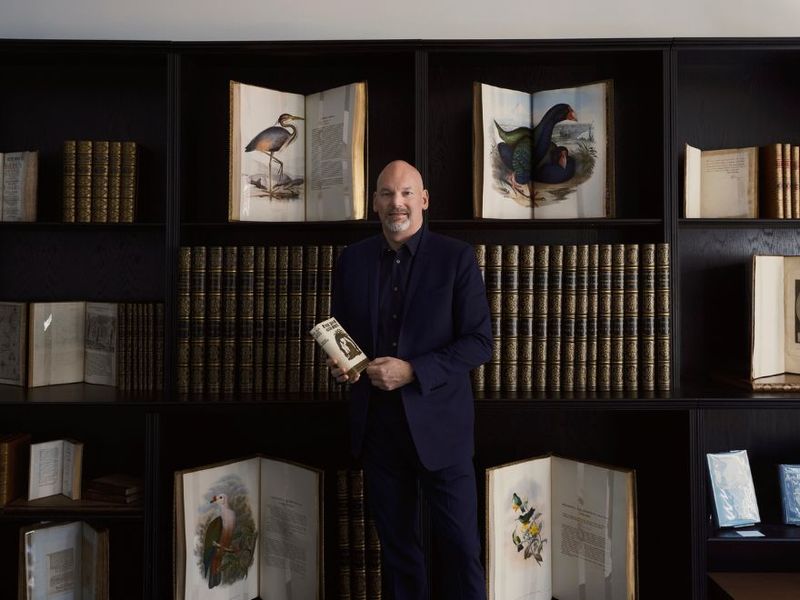
As the son of Peter Harrington, who founded London’s esteemed Peter Harrington Rare Books—one of the leading rare book dealers in the world and the largest antiquarian book dealer in Europe—Pom Harrington understands all too well the precious value of print media, and practically has since birth. Over time, Harrington has, perhaps inevitably, become an avid collector in his own right, with his ever-growing personal collection fueled by a self-proclaimed “obsession” with Roald Dahl and other childhood nostalgia, including The Lord of the Rings series and the book that inspired the 1996 cult classic movie Trainspotting. The owner of the business since his father’s passing, in 2003, Harrington is now expanding the store’s reach to the U.S. with its first-ever international location in New York City, opened last month on the Upper East Side.
Here, Harrington shares his daily digest; his most prized possessions; and his tried-and-true sources for the latest on art, wine, and English football.
How do you start your mornings?
Like everybody—I pick up my phone and see what’s come in overnight. Whether I’m in London or New York, I bleary-eyes open up and see if I’ve gotten any answers to whatever I’ve offered out, either trying to buy or sell a book. I try to go to the gym if I’m feeling very good. Boring emails before going into the office.
I move around a lot. In fairness, I do a lot of travel. I also live in Cape Town, South Africa, so I spend time down there. So I’m sort of bouncing between Cape Town, London, and New York, which sounds terribly glamorous, but it doesn’t always feel that way. We also exhibit at these international fairs. So far this year we’ve done Abu Dhabi, Melbourne, San Francisco, and New York.
Where do you get your news from?
My default for daily news is the London [Sunday] Times. I do find them more balanced than most, slightly more center-right, or actually just quite centralist. But actually, I subscribe to quite a few newspapers, just because I like the variety. I’ve got the Financial Times, where I find more detailed stories, and they do great weekend selections. The FT Weekend is a newspaper I try to buy—they cover art very well, and particularly The Winter Show in New York, or, you know, Frieze Masters, these big shows that go on. The demographic that reads the FT tends to be very much our customers. I sort of follow the FT because that’s what my customers follow. It does keep you quite current. I also like Bloomberg, The Guardian, sometimes The Telegraph, The Economist… Oh, and I do find the BBC News website quite good.
Any favorite newsletters?
Well, I used to follow wine quite a lot, but probably less so these days. My interest [in wine] is down in South Africa. Wine is a big part of the culture there, and we’re very near the wine region where we live, so I get these wine journals coming in, like Tim Atkin’s annual South Africa Special Report.
Any favorite podcasts?
The Rest Is Politics, with Alastair Campbell and Rory Stewart. I got quite into that particularly around the time of the election last year, because they really covered it so well, and they’re trying to be balanced. The other one—it’s a very English one—is on football. It’s by Gary Lineker [as well as Alan Shearer and Micah Richards], and called The Rest Is Football. It’s all about soccer, and that’s my other side. I’d say, if I have a hobby, I think English football is definitely my nothing-to-do-with-books kind of hobby.
What are some of your favorite rare books in your personal collection?
Years ago, I started off with Roald Dahl. I enjoyed him as a teenager, and my father gave me an inscribed copy, which came from the shop, and then I just sort of started buying Roald Dahl. So that’s become a bit of an obsession. I’ve ended up buying everything, all inscribed, including copies to his mother and his wife and his ex-wife, his children. Then there are very personal, quirky things often because they’re not expensive. For example, we bought the library of Christopher Lee, the actor who played Saruman [in The Lord of the Rings movies]. He had these Lord of the Rings books signed to him by Peter Jackson, the director, with a drawing. I just thought [these books] were very cool.Another one is that I always liked the movie Trainspotting. It was my “growing up” movie. And actually, the first edition [of the 1993 novel by Irvine Welsh] is really hard to get, surprisingly. Very few copies exist, and I thought, I’ve got to try and get a copy of that book, because that’s part of my… not quite childhood, I guess I was 19 or 20 when I found it. A very cult movie.
What are your favorite Roald Dahl books?
The short story “The Wonderful Story of Henry Sugar,” which, funny enough, has been made into a short movie, which is quite quirky. The more famous ones I fall for are Fantastic Mr. Fox—really enjoyed that as a book—and the original Willie Wonka [& the Chocolate Factory] movie, with Gene Hackman. That’s less to the book and more to the movie, but I’ve got the director [Mel Stuart]’s copy of the film script. My Roald Dahl thing goes beyond just the books—I’ve got the film script for that, I have a page of the manuscript from it that he gave away, I’ve got an original Wonka Bar wrapper signed by the kids of the cast.
How would you describe your approach to collecting?
Actually, quite simple: You definitely—advice to myself and my advice to others—have got to buy something you love. Don’t buy because you think you’re being clever; until you become a very seasoned collector, you’ve got to buy something that really appeals to you. The second rule is: Buy the best you can afford. If it’s got a problem, it’s always going to have a problem. Avoid buying that cheap copy unless that really is all you can afford, which is fair enough. But yeah, buy what you love and buy the best you can.
What books are you currently reading?
A biography on T. E. Lawrence, Lawrence of Arabia, by Ranulph Fiennes, which I’m halfway through. I like biographies and autobiographies. I recently read Boris Johnson’s autobiography [Unleashed], which was quite interesting. He’s a controversial character, in a way, but I found something quite cross reading it, because he has all the right charisma and intelligence to do that job [of prime minister], but he’s a habitual liar, and that’s probably not a good thing for a leader [laughs]. You read this book and you’re thinking, How much of this is true and how much of it is made up? I think he was a great mayor of London, did some good things there. But he blew it as prime minister. He wrote an excellent biography on Winston Churchill, which I’ve also read recently. I don’t read too much fiction.
Any guilty pleasures?
John Grisham. Every year I buy a John Grisham book. I just find it easy reading. The other thing I’ll admit to is buying something impulsively on Amazon at about one in the morning.
This interview was conducted by Emily Jiang. It has been condensed and edited.
Our handpicked guide to culture across the internet.
For the exhibition “The Eight Directions of the Wind,” on through Oct. 26, 2026, at the Huntington in San Marino, California, the British artist and master potter Edmund de Waal (the guest on Ep. 98 of Time Sensitive) orchestrates three site-specific installations mixing natural materials, texts, and recent works that explore, as he puts it, “the stories that objects carry.” [The Huntington]
On Oct. 27 at New York’s Morgan Library, our eight-seasons-straight Time Sensitive presenting sponsor, L’École, School of Jewelry Arts, will host an illuminating talk titled “Architecture and Jewelry: A Bridge Between the Arts” and featuring jewelry historian Sung Moon Cho and art historian Paul Paradis. [L’Ecole, School of Jewelry Arts]
In the new book Iceland Epic, writer, editor, and self-described Iceland enthusiast Erika Owen—The Slowdown’s very own marketing and audience development advisor—journeys to the Nordic nation for an awe-inspiring tour of its majestic landscape and natural wonders, cozy local restaurants, and avant-garde cultural offerings. [Assouline]
A recent study conducted by MIT’s Senseable City Lab found that pedestrians linger less than they did just a few decades ago, presenting an opportunity for urban designers to compel less frenetic movement and more serendipitous encounters through public space. [MIT News]
Curator Beatrice Leanza’s recently released book, The New Design Museum: Co-Creating the Present, Prototyping the Future, reveals how cultural spaces dedicated to design require transformation—of their missions, programs, and outreach platforms—to meet a field that today is moving well beyond its traditional object-based mode of presentation. [The University of Chicago Press]