In this week’s newsletter, we speak with The Whitney Review’s founding editor, Whitney Mallett, about her daily media digest; drop in on an exhibition reflecting on the primordial medium of drapery; and more.
Good morning!
When I was growing up in suburban Denver, in the mid-’90s, I used to make mixtapes for friends using my dad’s Denon dual cassette deck. In today’s efficient, Bluetooth-streaming, Spotify age, I really miss this analog art. It’s difficult to fully recall the slow pleasure in pressing record and stop and play, hearing the click of those cassette-deck buttons, and finding that rare delight in combining just the right songs from various CDs or vinyls. There was a special craft to making a mixtape—and, in turn, a pure joy to receiving one—that just can’t be replicated on a computer. I’m no Luddite, but clicking and dragging audio files on a screen simply isn’t the same.
Still, I love a good playlist, regardless of how it’s made, and there are so many to be found online, including more than 20 that, back in Covid-19 quarantine times, the likes of the fashion designer Philip Lim, the philosopher Simon Critchley, and the sound therapist Sara Auster created for this very newsletter. Perhaps we should bring our “Playlist” series back in 2026?
I bring up playlists because, in preparation for this week’s Time Sensitive conversation, I listened to three Spotify playlists that the episode’s guest, the artist Jennie C. Jones, made: one of them for New York’s Metropolitan Museum of Art, another for the Dia Art Foundation, and a third for the Pulitzer Arts Foundation in St. Louis. (The latter institution is currently presenting two exhibitions with Jennie through Feb. 9, one of them, “A Line When Broken Begins Again,” featuring a selection of her new and existing paintings, sculptures, works on paper, and sound pieces; the other, “Other Octaves,” a group show she curated of works by artists who have been formative to her practice, including Carmen Herrera, Agnes Martin, and Martin Puryear.)
Listening to Jennie’s playlists brought me back to my mixtape days, and that’s because—as is exemplified through her visual and sound art practice—when Jennie listens closely to a piece of music, she’s particularly attuned to its pauses, in-between moments, and breaks. She notices, with discernment and curiosity, the kinds of small sonic nuances that others might miss altogether. Her playlists, featuring handpicked tracks by many little-known and/or avant-garde musicians, raise up songs and voices that could all too easily be lost to time. Blasting Jennie’s playlists through the Bang & Olufsen BeoPlay A9 speaker in my living room, I experienced a kind of sonic awe that no algorithm could ever achieve.
Two songs I want to note here in particular, which we excerpt and talk about on the episode, are the first one on her Met playlist, Moses Williams’s “Sitting on Top of the World,” from the album Drop on Down in Florida: Field Recordings of African American Traditional Music 1977–1980, and the title track of her Pulitzer playlist, Julius Eastman’s “Stay on It,” performed by the experimental L.A.-based ensemble Wild Up. As becomes clear through my conversation with Jennie, these two very different compositions connect to her minimalist art practice in ways that are subtle and surprising—and, I would say, even profound.
I also recommend that you check out the music of the London-based harpist and jazz musician Nala Sinephro, whose track “Space 1” also appears on Jennie’s Met playlist. It has to be one of the songs I’ve listened to the most over the past few years.
—Spencer

“I like troubling the waters with this not-so-definable, multifaceted way of thinking.”
Listen to Ep. 145 with Jennie C. Jones at timesensitive.fm or wherever you get your podcasts
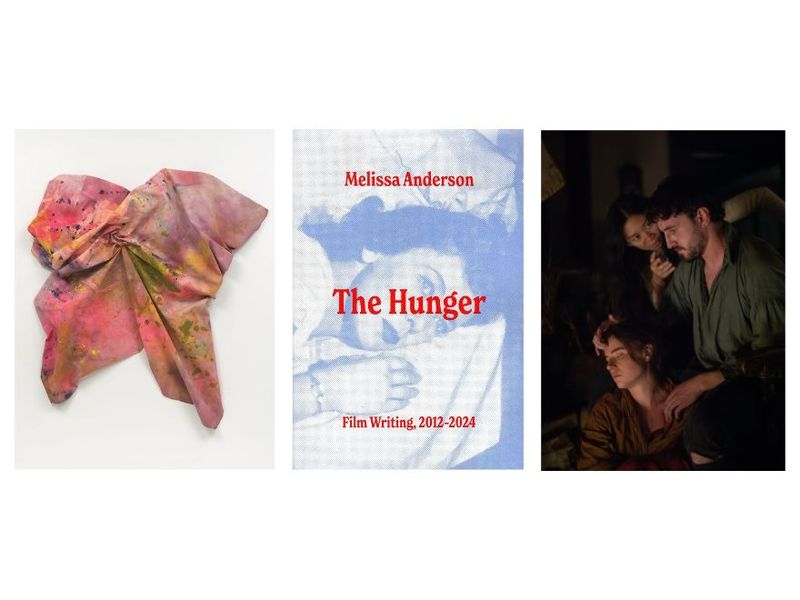
“Drop, Cloth” at Hollis Taggart and Susan Inglett Gallery
Drapery has played myriad roles throughout art history, from the folds of robes meticulously chiseled out in Roman marble statues to the woven canvases used as the standard foundation for most paintings since the 17th century. Spanning the two Chelsea galleries Hollis Taggart and Susan Inglett Gallery, and on view through Jan. 10, the exhibition “Drop, Cloth” examines this primordial medium. Curated by Glenn Adamson (the guest on Ep. 50 of Time Sensitive) and Severin Delfs, the show brings together approximately 30 works by 25 artists, including Sam Gilliam, who pioneered the expansion of fabric as an artistic medium in the ’60s, and Lynda Benglis, who studied the essence of fabric using non-fabric materials. In its totality, “Drop, Cloth” is both complex and manifold: There are the physical characteristics of fabric—its folds, patterns, and textures—as well as themes beyond what meets the eye, such as its behaviors of hiding and revealing, and its social implications as a feminist intervention. Reflecting on the show, Adamson asks, “What better metaphor could there be for the great fabric of aesthetic possibility, after all, than fabric itself, which yields new shapes so readily—just a fold here, a tuck there, and a flick of the wrist?”
The Hunger: Film Writing, 2012–2024 by Melissa Anderson
The critic and 4Columns editor Melissa Anderson’s invigorating collection of film writing, The Hunger (Film Desk Books), is a reminder of why fearless, rigorous, razor-sharp cultural criticism with a strong point of view still matters in a media landscape largely lacking it. As writer and artist Wayne Koestenbaum underscored at her book launch at the Brooklyn microcinema Light Industry earlier this month, Anderson, an eagle-eyed wordsmith, takes genuine pleasure in choosing the mot juste. (See her piece on Patrice Chéreau’s 1983 film, The Wounded Man, which includes “duds,” “brute,” “stud,” “deranging,” and “infatuation” in a single sentence.) Showcasing a mix of reviews for films old and recent alike—from Jacques Deray’s La Piscine (1969) to Coralie Fargeat’s The Substance (2024)—along with illuminating essays on singular stars such as David Bowie, Maggie Cheung, and Jane Fonda, an hour spent in Anderson’s lively company on the page will make you want to rewatch a title that prompted strong feelings and probe them more deeply. As she tells the scholar Erika Balsom in the book’s afterword, no matter how she feels about a film as the credits roll, Anderson always honors the “intensity of her response”—a critic’s foremost job, then and now.
Hamnet
Filmmaker Chloé Zhao paints a prismatic portrait of grief in Hamnet, her new movie starring actors Paul Mescal as Shakespeare and Jessie Buckley as his wife, Agnes, based on the 2020 novel of the same name by Maggie O’Farrell. Despite the dearth of historical records about the playwright’s personal life, his marriage, and the couple’s three children, O’Farrell’s story breathes life into these interstices by imagining how the untimely death of their young son, Hamnet, may have fundamentally shaped Hamlet, the theatrical tragedy written in its wake. To enrich her own retelling, channel the subconscious, and support her cast in finding their characters’ emotional core, Zhao, who has studied Jungian psychology, incorporated dream sessions, movement, and on-set meditation. As she noted during the BFI London Film Festival, in reference to Werner Herzog’s notion of ecstatic truth, “finding the right moment to have logos and the right moment to have mystery, that is up to you, to do the balancing act.” The result is one of the year’s most piercing cinematic depictions of how sudden loss irrevocably alters one’s internal landscape and can be alchemized, over time, into a hauntingly cathartic work of art.

Few people have their finger on the pulse of emerging talent across culture as much as Whitney Mallett does. As the founding editor of the independent journal of literary criticism The Whitney Review of New Writing, it’s in many ways her job to stay abreast of our mercurial media landscape—not only in terms of literature, but also the various threads that feed into and out of it: pop culture, international news headlines, under-the-radar YouTube shows, up-and-coming Substackers. Though she stays on top of the trends, she’s decidedly not one to follow them, and that just might be The Whitney Review’s secret sauce; during this very interview, she quoted writer and artist Nora Treatbaby, who wrote, “If most people practiced being really, really honest with themselves about themselves, they would have incredibly interesting things to say.” Here, Mallett shares how she stays true to her own vision, the writers she comes back to again and again, and the ways she fills her cup after a full-plate week.
How do you start your mornings?
I tend to have coffee at home and, most days, listen to Democracy Now! while I do. In addition to their news and headlines, I also like their musical selections. It also reminds me that you can have, like, Cocteau Twins and coverage on genocide in one episode. Or [they’ll interview] a virology Ph.D., but they’ll be wearing a velvet blazer and a bow tie. I like that eccentric people end up on there. It’s very different from the high camp of corporate network news in a way that I really like.
Apart from Democracy Now!, where else do you get your news from?
I feel like Democracy Now! covers me for my news, but another thing that’s interesting is, even in the past few months, so many more news sites are paywalled than there used to be. I canceled my New York Times subscription and started paying for New York magazine. So that’s where I read my magazine journalism. It was actually the Wendy Williams story that made me pay. I was just like, I need to know about this.
Do you subscribe to any newsletters?
Natasha Stagg’s Selling Out is the only Substack I pay for. She’s a writer and someone I’ve known personally for a lot of years. She just does it very elegantly. She puts out a couple a week. I do also like that sometimes I’ll have seen her at a dinner, and then I see how she writes about it. My birthday party made it in. I think it’s one thing to watch someone mythologize their life from afar. I think it’s often quite cringe when you actually know the person and you see them doing it. It’s hard to write personally without either being overly self-deprecating or romantic. To get to see the actual context of it, and then see it become formalized or stylized into something, it’s very close to home, and it makes me consume it a lot more regularly.
Princess Babygirl is also one of my favorite Substackers. The writer’s name is Safy-Hallan Farah. She’s writing a lot about self performativity, in a way. There was this piece on what she called “the id girl,” which included Lena Dunham and Ivy Wolk. The id girl is this kind of, I don’t know if oversharing is the right word, but this kind of nesting doll, with many layers. I love the way you feel like you’re following how she thinks, and there’s a strong voice in it, and then it can be very analytical at the same time. It’s a pleasure to read this rhythm of thinking.
Infinite Jaz, by the journalist Jasper Diamond Nathaniel, is one that I read that’s recording on the occupied West Bank. There’s a lot of stuff in his newsletters that’s filling a hole of what regular media isn’t doing.
What podcasts do you listen to?
Interior Motives. Is it a podcast? Is it a YouTube show? It’s my new obsession. They have a lot of people guest-starring that you may know from other podcasts, or people like Macy Rodman, who was also in the new Whitney Review. There’s Steven Phillips-Horst and Lily Marotta, who are from the Celebrity Book Club podcast. Lauren Servideo just went on with Emerson Rosenthal, who I think is her husband. Users submit pictures of bedrooms, and they analyze from the bedroom: Is this a male, a female, pansexual, trans bedroom? They’re just all very funny, too. I got really into it when I was rotting in bed this week. It’s also good meta-rotting-in-bed material, because you’re also seeing the spaces and the rotting that other people do. I think there’s a meta rot going on.
“Meta rot.” You’ve got to coin that. [Laughter] What are your favorite magazines?
I just went to the launch for the new Pin-Up magazine [founded by Felix Burrichter], and that’s forever one of my favorite magazines. I’m on the team, so I’m a little biased, but it’s the magazine that I’ve probably learned the most from working at, and I’m always really excited to crack open the new issue. I’m also a fan of NYRA. I think a lot of people put The Whitney Review in that category. We have a similar format and were birthed at a similar time. I really enjoy what they’re doing. Viscose is another magazine I’m a big fan of. They’re taking an intellectual approach to fashion and reinvent themself formally every issue.
I also have Untapped near me right now. I recently met its editor-in-chief, Tiffany Jow [the former executive editor of The Slowdown], at a magazine conference. Tiffany was part of a panel called “Owned Media.” “Owned media” just means there’s a corporate backing. But that’s exciting to me, that people are willing to fund editorial in that way and make it really cool. Carhartt Work in Progress is a good example of that, too.
I’m excited that Performa started Works in Practice magazine—instead of Work in Progress. [Laughs] There are so few places to write about performance. I think it’s an exciting moment.
What books have you been reading recently?
I loved Perfect Victims by Mohammed el-Kurd. I decided to review it for The Whitney Review because, to be honest, I was expecting to have to make myself read it, and it would be very somber… It’s still very heavy, but there’s so much warmth and humor and creativity and formal experimentation and pinpointed use of register of the voice that it’s actually a pleasure to read in many ways, even though it’s dark material. I loved its use of footnotes. The footnotes are not overly academic; they almost are little asides, and let you have this break from the main thrust, to add more information. They’re often very idiosyncratic. There’s one moment in a footnote that I think is really where you’re expecting to get the translation of a phrase in Arabic, and then it says, “Ask your Arab friend.” It makes it a social reading experience. Because if you’re reading it, and you’re like, I don’t have an Arabic-speaking friend, it’s telling you, maybe you should, or why not?
My favorite book I read this summer, which I haven’t written about at all, is Paradise Logic by Sophie Kemp. I was expecting it to be good, and it was way better than I expected. It’s kind of about the cult of heterosexuality and rape [culture], but in such a surreal, weird way. I was really moved by it.
Which writers do you find yourself coming back to again and again?
Philippa Snow, Alissa Bennett, A.S. Hamrah, Chris Kraus. Ishmael Houston-Jones—he’s mostly known as a dancer and choreographer, but his book [Fat and Other Stories] is so good. On the subject of Chris Kraus and the new narrative, I love people like Kevin Killian and Dodie Bellamy. That kind of stripped-down, personal writing, I love everyone doing that. Eileen Myles and Lynne Tillman are heroes to me. There’s just something so cool about their style; it’s smart, but not trying too hard.
I’m such a fan of Semiotext(e). A more emerging writer that I’m obsessed with, too, is Lauren Cook. He’s really finding a new way of writing that works for this moment. It feels very, for lack of a better word, post-internet or post-Tumblr. It’s figuring something out that works for now in a very honest way. I also love Maya Martinez. I find what she’s doing also really works for the moment. People like Maya and Lauren—they’re collaborators, too—their work seems to be defining a new zeitgeist, in my opinion.
Where do you go for literary criticism?
I make a point of reading The New York Review of Books and Bookforum religiously. But I’m conscious that I want to follow my own instincts and be confident in my own point of view, and neither follow nor be overly reactionary to what they’re writing.
There are other things that are not quite literary criticism. I’m a big fan of the U.K. magazine Worms. They cover a lot of the same emerging writers we do, but in a different way. They do more Q&As with people, like Maya Martinez, Lauren Cook, Diamond Stingily. They put out a chap book recently called Retail Therapy.
Do you have any guilty pleasures?
I’ll say that, having this kind of week of having a bunch of launches and feeling really burnt out, the other day I was just like, I need to watch some TV. Then I got into watching The Pitt, that medical show. When you’ve had a lot of stress, it’s almost ironic, but a thing that I think is common is you want to watch a show where you’re safe and not stressed out, but you’re getting secondhand cortisol spikes from the show. I think The Bear is kind of similar. Any kind of narrative where it’s a stressful work environment. It’s weird, I think it could be looked into more, why we want to watch other people be stressed. To watch something too slow would be excruciating.
This interview was conducted by Emily Jiang. It has been condensed and edited.
Our handpicked guide to culture across the internet.
Released this week, the book Enoura Observatory: Land of Distant Memories by photographer, artist, and architect Hiroshi Sugimoto (the guest on Ep. 114 of Time Sensitive) offers insight into his poetic, deep-time vision for his architectural complex in Odawara, Japan—the apotheosis of his art practice. [MW Editions]
Artist Nick Cave (the guest on Ep. 86 of Time Sensitive) shares his go-to spots in his home city of Chicago, from the Lost Language sauna on the city’s North Side to the two-Michelin-starred restaurant Alinea, where you can find “food as art at its best.” [Airmail]
On the latest episode of The Nature Of podcast, Atmos editor-in-chief Willow Defebaugh is joined by writer and cultural critic Roxane Gay (who also spoke with Spencer on Time Sensitive back in 2022) to reflect on 10 years since the release of her seminal book of essays, Bad Feminist, and to explore the evolving landscape of feminism. [Atmos]
Chef Daniel Humm (the guest on Ep. 53 of Time Sensitive) has entered yet another new realm—this time, children’s literature—as the co-author of Daniel’s Dream, out Jan. 20, which encourages kids to imagine boldly and follow their curiosities. [High Tree Publishing]
Architecture writer Michael Webb, who interviewed Frank Gehry on multiple occasions, reflects on the inimitable architect’s life and legacy following his passing last week at age 96. [Wallpaper]