In this week’s newsletter, we lose ourselves in Taryn Simon’s probing new Guggenheim exhibition, which traces the 40-year career and life of an anonymous, retired F.B.I. agent; speak with former New York City Ballet dancer Adrian Danchig-Waring on his possibility-filled next moves; and more.
Good morning!
Olivia here. On a recent Saturday afternoon, while gradually making my way up Frank Lloyd Wright’s Guggenheim spiral, I paused to read a wall text of Taryn Simon’s novelistic, 42-chapter exhibition, “Father Country I Do Love You” (on view through March 14, 2027). A young woman approached me from behind, tapped my shoulder, and asked if she could take my picture. I hesitated briefly, unsure of her intentions. “I just love the way your coat looks against the backdrop,” she said. “I thought you might like to have it.” A moment later, a photo materialized on my phone. There I was, standing on a vermillion carpet beside heavy curtains in the same striking shade of red as my raincoat. As I turned to thank her, she had already disappeared up the ramp and into the crowd.
It was precisely the kind of puzzling, unexpected human encounter that Simon—the guest on our latest episode of Time Sensitive—explores throughout the exhibition, and has long examined through her rigorous, revelatory practice. One never knows where an image taken of them may end up, or in whose hands; what will happen to it at a later date; or what someone will see in it at some distant point in the future. In her new show, Simon delves into this phenomenon and confronts the often dark, sometimes beautiful, always perplexing heart of American history, charting the intertwined paths and larger-than-life stories of an unnamed, retired F.B.I. agent and, in a roundabout way, her own father: an irreplaceable collaborator, captivating storyteller, and diligent documentarian, whose Alzheimer’s diagnosis in 2020 has irreparably altered their ability to continue their conversation.
Among the exhibition’s many strengths is Simon’s steadfast refusal to dole out easy answers or conclusions about the real-world dramatis personae it showcases. There are so many ways to get lost in these pictures, videos, and installations she has crafted out of nearly 10 years’ worth of interviews. For those yet to experience it, I recommend pausing at some point to peer over the edge of the rotunda and people-watch. Notice who’s stuck on a particular moving image, photograph, or object; catch their subtly shifting facial expressions as another detail reveals itself, complicating what came before. By the time one reaches the top, dizzy and dazed after attempting to take this whirlwind presentation all in at once, the only certain thing is that there’s more to these individuals, and to each of their interconnected lives, than first meets the eye. As Spencer notes at one point in his Time Sensitive exchange with Simon, “A viewer might spend a couple of hours with it, as I did the other day, but that’s a decade’s worth of work.”
“Father Country,” intentionally or not, serves as a reminder to take seriously whatever catches our eye each day, and to keep looking. It’s also a testament to Simon’s dogged ability to follow her nose. As she acknowledges, no one will ever fully figure out or know the people closest to them. It’s in the seeking itself where the intrigue—and a deeper sense of purpose—lives.
—Olivia
P.S. I’m delighted to share that Time Sensitive won in two categories of this year’s Signal Awards: Sheila Hicks (Ep. 153, Season 13) received gold in the Arts & Culture category, and Theaster Gates (Ep. 143, Season 12) received bronze for Interview or Talk Show. Thank you, as always, for listening.

“Knowing is such a tricky thing. I immediately go to my child or something, but you can’t ever know anyone or anything. I think that’s probably at the core of a lot of what I do.”
Listen to Ep. 160 with Taryn Simon at timesensitive.fm or wherever you get your podcasts
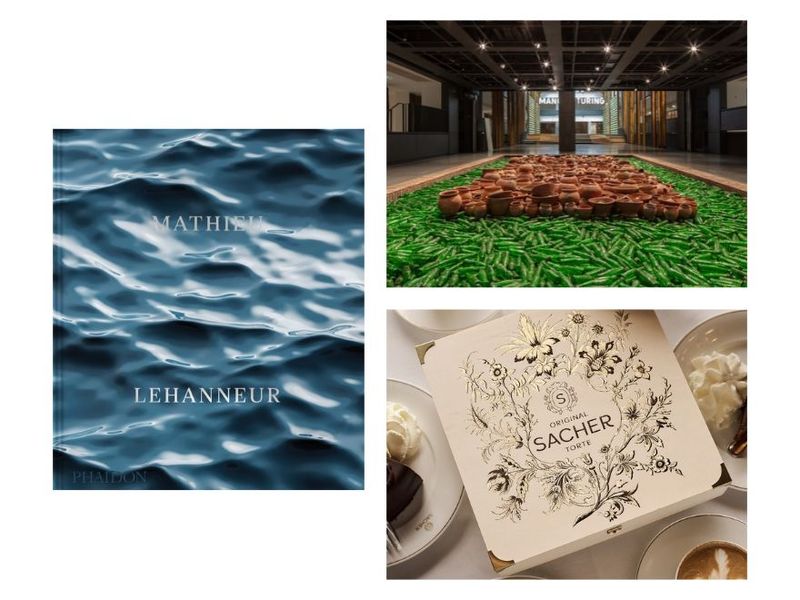
Mathieu Lehanneur
Much like his ravenous, radically imaginative mind, the work of French designer Mathieu Lehanneur practically knows no bounds. Spanning, among other things, pharmaceutical packaging, an aquaponic aquarium, and—one of his most ambitious projects to date—the behemoth, hot-air-balloon–esque floating cauldron for the Paris 2024 Olympic Games, his creations meld art and science, defying strict categorization. Their common denominator is what our very own Spencer Bailey describes as “magical realism” in his foreword to Lehanneur’s new self-titled monograph, out next week from Phaidon. Split into 10 chapters that reflect the defining principles of his practice, the book traverses 80 projects created across more than 20 years, pulling back the curtain on his singular process and underlying obsessions, be they history, math, medicine, spirituality, or time. In addition to Spencer’s foreword, the volume also features an essay by historian and curator Constance Rubini on the Olympic torch and cauldron project—which, she says, “gave rise to a collective effervescence”—and an illuminating interview between Lehanneur and writer and photographer Lucie Weeger. “Objects and things always tell us what we are,” writes Lehanneur in relation to his Olympic designs. It’s a sentiment that could be applied to every bewildering thing he brings into being. —Emily Jiang
Ibrahim Mahama’s “The Harvest Season” at the Fondation Cartier
The spirit of nnɔboa, an Indigenous strategy of collectivist farming practiced in Ghana—one grounded in the principle of work for all, by all—permeates artist Ibrahim Mahama’s exhibition “The Harvest Season” at Paris’s Fondation Cartier pour l’Art Contemporain (on view through Feb. 28, 2027). Rather than accept the invitation to spotlight his work alone, here Mahama gathers nine artists and collectives to imagine African futures together alongside him. A testament to the potential of artists to reappropriate history, the site-specific installation “Things Fall Apart” reconstructs an abandoned Ghanaian glass bottle factory—one of the last major decentralization projects of the country’s first president, Kwame Nkrumah—that Mahama (the guest on Ep. 36 of Time Sensitive) purchased in 2024 to repurpose its materials for an art center he founded in Tamale, in northern Ghana. Featuring traditional Ashanti stools, a new iteration of the installation “Parliament of Ghosts” presents an empty, amphitheatrical parliamentary chamber that alludes to a failed democracy, a reference to the coup of 1966 and subsequent dissolution of the Ghanaian government. Through this piece, Mahama invokes the “ghosts” of institutions that failed or never existed. “The future isn’t something that just ‘exists’ somewhere,” Mahama says, “it also lives in our past memories, in the form of unrealized futures.” —E.J.
150th Anniversary Sacher-Torte Box by Aerin Lauder
Vienna has long held meaning for Aerin Lauder, founder of the beauty and lifestyle brand Aerin, who first moved there in high school, when her father briefly held the role of U.S. Ambassador to Austria in the mid-1980s. In 2015, she said of the city, and specifically its historic Demel café, “I remember being so charmed—the smoked glass with flower etchings, the decorative tortes, the candy section.” Now, more than four decades (and many return trips) later, she’s marking 150 years of one of the City of Music’s grandest establishments—Hotel Sacher Wien, on Philharmonikerstrasse, directly opposite the Vienna State Opera—with a custom-designed wood box made to house its handcrafted Original Sacher-Torte. Available from Oct. 27 through early next year, this limited-edition vessel, done in collaboration with her brand, comes festooned with a floral motif rooted in the Viennese decorative arts. Whether gifted to an old friend this holiday season, or set down on a table as the pièce de résistance of a luxuriously long meal, it’s a graceful keepsake that rises to the occasion of this singular chocolate cake, which still follows Franz Sacher’s enduring 1832 recipe to perfection. —Olivia Aylmer
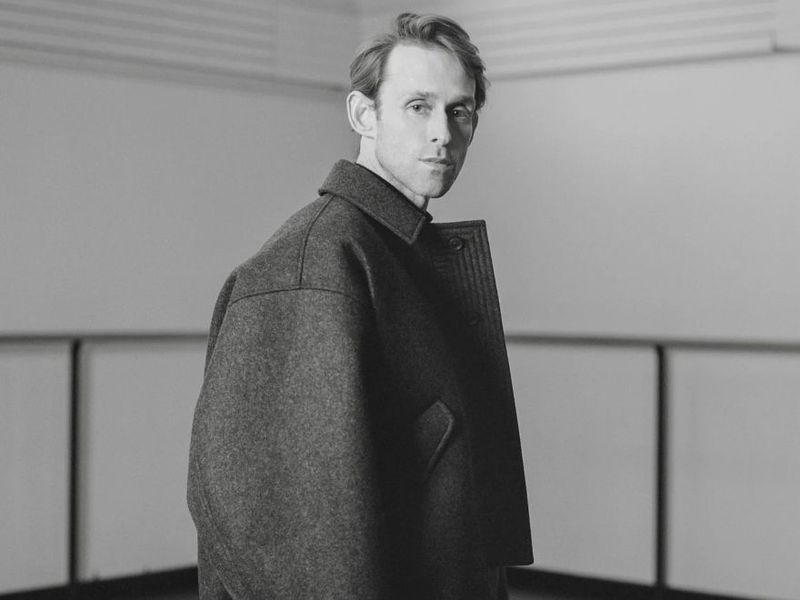
When outgoing New York City Ballet principal dancer Adrian Danchig-Waring took to the stage for one final curtain call this past Sunday afternoon, after 24 devoted years with the company, he did so the only way he had ever imagined: surrounded by his fellow artists, friends, and loved ones, sharing the spotlight. As he put it to The Slowdown a couple weeks before, “I’m crossing a threshold from one phase of my own consciousness to another.” Now, as the ongoing artistic director of the New York Choreographic Institute, City Ballet’s experimental arm, he’s poised to push the art form forward even further while honoring its roots, as he stewards the development of risk-taking works based in ballet yet not beholden to tradition.
Here, from his hydrangea-filled rooftop, Danchig-Waring discusses expanding the vocabulary for career transitions in dance; crafting his farewell program with “architectural integrity”; and connecting the dots between disciplines, from ballet to metaphysics.
You chose to bookend your final performance with two quintessential Balanchine works, “The Four Temperaments” (1946) and “Agon” (1957), along with Lar Lubovitch’s “Each In Their Own Time” [originally made for Danchig-Waring in 2021, and notably the first duet made for men to join the company’s repertoire] and the premiere of Pam Tanowitz’s “Once With You” in between. What is it about these works that makes you feel at home in them?
The intention was to look at the past, to embody that history, and to use that information and experience to inform this living present and set me on a future path. I wanted to create a program with architectural integrity, and the Balanchine black-and-white ballets, to me, are the foundation of this whole cultural enterprise that is the New York City Ballet. When the curtain rises on “The Four Temperaments,” the audience witnesses a series of themes that, in less than ten minutes, establish an entire vocabulary and system of thinking about how ballet could be modern. Everything that followed that statement—that 1946 premiere—has been in pursuit of expanding the capacity of ballet to meet the present moment.
There is such a deep familiarity in these dances and in these specific roles, but it’s not something I ever want to take for granted. There is muscle memory that allows me to retain the choreography. It’s a scaffolding, and I get to re-inhabit that in the living moment. A profound gift of having danced here for twenty-four years is that, as I return to these roles, I discover new facets of my being, because they hold up a mirror.
I’m also thinking about who’s on stage with you at different points. You’re not dancing in isolation. Why was it important that you be among your community, both on stage and in the audience, on this day?
I was very clear about this from the outset, that my farewell performance would be about a collective experience. A huge part of why I’ve continued dancing into my forties is the value I take from being part of something bigger than myself. So, being part of a big ballet, where everywhere I turn, there are other people I care about, that really led me to insist on some casting decisions.
The real beating heart of the program is a quartet that Pam Tanowitz gifted me. She assumed it would be a solo commission, and I had never made that assumption. I very much wanted this to be a group dance. In conversation with Pam, I decided that this should be a quartet in which I get to dance one last time with my three closest ballerinas [Unity Phelan, Mira Nadon, and Indiana Woodward], all of whom have witnessed so much of the last decade of dancing and shared and taught me so much. It’s tethered to this idea that everywhere I looked over the course of that two-hour performance, I wanted to feel reciprocal love for the other humans who are sharing in it.
In preparing for our conversation, I’ve been thinking about how there’s perhaps an opportunity to reframe how we think about the word “retirement” in relation to dancers—especially when they’re exploring all of these underexplored, newly emerging parts of self, after training since childhood. What does that term bring up for you?
It’s not a term I’m using, because it doesn’t feel at all appropriate for the emotional experience I’m in. It feels like a “rewiring.” That feels closer to what is happening intellectually, neurologically, and physically, for me. I am taking all of this sustained attention I have focused on being a ballet dancer and redirecting it in other spaces that offer me the opportunity to grow. At this moment, I’m crossing a threshold from one phase of my own consciousness to another, and I get to observe it, experience it, talk about it a lot. That process feels healthy. It’s therapeutic.
There is still an urgent need to find language around what is happening. I am grateful to be dancing in this body through this period of time, and I am overwhelmingly excited to be on the other side of it. I can already start to sense that all this energy I’ve been pouring into tonight’s performance or tomorrow’s performance gets to come back to me, and I get to very intentionally determine where I reinvest it.
I love this idea of reclaiming your energy or feeling it come back to you. There’s also this energetic exchange between audience and performer, where what you’ve put out there has this ripple effect.
Well, we’re in it together. I think that there are two aspects to a dancer’s life. There is the relatively isolated, rigorous practice. Then there is the necessary release and catharsis of dancing with people, and that often translates into performance, too. It’s a collective experience that brings us together, that realigns our heartbeats, that pulls us back into our animal instincts. I am now more interested in those collective emotional experiences than I am in the perfection of the technique.
On this point of collective experiences, I was recently reading this piece in The Yale Review by Joanna Biggs. She makes a compelling case for why experiencing ballet, or any kind of dance, performed live has never been more vital, because it offers a sense of attention, awe, and stillness in our era of distraction that’s increasingly hard to locate. What is it about this primal act of bodies moving through space to music that offers such a refuge right now?
I completely agree with that cultural assessment. The absence of sustained attention is a modern-day plague. The spaces in which we have the invitation to hone that ability are increasingly hard to find, because we live in an attention economy. To have an unmediated experience of art, where you have direct exposure to the art object or the practice itself, it’s not being mediated through a screen or somebody else’s commentary on it… It is direct transmission from source through expression or medium, to you, to your full-bodied system of understanding.
Turning to the New York Choreographic Institute, I had the pleasure of attending a showcase this summer and seeing you in your element, facilitating this exciting temporal experiment, where new works are created in the span of two-week sessions. In your welcome remarks, you called the process “beautiful, terrifying, and addictive.” Why those three words?
It’s a space where we are allowed to question everything, and that feels like an antidote to so much of what is imposed on us through ballet convention, or single-minded teachers, or other inputs that are largely superficial in their understanding of what ballet is, what it can be, or who it’s for. It’s a playground and laboratory for cross-pollination between disciplines, but also between cultures and histories.
There is beauty in the collective histories that come into that room, the training that informs it. Part of that is the Balanchine style and technique, and the embodied archives of New York City Ballet dancers, and all of the art history they have available, coursing through their veins. But then there is also the beauty of spontaneous discovery. There is the beauty of collision between these ballet-trained dancers and postmodern, contemporary, or hip-hop–based choreographers.
My job is to create meaningful support and trust, and to a degree, safety, so that everyone who comes into that space is willing to be changed, and that can often feel terrifying. There is a lot of fear around true vulnerability, around being exposed, around being seen. I think that ballet can be an armor—the formalized technique, the rigorous practice, the system can shield you from exposure. Very few artists invite audiences into their inner life.
Before we get to the third adjective, there’s an element that I’ve been dancing around a lot, which is, I think there is a global problem in ballet today that is born of choreographers believing that their responsibility is to make work in the style of their predecessors. Again, this is where language maybe hasn’t caught up to the gut-check…
Monarch! [Pauses and points up, as an orange-and-black butterfly darts overhead]
[Gasps] That was really beautiful. I just saw the tail. Thank you for that.
Wonder.
[Laughter]
Speaking of awe…
[Laughter]
…and what this institute has the potential to do is to support the creation of intelligent work that observes the larger cultural context and dialogues with essential ideas from other disciplines. The shorthand as I’m making decisions is: Does it help us become and—forgive this—the Bell-Labs-meets-Ballets-Russes of our time? Where watercooler conversation centers around what’s happening in philosophy and metaphysics, technology and embodied practice? All of these things in isolation contribute to this increasingly fractured, online platforming. Bringing people into a shared space, a shared ritual, allows us to create meaning together.
And it’s addictive for me in that I’m seeing … the concentric circles of community-building and of capacity-building. I care so deeply about these artists, many of whom are long-time collaborators. But some are young upstarts, with wild ideas, ambition, and curiosity. I’m at a phase of life where I want all of my learning to be available for them. What’s addictive is being able to excavate the past, my own personal past, but also the historical past, and bring that into this conversation.
This interview was conducted by Olivia Aylmer. It has been condensed and edited.
Our handpicked guide to culture across the internet.
Novelist George Saunders (the guest on Ep. 151 of Time Sensitive) tells fiction editor Deborah Treisman about the six-plus-year trajectory of writing his latest story, “Appeasement, Ohio,” which examines what’s at stake for human relationships in an age of misinformation fueled by willful ignorance. [The New Yorker]
On Nov. 14, the Brooklyn Academy of Music will celebrate the late Robert Wilson’s (Ep. 96) long-awaited memoir, The Space Behind the Face, a “road map” for artists written alongside his friend the actor Keith McDermott. [BAM]
In a new interview, Sheila Hicks (Ep. 153) tells artist Dan Coopey about her habit of listening to old clothes people pass along to her and, through her fabric-wrapping, giving these garments new life. [Art Review]
As the recently named inaugural architect-in-residence of the International Arts and Mind Lab at Johns Hopkins University, Michael P. Murphy (Ep. 57) will contribute his astute interdisciplinary thinking on how the built environment shapes our minds and lives. [IAM Lab]
Artist and author Maira Kalman (Ep. 48) shares her own “three (good) things,” including Joy, her new paintings-and-prose collection (out Oct. 27), and the world premiere of her short film “Let’s Keep This Conversation to a Minimum” at IFC Center in New York on Nov. 2. [Instagram]