In this week’s newsletter, we visit Japan through several of the polymath artist Hiroshi Sugimoto’s projects; check in to Vipp’s new Upstate New York guesthouse; and more.
Good morning!
Those who know me well know I’m deeply interested in Japan. To be clear, though, I don’t exactly consider myself a Japanophile. My ongoing fascination with Japan is through a very specific lens. It was ignited in an instant, in 2014—thanks, in part, to the artist and photographer Hiroshi Sugimoto (the guest on Ep. 114 of Time Sensitive). That spring, I was invited to attend the ceremony for the first annual Isamu Noguchi Award, honoring Sugimoto and the architect Norman Foster, at the Noguchi Museum in Queens. At that moment in time, I knew who Sugimoto and Foster were (I’d met Sugimoto in his New York studio two years prior), but—and I’ve shared this story through our contributing editor Dalya Benor’s The Pleasure Lists newsletter—I didn’t know who Isamu Noguchi was. As if by osmosis, I responded to that museum and garden, and to Noguchi’s work, in a totally visceral, emotional, unintellectual, primordial way. This then led me down a long path of inquiry, one I’m still on today, and will be for the rest of my life.
I’ve now been to Japan seven times. My first trip, in 2015, was regrettably short, there for only two days to interview the Swiss architect Jacques Herzog in a Tokyo café near the Miu Miu flagship in Aoyama that his firm, Herzog & de Meuron, had then just designed. Another time, I went for around a week, touring Grand Seiko’s watchmaking studios in Morioka and Nagano. Three times, I’ve gone for vacation, one of them my honeymoon. More recently—for five days in 2023, and then again a few weeks ago—I went on assignment for the multivolume book series that The Slowdown’s editorial studio is overseeing for The Leading Hotels of the World (the third edition, Explore, comes out on June 24). On that 2023 visit, I stayed at The Okura Tokyo to write a feature about it for the first edition, the currently out-of-print Design book. Even at The Okura Tokyo, I found a connection back to Noguchi: The hotel’s architect, the late Yoshio Taniguchi, received the 2015 Noguchi Award.
For this latest trip, I was back at The Okura Tokyo, and also stayed at three other extraordinary LHW hotels: the Imperial Hotel Kyoto and Espacio Nagoya Castle, both newly opened, and the Palace Hotel Tokyo—each of which will be included in a future edition of the LHW book series.
There’s so much I could say about this most recent trip to Japan—which also included visits to Karuizawa; Hakuba, for two days of skiing; and Kanazawa, where my wife and I found ourselves in awe of the exquisite Kenroku-en garden—but there’s only so much space here. If I could pick one highlight from the three weeks, it would have to be the lunch we had at Hasshoukan, a 12-room kaiseki restaurant in Nagoya, established in 1925 on a former wood merchant’s estate and a favorite of the 20th-century potter Kitaōji Rosanjin (who, to tie this back to Noguchi again, hosted and mentored Noguchi in Kamakura from 1951–52). Among the buildings are a 500-year-old country house from Kōka, relocated in 1930—we had our meal served in this room over an open binchotan charcoal fire (see my pictures here)—and four structures designed or remodeled by Sutemi Horiguchi and completed in the ’50s. To my surprise, Hasshoukan’s not yet a National Treasure, but it definitely should be. To eat there is to travel through time.
Below, for our latest “Escape” column, our editor-at-large, Cynthia Rosenfeld, turns her attention toward Japan—specificially, Sugimoto’s Japan—through the new Imperial Hotel Kyoto (designed by the architect Tomoyuki Sakakida, who runs the studio New Material Research Laboratory with Sugimoto), as well as Sugimoto’s Enoura Observatory near Hakone and the Tokyo restaurant Sahsya Kanetanaka, which he also designed and is my absolute favorite kaiseki lunch spot in the city. If I may say so, this Sugimoto-oriented journey is especially well worth making this summer, when the artist will see the opening of “Hiroshi Sugimoto: Extinction” at the National Museum of Modern Art, Tokyo.
—Spencer

“I always talk about ‘memorable space’ to the office. I think architecture, if it’s too refined, becomes quite standard and not memorable.”
Listen to Ep. 148 with architect Shohei Shigematsu at timesensitive.fm or wherever you get your podcasts
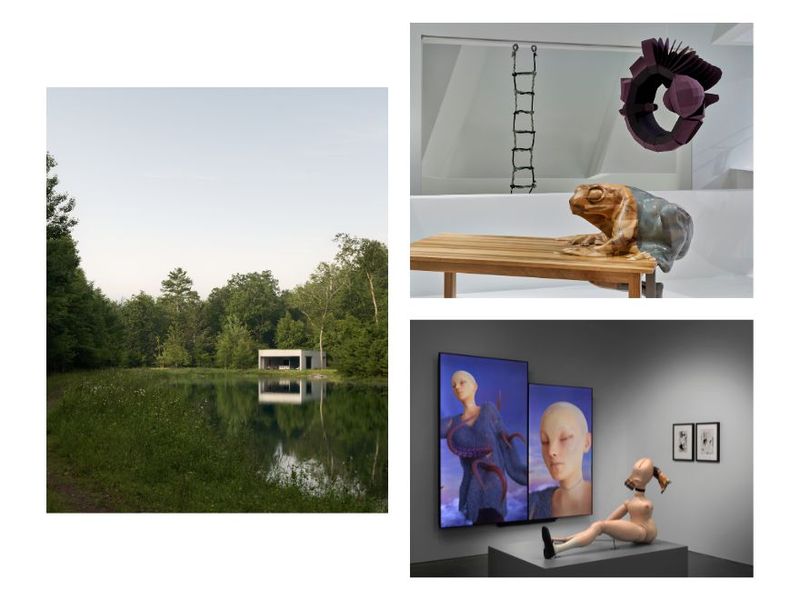
Vipp Pavilion
Perched on a pond at the edge of a verdant forest in Lumberland, New York, in the Catskills, Vipp Pavilion—the Danish design brand’s first guesthouse in the U.S., joining 14 others in places including Latvia, Mexico, and Norway—was conceived to be in perfect communion with its natural surroundings. “At first glance, the building resembles a stone on the pond,” says Sharon Johnston, of the L.A.-based firm Johnston Marklee, who with her life-and-work partner, Mark Lee, was commissioned to design the project. Opened earlier this month and available for stays, the 1,200-square-foot pavilion is composed of smooth and ribbed stucco that takes on a singular geometry of angles and ellipses that echo the contours of the pond. Described by Johnston as a “portal into nature,” the structure blurs the boundaries between inside and out. As guests pass through the courtyard and into the skylit interior, a panorama of the surrounding meadow opens before them. From a bird’s-eye view, the green roof blends in with the grounds below. Inside, autumnal browns and mossy greens complement a variety of Vipp pieces, including the anodized aluminum V3 kitchen. The space itself may ooh and awe, but so does its location; situated minutes from the Delaware River, outdoor possibilities abound, from hiking and rafting to fishing for the region’s native smallmouth bass and rainbow trout. —Emily Jiang
“Hella Jongerius: Whispering Things” at Vitra Design Museum
A stool made of felt, inflatable textiles, a woven “movie,” a miniature table embellished with a frog: Via these creations and others, designer Hella Jongerius has, throughout her 30-plus year career, continually questioned and reimagined the ways we make and interact with the objects that shape our daily lives. On view through Sept. 6 at the Vitra Design Museum in Weil am Rhein, Germany, “Hella Jongerius: Whispering Things” traces the designer’s evolution from her beginnings in the 1990s as part of the Dutch avant-garde outfit Droog, through her rise as a product and textile designer, to her more recent intimate ceramic works. Curated by Glenn Adamson (the guest on Ep. 50 of Time Sensitive), the exhibition unfolds through four chapters—“Dirty Hands,” “Business Class,” “Feeling Eye,” and “Cosmic Mind”—that together present more than 400 works, including furniture, textiles, ceramics, sketches, prototypes, films, and other projects developed in collaboration with the likes of Maharam, IKEA, and Nike. The result decodes Jongerius’s distinct design language defined by material diversity and rebellion, revealing how she has, through her highly experimental output, developed a sensitivity for the “whispering voices” of things—that is, the subtle cues through which design communicates its origins and possibilities. —E.J.
“New Humans: Memories of the Future” at the New Museum
The first exhibition to span the entirety of the new New Museum—now sporting its just-opened OMA-designed expansion—“New Humans: Memories of the Future” interrogates what it means to be human in the face of wholesale technological change. Through the work of more than 200 artists from more than 50 countries, including Camille Henrot (the guest on Ep. 140 of Time Sensitive), Toyin Ojih Odutola, and Anicka Yi, as well as 20th-century figures including Constantin Brâncuși and Salvador Dalí, the exhibition highlights moments that sparked new conceptions of humanity and its possible evolutions, from robots and cyborgs, to alien life forms, to virtual and even post-human worlds. A time machine of sorts, “New Humans” draws parallels between disparate ages: The 1920s, for instance, saw the first appearance of the term “robot,” the arrival of automated factory labor and mechanized warfare, and the eruption of new media, all phenomena that have reached a new extreme in our hyperefficient, misinformation-riddled digital age. Likewise, the deluge of A.I.-generated visuals flooding our social media feeds have their roots in the machine-aided computer drawings of the 1960s. At a time when technological advancements and their unanticipated consequences are unfolding at explosive rates, “New Humans” proposes art and science fiction as vital forms of collective reckoning and hypothesizing. —E.J.
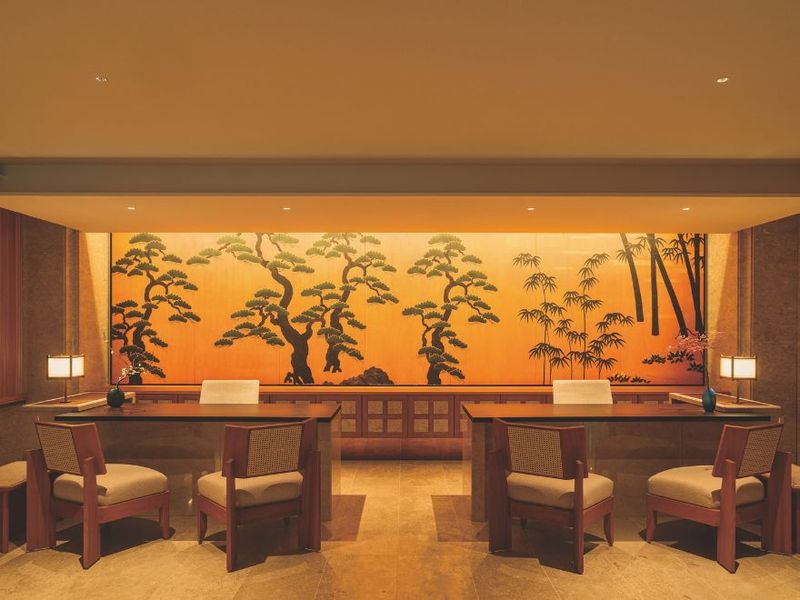
Kyoto’s Gion district, with its meticulously preserved machiya structures and ochaya, or teahouses, along narrow cobblestone lanes, has served as a center of geisha, or geiko, culture since Japan’s Edo Period (1603–1867). Originally financed by ohana-dai, or gratuities, given to geishas and maiko apprentices, Gion’s Yasaka Kaikan theater was built in 1936 with wing-tipped, copper-tiled roofs atop all seven floors. Registered on Japan’s Tangible Cultural Property list, the commanding 100-foot-high structure reopened earlier this month as the exquisite 55-room Imperial Hotel Kyoto, its interiors transformed by the Tokyo firm New Material Research Laboratory (NMRL). Founded in 2008 by the multihyphenate artist Hiroshi Sugimoto and architect Tomoyuki Sakakida, NMRL’s name reflects their appreciation for historical aesthetics and shared mission to liberate materials and techniques from the limitations of tradition.
For the Imperial Hotel Kyoto, their first hotel interior design project and the Imperial brand’s first opening in three decades, Sugimoto and Sakakida identified organic elements like Japanese marble and Ōya stone (also used in Frank Lloyd Wright’s 1923 building for the Imperial Hotel Tokyo) inside the original theater structure. They subtly worked these details into this new iteration, designed for short-term stays yet nonetheless intended to transcend time. Inside, the NMRL spaces incorporate the theater’s original stone pillars, window frames, and terra-cotta reliefs, as well as bring in a 16th-century stone wellhead and, in the entryway, a 1,000-year-old zelkova wood panel. Remarkably, if naturally, artworks by Sugimoto appear throughout, including a magnificent gold-emblazoned seven-screen fusuma-e (“painting for a sliding door”) with green pine trees and an ethereal “Seascape,” one of the artist’s signature sea-meets-sky black-and-white photographs, both in the lobby. There’s even a calligraphic work of Sugimoto’s in the subterranean spa.
The horizon is what first brought Sugimoto and Sakakida together, when Sugimoto and his Odawara Art Foundation set out to create the Enoura Observatory, which opened in 2017 overlooking Sagami Bay, south of Tokyo. Not a trained architect, the artist hired Sakakida, who designed the place from the inside out, using premodern methods for the glass-wrapped Reception Building and the 100-Meter Gallery with its cantilevered slab roof atop an expanse of glass that appears to float above the sea. Along with showcasing Sugimoto’s profound, meditative art, the modern-day pilgrimage site incorporates 15th-century gates, a teahouse, a Roman-style stone rotunda, and a glass platform for viewing the sunrise during the winter solstice.
Sugimoto, who is based between Tokyo and New York, has built overseas and throughout Japan since his first commission, in 2001, to revive the intimate Go’o Shrine on Naoshima Island. For those unable to make the multistage trek to that deceptively simple stone and wood homage to ancient Shinto worship with its underground chamber framing the Seto Inland Sea, there’s always the restaurant Sahsya Kanetanaka, hidden along Tokyo’s ultra stylish Omotesandō avenue. On a concrete floor inspired by the 10,000-year-old tataki technique of combining pounded soil, lime, and water, two elongated Hiba wood dining counters face a bamboo garden. A gelatin silver photograph from Sugimoto’s 2004 “Conceptual Forms” series presides over the minimalist enclave.
This summer, beyond the new Imperial Hotel Kyoto, there will be added reason for the Sugimoto-obsessed to head to Japan: Some 60 of his photographs, from the late 1970s to the present, will be on view in “Hiroshi Sugimoto: Extinction” at the National Museum of Modern Art, Tokyo, from June 16–Sept. 13. The exhibition marks his first large-scale solo photography presentation in Japan in 20 years. —Cynthia Rosenfeld
Our handpicked guide to culture across the internet.
The just-opened exhibition “Dave: All My Relations,” organized by artist Theaster Gates (the guest on Ep. 143 of Time Sensitive) and on view through May 2 at Gagosian’s Park Avenue outpost, honors the life and work of David Drake (1801–1874), an enslaved ceramicist from the Edgefield area of South Carolina, and traces his influence on Gates’s own practice. [The New York Times]
In preparing to photograph Jay-Z for the latest cover of GQ, artist Rashid Johnson (the guest on Ep. 25 of Time Sensitive) drew from representations of Black life documented by Harlem Renaissance photographer James Van Der Zee, as well as the surreal interiority of Francis Bacon. [GQ]
Kyle Chayka breaks down Silicon Valley’s new buzzword, taste, which, to tech bros, he argues, takes on a distinctly pragmatic, profit-driven definition, or, in simple terms, “the ability to discern what will make the most money.” [The New Yorker]
In the just-released film John Lilly and the Earth Coincidence Control Office, directors Michael Almereyda and Courtney Stephens and narrator Chloë Sevigny explore the life of visionary neuroscientist Dr. John C. Lilly, who tested the limits of consciousness through sensory deprivation tanks, communication with dolphins, and psychedelic experiments. [First Showing]
Calvin Tomkins, the lauded author and art critic who for nearly 70 years profiled giants of the art world for The New Yorker (including Johnson, in 2024) and was renowned for his insightful, witty prose, passed away last week at 100. [Artnews]