In this week’s newsletter, we go off-piste at Hotel La Perla in the Dolomites, catch “Peter Doig: House of Music” at the Serpentine in London, and more.
Good morning!
Among the most prolific and everywhere-all-at-once people I’ve ever met, the curator and Serpentine Galleries artistic director Hans Ulrich Obrist is, as you’ll hear on our latest episode of Time Sensitive, a reference machine. Throughout our kaleidoscopic 80-minute conversation—our year-end episode and Season 12 finale—he casually brings up, with much meaning and nuance, an encyclopedic list of names from across art, architecture, literature, music, poetry, and beyond—living and dead, famous and little-known—in this order: Shumon Basar, Markus Miessen, Frank Gehry, Bettina Korek, Maja Hoffman, Tom Eccles, Beatrix Ruf, Philippe Parreno, Liam Gillick, Tino Sehgal, Pierre Boulez, Etel Adnan, Friederike Mayröcker, Siah Armajani, Doris Lessing, Jonas Mekas, Giorgio Vasari, Ludwig Binswanger, Aby Warburg, Claude Sandoz, Robert Walser, Keith Haring, Harald Naegeli, Hans Krüsi, Peter Fischli, David Weiss, Édouard Glissant, Yona Friedman, Fernand Braudel, Jean de Loisy, Marie-Claude Beaud, Kasper König, Serge Daney, Rosemarie Trockel, Alighiero Boetti, Maria Lassnig, Arpita Singh, Kamala Ibrahim Ishaq, Faith Ringgold, Suzanne Pagé, Julia Peyton-Jones, Giuseppe Penone, Zaha Hadid, Kazuyo Sejima, Ryue Nishizawa, Oscar Niemeyer, Sou Fujimoto, Frida Escobedo, Lina Ghotmeh (the guest on Ep. 129 of Time Sensitive), Marina Tabassum, Smiljan Radic, Bjarke Ingels (Ep. 4), Peter Cook, Alexandra Daisy Ginsberg, KAWS, Dan Colen (Ep. 40), Otobong Nkanga, Yinka Shonibare, Adrián Villar Rojas, Peter Doig, Lizzi Bougatsos, Brian Eno, Theaster Gates (Ep. 143), Minsuk Cho, Danielle Brathwaite-Shirley, Umberto Eco, Koo Jeong A, Simone Fattal, Ryan Trecartin, Christian Boltanski, Bertrand Lavier, Bernard Stiegler, Federico García Lorca, Luis Barragán, Lina Bo Bardi, Lucius Burckhardt, Jacques Herzog, Pierre de Meuron, Bice Curiger, Cedric Price, Holly Herndon, Mat Dryhurst, Joan Littlewood, Richard Rogers, Renzo Piano, Marta Minujín, Alex Poots, Kunlé Adeyemi, William Forsythe, Laurene Powell Jobs, Abbye Churchill, Pontus Hultén, Daniel Buren, Sarkis Zabunyan, and Serge Fauchereau. For a deeper listen, I recommend following along with the episode’s timesensitive.fm transcript, which links to many of the names, exhibitions, books, and other things we talk about.
This may be the most reference-filled Time Sensitive episode we’ve ever done, and that’s as it should be: To be in conversation with Hans Ulrich—or “HUO,” as many friends and colleagues call him—is to enter a sort of HUOpedia, where he makes fascinating connections across the vast constellations in his life and mind. While it could be argued that Hans Ulrich is at the very center of the art world, in many ways he is his own centrifugal force within it, constantly spinning, flung in new directions, always open, searching, and trying to realize yet another unrealized project. The art world’s Energizer Bunny, Hans Ulrich marches to the beat of his own purposefully urgent drum, pushing boundaries in the process. His energy is omnipresent—and inviting. “When you’re with him,” Art Basel CEO Noah Horowitz told me recently, on Ep. 144, “you feel very important. He has this extraordinary ability to make the people around him feel like they’re the center of the world.”
To wrap 2025 and Season 12 with Hans Ulrich feels especially appropriate. We’re now about to enter our seventh year in this grand media experiment that is The Slowdown, and as we do, I’m reminded of exactly why we do this: to encourage greater reflection and awareness, to foster community, and to make meaning and create impact through carefully crafted, in-depth storytelling. The indefatigable Hans Ulrich embodies all of this through his multifarious work, whether at the Serpentine, with its annual Serpentine Pavilion, which has become a defining annual moment in culture globally and a springboard for many of today’s leading voices in architecture, or via his handwriting project; his ongoing “do it” series; his Brutally Early Club; his interview Marathons; his dozens of books, including, most recently, Life in Progress and Wish You Were Here; and the hundreds of exhibitions he has curated since organizing his very first, “The Kitchen Show,” in the kitchen of his apartment in St. Gallen, Switzerland, in 1991.
As we head into the holidays—and I wish you all a restful period of pause—may I suggest you take Hans Ulrich’s heed and go for a slow observational stroll each day, or perhaps, better yet, make it a daily ritual for 2026. Referencing the Swiss sociologist and economist Lucius Burckhardt’s notion of promenadologie—the science of a stroll—he says, “I firmly believe that we need more strollology.” I wholeheartedly agree.
—Spencer

“I believe in this idea that art and architecture can transform us, and can create these extraordinary experiences, which is why I get out of bed in the morning.”
Listen to Ep. 146 with Hans Ulrich Obrist at timesensitive.fm or wherever you get your podcasts
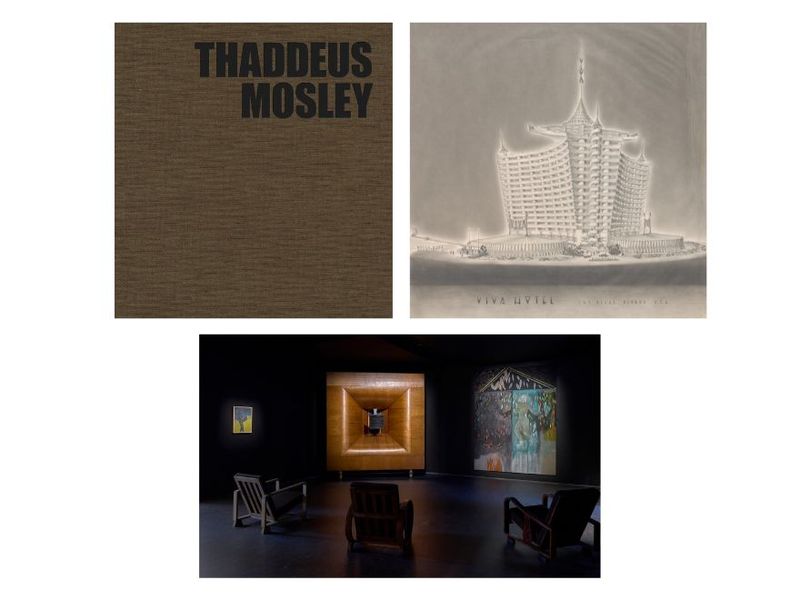
Thaddeus Mosley: Weight in Space
The 99-year-old Pittsburgh-based artist and sculptor Thaddeus Mosley (the guest on Ep. 111 of Time Sensitive) has a deep and enduring obsession with wood. Continuing in the abstract traditions of his sculptor forebears Constantin Brâncuși and Isamu Noguchi, as well as referencing modernist modes of jazz, Mosley’s “sculptural improvisations,” as he calls them, preserve the essence of their material while also taking on awe-inspiring, otherworldly, sometimes practically gravity-defying geometries. Out next month, Weight in Space (Karma Books) is the most comprehensive monograph on the artist’s oeuvre to date, chronicling the seven-plus decades since he began carving works in a basement studio, shaping salvaged timber into towering abstract forms. The volume brings together new scholarship by theorist and poet Fred Moten and curator Catharina Manchanda, a conversation between Mosley and Hans Ulrich Obrist (yes, he’s everywhere), and excerpts from an extensive oral-history interview conducted by writers Bridget R. Cooks and Amanda Tewes. A wide-spanning yet intimate portrait of the artist emerges that’s as timeless as his work. As he said on his Time Sensitive episode, “I’ve always strived to do something that’s not only interesting today, but will be interesting in a hundred tomorrows.”
“Bruce Goff: Material Worlds” at The Art Institute of Chicago
Known for his eccentric, avant-garde, veering on fantastical designs for homes in suburban and rural areas across the United States—particularly in the Midwest and the Great Plains—architect Bruce Goff’s (1904–1982) complex, contrarian vision was the subject of much controversy during his time. Expanding the definition of site-specific, organic architecture beyond the work of his mentor Frank Lloyd Wright, Goff’s houses wove together references and materials from their regional landscapes (such as coal and goose feathers) with midcentury design objects. On view through March 29 at the Art Institute of Chicago, “Bruce Goff: Material Worlds” is an ode to his bold, unapologetic practice, featuring more than 200 works, including detailed architectural drawings and models; his personal collections of seashells, crystals, popular magazines, clothing, and Japanese and Chinese embroidery; a selection of his lesser-known abstract paintings; and a customized player piano featuring his own experimental musical compositions. Exploring his unconventional body of work and eclectic influences in equal measure, the exhibition embodies one of Goff’s oft-quoted references, from a book of composer Claude Debussy’s musical criticism: “Discipline must be sought in freedom, and not within the formulas of an outworn philosophy.”
“Peter Doig: House of Music” at Serpentine South
The lively, communal spirit found across the island country of Trinidad—the birthplace of calypso—is channeled through both sight and sound in “Peter Doig: House of Music,” co-curated by Hans Ulrich Obrist and on view through Feb. 8 at London’s Serpentine South gallery. Its title gleaned from the song “Dat Soca Boat” by Trinidadian calypsonian musician Shadow, the exhibition pairs Doig’s recent paintings with audio emanating from two sets of rare, restored analog speakers to create an immersive, or even transportive, experience. Depicting musicians performing, people dancing, and spaces where music is played or heard, many of the works on view were created during Doig’s formative years living in Trinidad, from 2002 to 2021. Tracks hand-selected by the artist from his personal archive, meanwhile, waft into the space from a set of high-fidelity 1950s Klangfilm Euronor speakers and an original Western Electric/Bell Labs sound system, designed in the 1920s to usher in the era of “talking movies.” On Sundays, the space further comes alive through “Sound Service,” a series of live listening sessions inviting musicians and artists such as Brian Eno, Arthur Jafa, and Ed Ruscha to share their own affinities and collections—an enactment of the show’s core ideas around sound as memory and the value in communal listening.
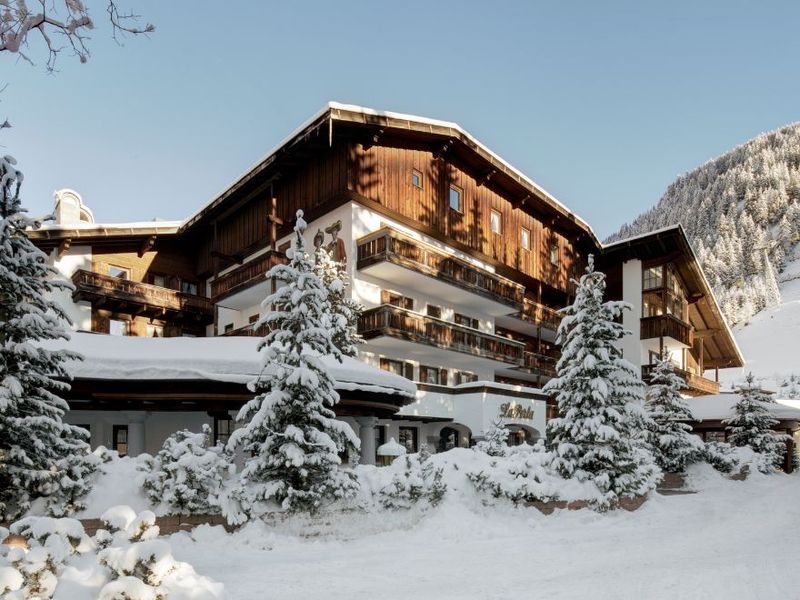
Nestled in northern Italy’s South Tyrol region, Hotel La Perla can be found near the old church and historic Ladin houses in the village of Corvara in Badia, surrounded by the towering Dolomite Mountains. Ernesto and Anni Costa originally built La Perla as their six-room, Tyrolean-style home in 1956. Today, the 51-room hotel’s cozy interiors brim with regional antiques. Two generations of the Costa family—who speak of their duty to preserve it—eagerly share Ladin culture, with its Swiss, Austrian, German, and Italian influences and distinctive traditions, including its language that resonates with echoes of Latin.
The chalet-style rooms are filled with wool rugs, decorative pottery, warm-toned fabrics, and wood furniture handmade by neighboring artisans. Each is individually finished with local Ladin artifacts such as hats, walking sticks, teapots, and locks; most feature awe-inspiring views of the nearby peaks. The Col Alto gondola, Italy’s first ski lift, built in 1946, still operates a mere 98 feet downhill from the main entrance of La Perla, allowing guests to ski straight out and onto some of Europe’s most scenic pistes. Also on the premises is Ciasa Vedla, the 16th-century wood-clad house where Ernesto Costa was born, now an enchanting museum exhibiting historic clothing, ski paraphernalia, kitchen utensils, and handmade Ladin games. Wine tastings, country-style dinners, and aperitifs with the Costa family are enjoyed here.
Summer welcomes chef-led foraging at La Perla, where the food skews local and organic. The Michelin-starred La Stüa de Michil, helmed by chef Simone Cantafio, inhabits two carefully restored 17th-century wood-paneled stubens, its Alpine-oriented dishes accompanied by wines from among the 35,000-plus dramatically displayed bottles inside the Mahatma Wine cellar, including Ladinian wines. Après-ski, guests head for L’Murin, the hotel’s rustic clapboard barn turned beer garden. —Cynthia Rosenfeld
This text was originally published in the book Culture: The Leading Hotels of the World (Monacelli), with editorial direction by The Slowdown.
Our handpicked guide to culture across the internet.
Mathaf: Arab Museum of Modern Art in Doha, Qatar, has announced a major campus expansion, led by architect Lina Ghotmeh (the guest on Ep. 129 of Time Sensitive), aimed to shift the museum’s identity to a place where—alongside the exhibitions on view—artists can work, test materials, and host workshops. [The Architect’s Newspaper]
Danish-Norwegian filmmaker Joachim Trier reflects on the making of his latest film, the 2025 Cannes Grand Prix winner Sentimental Value, an emotionally complex drama about filmmaking, familial legacy, and frayed father-daughter ties. [Financial Times]
What to Wear, a post-rock opera first staged by Richard Foreman in 2006, will return after two decades for a three-night run at BAM in mid-January, now with special guest St. Vincent and creative direction by Big Dance Theater’s Paul Lazar and Annie-B Parson (the guest on Ep. 78 of Time Sensitive). [Brooklyn Academy of Music]
Triple Canopy magazine’s new issue, “Not Nothing,” delves into the world’s seemingly empty spaces, apertures, orifices, and portals, recasting the void as a place of possibility. [Triple Canopy]
Our contributing editor Dalya Benor covers designer Kelly Wearstler’s inaugural exhibition, “Again, Differently”—exploring repetition, materiality, and memory—on view by private appointment at the historic pool house of her Beverly Hills home. [Pin-Up]