In this week’s newsletter, we pay a visit to craftsperson and editor Deborah Needleman’s ethereal Hudson Valley studio, tuck into Alison Roman’s cozy new cookbook, and more.
Good morning!
Spencer here. I’m back at it after moving homes in Brooklyn (and, by association, the Time Sensitive recording studio) the past couple of weeks, a whirlwind period that also included hosting an intimate dinner with Performa’s RoseLee Goldberg last week at the restaurant Manuela; co-chairing the Noguchi Museum’s annual benefit on Monday, at which the architect and furniture designer Mira Nakashima (the guest on Ep. 101 of Time Sensitive) and the artist Kan Yasuda received the 2025 Noguchi Award; and speaking with the editor-craftsperson extraordinaire Deborah Needleman for the first-ever “Moss Talk” at the just-opened members’ club Moss in Midtown Manhattan, a block north of Bryant Park, on Tuesday.
Building on our 2022 interview, for Ep. 66 of Time Sensitive, Deborah and I discussed the joys of making and her unexpected turn toward basketry in 2018, following a four-year run at the helm of T: The New York Times Style Magazine. Among other things, our conversation highlighted the importance of “tacit knowledge,” the intergenerational passing down of craft techniques, and the “material intelligence” (to use a Glenn Adamson term) we seem to have lost in our mass-production world—all of which she also gets into in the debut column of our “Studio Visit” series, below, written by New York– and L.A.-based creative Anabelle Cole. Based on a trip Anabelle made earlier this fall to Deborah’s Hudson Valley studio, this “Studio Visit” marks the beginning of a series in which Anabelle will journey to various artists’ and makers’ workshops and ateliers for a firsthand look at where and how they bring their creations to life.
It’s fitting that, by total happenstance, the “Moss Talk” and Anabelle’s “Studio Visit” with Deborah are landing on the same week as we also put out Ep. 143 of Time Sensitive with the artist-urbanist-potter-performer Theaster Gates. Craft is central to Gates’s work, too. I suppose you could call it “Craft Week” here at The Slowdown, but then again, it’s pretty much always “Craft Week” here. (It’s worth saying, though, that craft’s reputation would benefit greatly from avoiding any mention of a “Craft Week” altogether!) Craft is, always has been, and always will be a quiet, steady underlayer of The Slowdown, from this newsletter, to our editorial studio work for the likes of The Leading Hotels of the World and Molteni & C, to Time Sensitive.
For me, Theaster’s Time Sensitive episode represents a pure and simple embodiment of The Slowdown, which is to say it’s a slow-building, contemplative dialogue about bridging cultures and fostering community. And who better than Theaster to discuss these things with? In my mind, everything he does, from painting and urban development to arts administration and performance, is rooted in his rigorous training as a potter in Japan and is its own form of throwing, molding, shaping, glazing, and firing clay. He is an artist whose collective body of work can be viewed in its entirety as a singular form of “social sculpture.”
The other week I joked that Time Sensitive could be viewed as a “potcast,” in the sense that, for me, creating each episode is not unlike a potter shaping a ceramic vessel. Perhaps it’s even more accurate to liken Time Sensitive to a kind of Beuysian social sculpture, a platform for highlighting the great potential of art and culture to transform society.
—Spencer

“I feel like I’m always wanting to make a space where people just feel safe enough to not have to do very much, and that, in not doing much, they can then get to the business of the soul and the spirit.”
Listen to Ep. 143 with Theaster Gates at timesensitive.fm or wherever you get your podcasts

“Oh, You’ve Got to Come Back to the City” at Gray Chicago
In so many ways, the life of artist, urban planner, and pedagogue Theaster Gates has been one dedicated to the city of Chicago. From rehabilitating abandoned, dormant buildings on the city’s South Side into dynamic art and community spaces; to resuscitating important archives, such as those of the magazines Ebony and Jet; to teaching at the University of Chicago, Gates (the guest on our latest episode of Time Sensitive) breathes new life into all of the spaces, places, and materials he engages. His current Gray Chicago exhibition, “Oh, You’ve Got to Come Back to the City,” on view through Dec. 20, delves further into his deep, lifelong relationship with his home city. Taking its name from Chicagoan Marvin Tate’s song “City Promenade”—in which the city beckons its residents to come back from the suburbs to “the place where you belong,” “the place where you were born,” “the city of dreams”—the show brings together a new series of tar paintings and ceramic sculptures that evoke urban blight and the potential that lies within that decay. For the central installation, an assortment of marble, granite, and concrete forms from Gates’s stone repository act as plinths for ceramic works and everyday artifacts that recall ephemera left behind by former inhabitants. Developed in conjunction with his exhibition “Unto Thee,” on view through Feb. 22, 2026, at the University of Chicago’s Smart Museum of Art, “Oh, You’ve Got to Come Back to the City” challenges any cliché or typical narrative around aging infrastructure while also shining lights on the city’s signs of excess and disrepair.
Something From Nothing by Alison Roman
Making a delicious meal doesn’t always have to entail a trip to the farmer’s market; pricey, one-time-use ingredients; or washing pots and pans into the wee hours of the night. Food writer and cook Alison Roman (the guest on Ep. 139 of Time Sensitive) gets this point across effectively in her just-published cookbook, Something From Nothing (Clarkson Potter). Inside are more than 100 recipes—including Roman’s viral shallot pasta recipe and signature accoutrement such as her “Aioli for Everything” and “Very Good Tomato Sauce”—whose components can be sourced from most home cooks’ pantries, fridges, and freezers. Through these deceptively simple recipes, shelf staples like a bag of beans, a box of dates, a tin of anchovies, or a jar of olives are transformed into herby salads, saucy pastas, and aromatic soups and stews. Accompanied by Roman’s usual reflective, relatable commentary, the book makes each dish feel approachable and unfussy. Don’t have a certain ingredient on hand or need to sub something in? “No problem,” the book seems to say, nudging you to eschew rigidity, use your intuition, and flip the script from “making do” to “making the most.” Indeed, when asked what the phrase “something from nothing” meant to her, Roman said on Time Sensitive, “It means that you are doing a lot with very little, which is just really me rephrasing ‘something from nothing.’ But I think it really is… what I love about cooking: turning a thing or an ingredient into something more than what it started as.”
“Material Curiosity by Design: Evelyn & Jerome Ackerman” at Craft Contemporary
With their mutual designer-craftsperson backgrounds; bold, avant-garde uses of pattern, color, line, and proportion; and prolific, five-decade-long output across various media, including ceramics, mosaics, textiles, woodcarvings, and metal, the design duo Evelyn and Jerome Ackerman played a key role in shaping the aesthetic of what today is known as California modernism. “Material Curiosity by Design: Evelyn & Jerome Ackerman,” on view through May 10, 2026, at Craft Contemporary in Los Angeles, puts the Ackermans’ vibrant creations in conversation with modern-day works by three California-based artists whose practices each revolve around a single material—textile artist Porfirio Gutiérrez, ceramicist and designer Jolie Ngo, and wood sculptor Vince Skelly—demonstrating the evolution of California design over the past 75 years. Curated by Danielle Charlap and designed by Gary Wexler, the exhibition showcases final products as well as preparatory materials, offering a new window into the Ackermans’ material savvy and techniques across mediums. Drawing a throughline between the historical and the contemporary, “Material Curiosity by Design” testifies to the continued value of intimate material relationships in design practices and to the Bauhaus conviction that fine art and functional design hold equal importance.
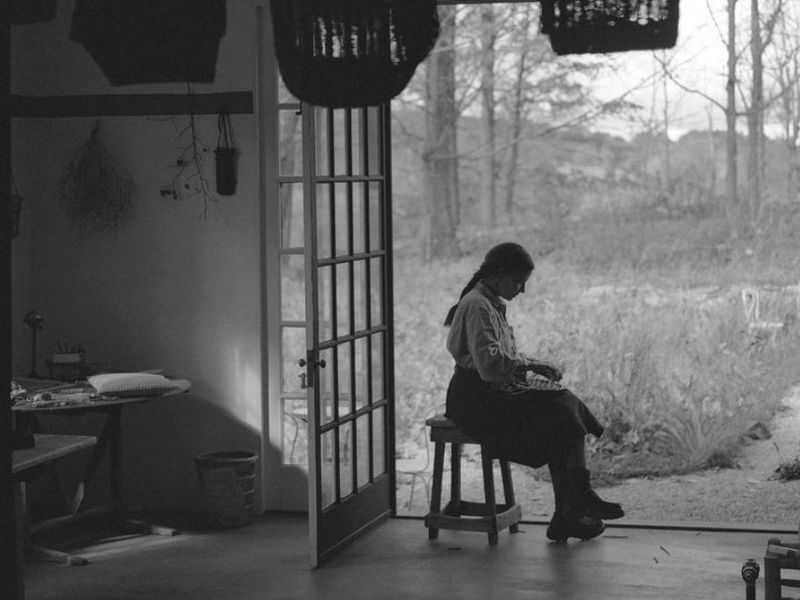
A chair, a bowl, and a basket—all are objects at the intersection of form and function, and that embody the mind and rhythm of the maker. For some, craft is an act of utility; for others, it is an aesthetic pursuit, a devotion to form and detail. For Deborah Needleman, it has become something even more expansive: a way of life that ties together making, seeing, and simply being in the world.
Almost as soon as I stepped into her Hudson Valley studio, its floors still damp from Needleman having left the water running in her willow-soaking tub the day before while she got caught up in another activity, my senses also flooded. Clean, earthy smells rose from bundles of willow and rush leaning in loose bundles against every corner. Baskets at various stages of becoming, some just beginnings and others fully finished, hung from steel nails driven into exposed wooden beams. Evidence of her travels surfaced everywhere: baskets from Japan, Wales, and North Africa; textiles sourced from markets abroad; dried plants, each carrying a story from another place.
For her, craft isn’t only about what you make, but about how you live while making it. Where many makers focus on the object as the end goal, Needleman sees craft as a philosophy of attention, a way to stay connected to time, to materials, and to one’s daily pace. “It’s about the way I wanted to live my life, and the making is just one part of that,” she says.
This way of life couldn’t be more different from the high-flying one she left behind. Before weaving, Needleman spent decades in media and publishing, first as founding editor of the home magazine Domino; then as creator of The Wall Street Journal’s “Off Duty” section and editor of WSJ. Magazine; and from 2012 to 2016 as editor-in-chief of T: The New York Times Style Magazine. Her career was assuredly rooted in beauty and aesthetics, but oftentimes in ways, she found, that pulled her out of living more fully in the present. “Fashion seasons are always six months ahead, magazines are always three months ahead, you’re always thinking about a different time,” she says. That rhythm, while exhilarating, left little room for the kind of slow noticing that she yearned and that craft requires.
These days, in her studio, time moves differently. It’s shaped by the work itself, framed around attention to material and environment. Sounds during her process, such as willow being clipped or bent into shape, or the creaks of one of many of her antique rustic chairs, continually draw her back into the here and now. There’s no pressure for novelty, no race toward the next thing. “There is so much that happens in the tiny spaces between actions that are repetitive,” she says. “You come to understand the material and the environment more and more,” learning that every day, every season, brings a new set of conditions.
This sensitivity to time has become central to her way of life. Needleman recalls studying with a rush-weaver in Wales, who once told her, “Every day at four o’clock, the rush is perfect—it feels like silk ribbons.” The remark—capturing a whole way of being, one in which time is not measured by productivity, but by presence—has practically become a touchstone for her practice. To be a craftsperson is to pay attention, to notice the exact moment when a material is prime, when light shifts, when air grows damp enough for the conditions to be ideal. “You have to have a relationship with the materials,” she says. “I rely on my materials.”
There’s a gentleness in the way Needleman talks about her work, not as something she does, but as a lifestyle she has come to learn. The weaving process has even changed how she relates to her own body. “I used to hate my hands,” she says, laughing. “Now that I rely on them so much and see what they’re capable of, there’s an elegance to the movements in my hands. I’ve come to respect them more.”
That newfound respect reflects a deeper shift: an understanding that craft is as much about the maker’s body as it is about the finished form. Each gesture matters. The repeated motions of weaving—soaking, bending, tightening, shaping—demand both concentration and repetition, while allowing the maker to enter into a sort of flow state. “There’s a focus you enter into through repetition,” she says. “It allows you to be in conversation with the material.” The rhythm becomes almost meditative, the body moving in quiet dialogue with what it touches.
While Needleman’s publishing past was framed around work that keeps one “just in the head,” craft requires an embodied relationship with materials and nature and process. “We think of intelligence as in our brain, but it’s also in our body,” which she has grown to learn through her craft. As she demonstrates the first steps of a new base—crossing, aligning, tightening the join—she works surrounded by objects that hold their own lived histories: Japanese harvest baskets, Moroccan date baskets, a French market basket smoothed by decades of use. They all seem to affirm the slow material intelligence she describes. And while Needleman certainly makes beautiful things, she doesn’t talk about them as art. What excites her is not the finished basket, but the life that forms around its making; the freedom to work at her own pace, to align her days with weather and the seasons, to feel time as something abundant rather than scarce. —Anabelle Cole
Our handpicked guide to culture across the internet.
John Hoke (the guest on Ep. 61 of Time Sensitive) announced last week that he has retired from his position as Nike’s chief design officer “happily, humbly, gratefully” after 33 years at the company. [LinkedIn]
In his latest Substack post, actor, director, and writer Ryan Piers Williams shares his guide to slowing down in order to enter a state of deep, focused attention—the type needed for any kind of creative practice. [Wildly]
Ahead of Brazil hosting the COP30 climate summit, climate scientist Carlos Nobre explains why—due to continued deforestation and rising global temperatures—the “tipping point” for the Amazon rainforest is now much closer than originally expected. [Financial Times]
In the newly released book Immortal: Portraits of Aging (Phaidon), photographs by Richard Avedon of cultural figures including Marcel Duchamp, Duke Ellington, Toni Morrison, and Patti Smith evoke the inevitable and universal process of growing older. [Phaidon]
At this year’s Design Miami fair, from Dec. 2–7, Gagosian and the Italian design company Malaparte will present “Casa Malaparte: Furniture,” a specially curated series of furniture pieces designed by writer and filmmaker Curzio Malaparte (1898–1957) for his cult-famous 1938 house dramatically perched atop a Capri cliff. [Gagosian]