In this week’s newsletter, we appreciate the foundational role of architecture in our daily lives with Michael P. Murphy, visit an illuminating Daniel Brush exhibition in Paris, and more.
Good morning!
Emily here. Last weekend, I attended a wedding at the Brooklyn Botanic Garden. Following the dinner and dancing and a host of farewells, my partner, Paul, and I found ourselves among the last people to leave. With the closing number by the live band still reverberating in our ears, we moved through the whooshes and clangs of the waitstaff clearing the tables and emerged into the warm, still night. A low-lit path to our right gestured toward the exit and the ensuing afterparty at a nearby bar, but something about the total darkness that stretched out before us seemed like a more promising invitation.
Instinctively, we took off together, with minds to plead ignorance if we were caught. Sans light, the grounds I know well were rendered strange. After some aimless roving, circumambulating, and retracing that, from an aerial view, perhaps resembled a Lucinda Childs dance, we landed on a low stone wall looking up at the clouds against the indigo sky. It was one of those rare moments in which time both contracts and dilates, in which you feel here and not here, intensely alive and yet also outside of your life, beholding it from a distance.
It’s the kind of moment that this week’s Time Sensitive guest, the writer Maria Popova, founder of the website and newsletter The Marginalian, might say taps in to the “mystery of being alive,” that merges poetry and science—or as she puts it, “verse” and “universe.” “To live wonder-smitten with reality is the gladdest way to live,” she has written, and I couldn’t agree more.
Olivia’s conversation with the architect Michael P. Murphy—the subject of our latest “Interview With,” below—also explores this idea of deep looking. As she writes, his new book, Our World in Ten Buildings, illuminates the “countless seemingly small decisions” that go into the built environments that shape and create meaning in our everyday lives. After reading it, you’ll see the contours of any space you enter—even those most familiar ones you have mapped in your mind—in an entirely new light.
The older I get, the more I allow my days and weeks to unfold of their own accord rather than try to adhere to any kind of rigidity. The more I do so, the more I notice—most recently, the arresting unkempt plot of roses, foxgloves, and geraniums on the corner of Washington and Willoughby in Brooklyn—and the more gratitude and wonder pours out of me.
May we all remind ourselves more often of the mystery of being alive.
—Emily

“All the greatest, most enduring, most eternal works of art have to do with the limits of our humanity, the limits of consciousness, the limits we keep colliding against just by the nature of our creaturely endowment.”
Listen to Ep. 154 with Maria Popova at timesensitive.fm or wherever you get your podcasts
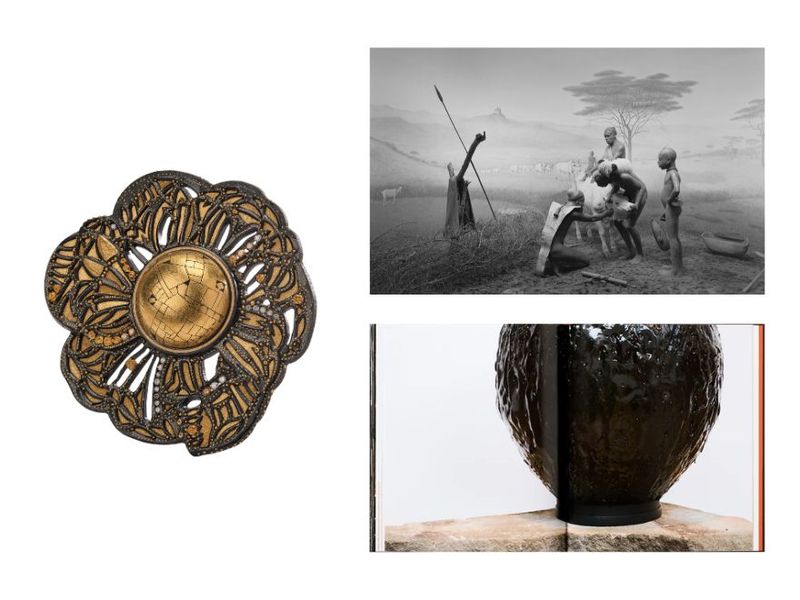
“Daniel Brush: The Art of Line and Light” at L’ÉCOLE, School of Jewelry Arts, Paris
“However small a jewel or a gem is, it can have enormous presence.” The extraordinary artist, metalworker, and jewelry-maker Daniel Brush (the guest on Ep. 23 of Time Sensitive, recorded in 2019) taught this pearl of wisdom to jewelry historian and author Vivienne Becker, and it now reverberates through the just-opened exhibition “Daniel Brush: The Art of Line and Light,” on view through Oct. 4 at L’ÉCOLE, School of Jewelry Arts in Paris. Co-curated by Becker, a devoted friend of the late artist for more than three decades, and Olivia Brush, his wife and vital longtime collaborator, it illuminates his deep fascination with light as a channel to the divine, made visible through his “visual poems,” in the form of exquisite jewel sculptures, talismanic objects, and meditative paintings. “Line,” Becker says, “was the way of coaxing light out in order to communicate what we both believe: that the jewel is a spiritually imbued object.” This nonchronological array of 75-plus pieces—several shown outside his New York studio for the first time—embody Brush’s boundaryless approach to working with materials, whether pure gold, stainless steel, diamonds, or ink. “He wanted his spirit to come through,” Becker says of Brush, who passed away in 2022 at age 75. “He said, time and time again, ‘I just want people to know that I was there, there was a human, the hands were there.’” —Olivia Aylmer
“Hiroshi Sugimoto: Extinction” at The National Museum of Modern Art, Tokyo
With the proliferation of deepfakes and other forms of generative A.I., images can no longer be trusted at face value. In the eyes of photographer, artist, and architect Hiroshi Sugimoto (Ep. 114), this unsettling reality marks an “extinction” of sorts: an end to photography’s “ability to serve as proof or evidence.” The creation of gelatin silver prints is also on the decline, and Sugimoto, at 78, is approaching his own time horizon (or, as he has put it, “about to leave this world”). These various intersecting truths are commemorated in “Extinction,” a retrospective at the Museum of Modern Art, Tokyo, on view from June 16 through Sept. 13. Unfolding across three loosely chronological chapters, the exhibition draws on 13 of Sugimoto’s series from the late 1970s to present, including “Stylized Sculpture,” on display for the first time. Among the approximately 60 gelatin silver photographs are several new additions to his renowned “Dioramas” and “Seascapes” series, including “Pokot” (2025), which depicts a display of the eponymous East African tribe at the American Museum of Natural History. In his artist’s statement, Sugimoto notes that instead of shashin (“copy of reality”), the Japanese word for photography, he finds “batsureiga” (“spirit-extracting image”) more fitting. This exhibition makes his reasoning self-evident. —Emily Jiang
Theaster Gates: A Clay Sermon
For Chicago-based artist Theaster Gates, clay is much more than just the medium he uses to form his pots, vessels, and sculptures; it also serves as a lifelong teacher, a gateway to felt knowledge, a religio-spiritual symbol, and the seedbed of his many creative endeavors, be it painting, urban development, or archival research. “As a potter, you learn how to shape the world,” Gates (Ep. 143) says. His 2021 exhibition at London’s Whitechapel Gallery, aptly titled “A Clay Sermon,” explored the earthen material’s legacy, including its relationship to labor and racial identity; its place within colonialism and global trade; and its function in ceremonial contexts. A new book, out next month, memorializes the show, surveying Gates’s handcrafted clay-based works across 20 years, from his early pots to his large-scale “Afro-Mingei” sculptures. Co-edited by curators Cameron Foote and Lydia Yee, the book features a new poem by Nigerian-British poet and novelist Ben Okri and an interview with the artist by master potter Edmund de Waal (Ep. 98). Tracing Gates’s intimate personal and artistic journey with clay, this soulful compendium is itself an exquisite vessel. —E.J.
After reading Our World in Ten Buildings (Atria/One Signal Publishers), an invigorating new book by architect Michael P. Murphy (Ep. 57), entering a school, hospital, or office will take on visceral layers of meaning. You may start to notice, as Murphy does, exactly how it feels to cross a threshold and step into a heightened sensory atmosphere consisting of countless seemingly small decisions, whether the height of the ceiling, the angle of light, or the presence of windows. The everyday built environment, in his view, plays a pivotal role in facilitating our personal sense of belonging or lack thereof. Above all, Murphy—who founded the design and development studio AMMA in 2024, and who previously served as founding principal of the nonprofit MASS Design Group—wants the public to reclaim our agency, connection, and active curiosity toward the elemental spaces that fundamentally shape our lives.
Here, he discusses the essential role of dignity in his work, why we must challenge the architect as “singular auteur” myth, and how his late father’s home restoration project showed him that repair in our fractured world is possible.
This book feels like a carefully constructed building unto itself. How did you land on its structure?
I kept thinking about not just the exceptional architecture in the world, but the ordinary. Even the concept that everyday buildings are themselves architecture is, to some degree, a big jump for the public. I think we’ve felt as a public that we don’t have access to architecture, because [of the idea that] it’s for wealthy people; it’s for elite institutions. One of the underlying premises of this book—and I would hope my work in general—is that, no, it’s the everyday spaces around us that actually have a transformative effect on our lives. We need to see their impacts for us to understand how we inhabit, design, and shape the architecture around us.
There are archetypes in our minds and in our world of buildings that we have inhabited and always will inhabit. It’s not infinite. There are certainly more than ten, but there aren’t a thousand. I thought these ten were at least a beginning to say, this typology—the hospital, the school, the memorial—if you understand just a little bit of how they’re thought about from the position or perspective of a practicing design professional, we might be able to ask those questions every day. When I go into the workplace, I might be able to say, “Hey, I actually see some of these ideas in my workplace I didn’t see before, and some of these are working really well, better than I thought. Some of them are not working at all. Could we change them? Could we have some agency over them?”
You write so movingly about the idea of dignity and what it means to build spaces that make people feel like they belong, and that their basic needs have been accounted for. How did you come to understand its central role in your work?
Dignity is really the feeling of belonging. It’s more than belonging, but it is the feeling of belonging—that this space is considered for me. I see myself in it. I feel welcomed, at ease, and comfortable. I feel like it is mine. I feel like it is ours.
There’s discussion in the book about the legislative role of dignity, that dignity is a right in German common law and that changed buildings after the war, it changed the role of prisons. There’s the human connection to dignity, like in “The Memorial” chapter, about whether spaces are designed for certain groups and not for others. Public spaces can create belonging and fellowship, and they can create segregation and isolation. It was the built environment that was used to segregate people and divide people and put up fences. The work of the built world is always responding to who belongs: who’s welcomed in, who’s allowed in, and how does that group that’s in feel within that space?
When you’re embarking on a new project and trying to understand the needs of the people who will inhabit a space, how do you account for questions you don’t yet know to ask?
First and foremost, let’s just assume the architect will never know every answer. Often, the idea of the architect as the sole visionary is just a false premise. We have been sold that kind of narrative, that there’s this “singular auteur.” If you think of it from the other side—that people in community are already solving those problems, already trying to address them every day—then the role of the architect changes to being a broker and listener and agent to open up dialogue and visibility on the everyday solutions that are already happening.
Bryan Stevenson calls this “proximity.” I started calling it “immersion.” Paul Farmer, the doctor I worked with, called it “accompaniment.” It is getting deep into place and into people’s everyday life that finds the necessary solutions and questions you didn’t know you had to ask.
One starting point of your path into architecture was witnessing your dad, who’s at the heart of this book, find a deep sense of renewed energy and purpose while restoring your childhood home, following his terminal cancer diagnosis. What about this experience do you think transformed him and provided healing power during such a destabilizing time?
The simple answer is, I don’t know. But I would say the reason I wrote the book is to ask that question, and to try to answer it as best I can. If working on this building healed him, then I really want to know how, not just from the perspective of my father saying it on a whim, but actually from a kind of neurochemical, physiological, scientific perspective; from a community, neighborhood, and urban perspective; from a metaphysical, psychological, mental perspective, on all of those scales. The building’s transformation from a beat-up, porchless, half-finished, historic relic in a crumbling, downtown district of an old, once-thriving mill town to a renovated home, vibrant, repainted, finished, and used again. That sense of repair—it’s everywhere in our world. It repaired me, in a way. It repaired him. I hope one of the stories here is that repair is possible in our world.
That diagnosis forced me from a post-graduation ennui to move home and start working with him on the house, just to keep myself busy, not thinking it would have deeper meaning than that. In that process, I found meaning, purpose, a career, a question I couldn’t answer but wanted to know more about. It changed the course of my life, gave me fuel to survive, and to overcome the grief of the eventual loss of my father. This book is very much about overcoming grief through purposeful work.
This interview was conducted by Olivia Aylmer. It has been condensed and edited.
Our handpicked guide to culture across the internet.
Debbie Millman (the guest on Ep. 51 of Time Sensitive) goes in depth with our very own Spencer Bailey on the latest episode of her celebrated Design Matters podcast, talking with him about everything from storytelling as a way of making sense of loss and identity to the value of slowness in a culture of acceleration. [Apple Podcasts]
On June 29, Anew, the just-opened Rockwell Group–designed “social impact action lab” and coffee shop headquartered in New York’s West Village, will host a panel discussion with designers, entrepreneurs, and philanthropists, moderated by Millman, on how intentionally designed spaces foster connection and social change. [Luma]
Ian Schrager (Ep. 100)—soon to open a new Public hotel in Los Angeles designed by John Pawson (Ep. 130)—reflects on four decades as a zeitgeist-harnessing hospitality impresario. [Interview]
In his review of the monolithic Obama Presidential Center on Chicago’s South Side, Michael Kimmelman (Ep. 14) appreciates the “detail and texture” brought by architects Billie Tsien (Ep. 45) and Tod Williams, though he critiques the museum tower’s uninviting, jolting presence, calling it “the tallest monument yet to presidential self-glorification.” [The New York Times]
Documentarian Sara Dosa discusses her elegiac new film, Time and Water, made with Icelandic writer and activist Andri Snær Magnason (Ep. 10), which draws on mythology, archival footage, and intergenerational memory, and serves as an exploration of his country’s disappearing glaciers. [IndieWire]