In this week’s newsletter, we immerse ourselves in “slow scent” with natural perfumer Mandy Aftel, honor Japanese artist Kan Yasuda’s sublime sculptures, and more.
Good morning!
Olivia here. This past Sunday, I settled in at A24’s recently reopened Cherry Lane Theatre for a Sofia Coppola–hosted screening of Hearts of Darkness: A Filmmaker's Apocalypse, her late mother Eleanor Coppola’s newly restored 1991 documentary that chronicles the tumultuous making of Francis Ford Coppola’s 1979 epic Apocalypse Now, shot in the Philippines when Sofia was 4. Following the screening, Sofia described her mom as a keen observer and center of unwavering calm amid the swirling on-set chaos, qualities that live on in her own grounded approach as a filmmaker. During a frustrating day behind the scenes of her 1999 debut feature, The Virgin Suicides, Sofia recalled her mom keeping the camera rolling in order to capture a fuller portrait of her daughter as an artist at work—insecurities, uncertainties, and all. Any annoyance Sofia felt in the moment has since dissolved into gratitude and respect for the ways her mom, a visionary artist in her own right, recognized the importance of documenting not only her shining moments, but the flawed, imperfect ones, too.
There’s an inherent vulnerability to letting oneself be witnessed in the act of making. Yet creative partnerships forged over time cannot exist—let alone thrive—without it. This week, we honored that vital interdependence in more ways than one. On Monday night, alongside RoseLee Goldberg, founding director and chief curator of the nonprofit Performa, Spencer hosted friends of The Slowdown, including several former Time Sensitive guests (artists Camille Henrot and Adam Pendleton; yoga teacher Eddie Stern; and editor, publisher, and curator Kim Hastreiter) for an intimate dinner at the restaurant Manuela in celebration of the 2025 Performa Biennial—on now through Nov. 23—as well as the 12th season of Time Sensitive. That same night, I convened with fellow podcast makers at Public Records in Brooklyn for the Signal Awards party, which recognizes culture-defining audio projects. I’m delighted to share that this year Time Sensitive received awards in five categories, including Craft: Best Host (Culture), Individual Episode: Arts & Culture (for Ep. 132 with chef Thomas Keller), and Interview or Talk Show, alongside the likes of Anderson Cooper, Hoda Kotb, and Dax Shepard.
Speaking of our podcast, on Wednesday, we released Ep. 142, with British designer Jay Osgerby. As his London-based industrial design studio, Barber Osgerby, approaches 30 years in business, Jay and his partner in the firm, Edward Barber, know all too well what it means to stay the course of a long-term creative partnership and reach a gratifying, full-circle moment.
Meanwhile, while speaking with the Berkeley-based natural perfumer Mandy Aftel for this week’s scent-centric “Interview With,” Foster Curry, her ever-supportive husband and business partner, chimed in toward the end of our conversation. “I’ve been eavesdropping from the other room,” he said. “I’ve heard Mandy teach her class literally a hundred times and she’s always enjoying it, learning more and more. I love listening to her talk… It’s giving me chills to hear what you’re talking about.”
Whether in love or at work, there’s beauty in being—as Lou Reed wrote and Nico sang—someone’s mirror: reflecting what they are, in case they don’t know.
—Olivia
“When an object carries memory, and that’s part of its soul, then you’ve really got something special, something really wonderful, which somebody will fall in love with and want to keep for a very long time.”
Listen to Ep. 142 with Jay Osgerby at timesensitive.fm or wherever you get your podcasts
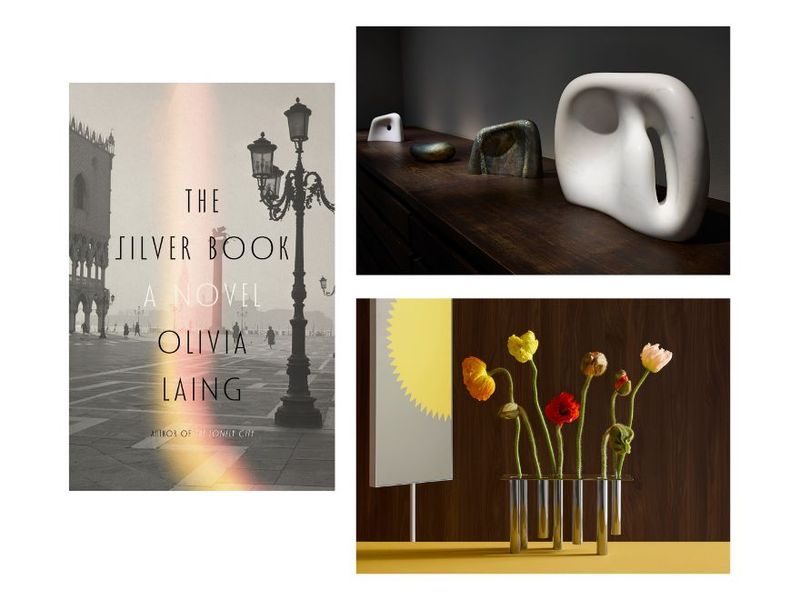
The Silver Book by Olivia Laing
Like a Russian matryoshka doll, British writer Olivia Laing (the guest on Ep. 138 of our Time Sensitive podcast) has a gift for nesting several layers of historical context, cultural references, and crystal-clear insights into the human condition in their work. The Silver Book (Farrar, Straus & Giroux), their hallucinatory new novel, is no exception. Out this week, it’s set in mid-1970s Italy, amid a period of social and political unrest (a.k.a. the “Years of Lead”), flare-ups of fascism, and legendary filmmaking by Federico Fellini and Pier Paolo Pasolini. In Venice, a queer love story unfolds between Academy Award–winning costume designer Danilo Donati (who received his first significant design credit on the 1962 Pasolini film La Ricotta) and Nicholas, a young English protégé, rising to a pitch with Pasolini’s brutal, still- unsolved Nov. 1975 murder. Laing’s body of work perpetually returns to art-making as a form of resistance to fascism. On Time Sensitive, recalling their time in Rome, where the novel materialized, Laing described their “uncanny” experience of writing it with uncharacteristic speed and intensity, unlike their typically slower, brick-by-brick, archive-based approach. “It’s this very turbulent period,” they said, “but it’s about people who are making something”—an eerily prescient parallel between ’70s Italy as portrayed in their novel and our world today.
“Kan Yasuda: Forms of the Unconscious” at Ippodo Gallery
Shaped by the hands of Japanese sculptor Kan Yasuda, Italian marble takes on an unfamiliar character—at once robust yet supple, still yet alive. “Kan Yasuda: Forms of the Unconscious,” on view through Jan. 17, 2026, at New York City’s Ippodo Gallery, brings together 16 new and known sculptures for the artist’s first solo exhibition in the U.S. in more than a decade. Based between Hokkaido, Japan, and Pietrasanta, Italy, since 1970, Yasuda carves, contours, and polishes stone in a conversation-like process with his materials, looking, feeling, and listening to summon their latent energy. The result is, without exception, profoundly poetic, tactile, and pure. To see his sculptures—more than 40 of which are on view at Arte Piazza Bibai, a sculpture park in Yasuda’s hometown of Bibai, Japan—is to experience a state of disbelief, or perhaps even to enter a dreamlike state. Indeed, Yasuda feels that “[his] job is to give… a visible form, a form that can be touched… to things that cannot be seen or touched.” The artist Isamu Noguchi, whom Yasuda assisted in realizing his seminal work “Slide Mantra” for the 1986 Venice Biennale, once said that a sculpture of Yasuda’s “transcend[ed] art.” In celebration of Yasuda’s receipt of the 2025 Isamu Noguchi Award next Monday, Nov. 17 (our editor-in-chief, Spencer Bailey, is a co-chair of the gala), the gallery will host a talk the following night with Yasuda and stonemason Giorgio Angeli, a longtime collaborator of his and Noguchi’s.
Molteni&C Gio Ponti Objects Collection
To step into any of the Milanese residences of the Italian architect and designer Gio Ponti is to inhabit—if only for a moment—his mind’s eye, in which each room is its own world, and every piece plays a part in its conception. This fall, the Italian design company Molteni&C, in collaboration with the Gio Ponti Archive, is reissuing a selection of eight objects designed by Ponti, which together serve as a microcosm of his singular, whimsical vision. (Read more about the collaboration, which began in 2012, in the 2024 book Molteni Mondo: An Italian Design Story, edited by our editor-in-chief, Spencer Bailey, with creative director Beda Achermann.) Developed under the artistic direction of Studio Cerri & Associati, the Gio Ponti Objects collection highlights three materials—stainless steel, wood, and ceramics—in homage to the architect’s close relationships with silversmith Lino Sabbatini, structural engineer Pier Luigi Nervi, and the ceramic workshop Buccheri Antonio Rossi. Two origami-like sculptures, “Cavallo” (the horse) and “Colombo” (the dove), interpret their respective eponymous animals with simple folded sheets of steel. The three wood “bottles” that comprise “Bottiglie,” meanwhile, take on a distinctly animate, anthropomorphic character. The vase-like “Bucchero” sculpture is made using the Etruscan technique of firing clay without ventilation to draw oxygen out of the material, resulting in a deep black hue. Far from a pragmatist, Ponti was a dreamer with an eye for form. This collection reflects his visionary sensibility.
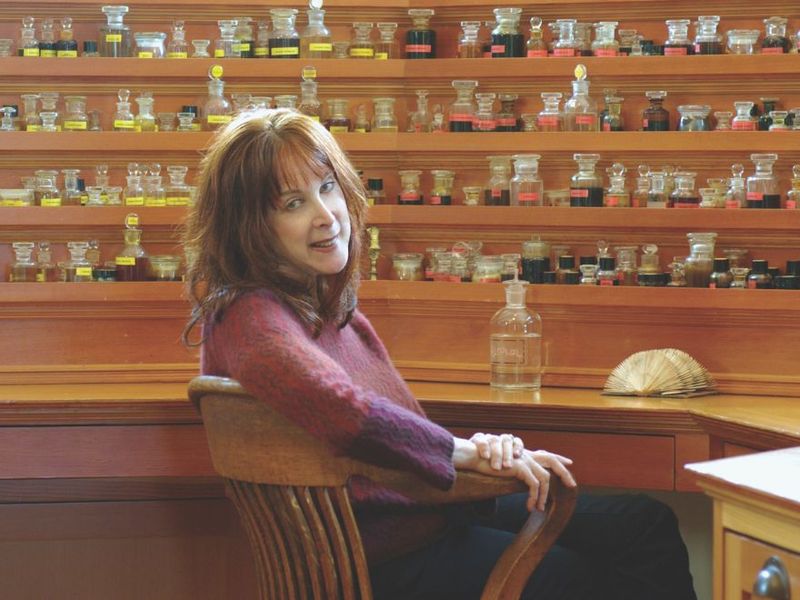
When natural perfumer Mandy Aftel describes a scent, the specificity and care she imbues in every layer makes one wonder whether they have ever truly smelled lemon, rose, or cinnamon. The only solution, it seems, is to book the next flight to Berkeley and visit the Archive of Curious Scents, the museum she runs out of her home, right behind chef Alice Waters’s Chez Panisse.
Aftel is attuned to the rich inner lives of her handcrafted fragrances: where they come from, what they’re made of, and how one note shapes another. The alchemical process extends to her obsessive research and tendency to delve miles deep into historical rabbit holes, out of which she translates ancient knowledge, drawing it into the present. Aftel’s forthcoming book, Symbolorum: The Secret Wisdom of Emblems (Abbeville Press), out Dec. 9, began with her discovering a genre of illustrated books from the 16th and 17th centuries called emblem books. After tracking down an original copy of Symbolorum et Emblematum, by the botanist and scholar Joachim Camerarius the Younger, she became fascinated by their evocative allegories and strange symbols with modern-day resonance, akin to a deck of tarot cards. As with a fragrance’s ability to suspend time, early emblem artists “create[ed] the most unusual images possible, to make the strongest impact on the reader’s memory.”
Here, Aftel, who coined the term “slow scent,” recalls her transformative immersion into natural fragrance three decades ago, and shares why she hopes people will join her in recentering sensory pleasure.
What’s an early scent memory that’s lingered over your past three decades as a natural perfumer?
I took a little class in an aromatherapy studio thirty years ago. I remember the first perfume I made in that class, which I still have, went in my [first] perfume line [Grandiflorum Perfumes], which I started with a friend. The friendship and the perfume business fell apart very quickly. But it was the first natural perfume line. We launched in Bergdorf Goodman in the ’90s. It was very complicated: It had angelica root in it, which is kind of a musky green root. It had juniper from gin; it was bright and woody-smelling. It had a kind of wild, sweet, very high-register orange. It had jasmine. It had oak moss, which is a lichen that grows on the edge of an oak tree; it smelled like wet forest. The richness of it was mind-blowing. It seemed to me like a whole world opened, as if someone had never seen color.
Where did your fascination with the sensory world start?
With the hundred-year-old books that wrote about these materials. I had a kind of understanding of how rich they were in culture and in rituals and in people’s lives, how they mark such important things. I was only interested in naturals, because natural essences, plants, and so on, were so deeply intertwined with who we were as people. It was the understanding of the richness and complexity of the materials in people’s lives, in every period of time, in every place on the globe—the enormity of it—and then the sheer beauty of those materials that were so complex they felt like people to me.
This idea of scents resembling people, in all their multifaceted complexity, is intriguing.
I think each essence has a kind of personality. When I’m blending with them, they are complex and different from one another—they have their own beauty, their own shortcomings and strengths. Think cooking ingredients: If you use cinnamon, it’s different from cardamom. Cardamom is sharper and cinnamon is warmer; you begin to understand them from the inside out. Then, if you read anything about culture, you see, [these materials] are there: in medicine and sexuality, in birth and death.
Turning to your forthcoming book, Symbolorum: The Secret Wisdom of Emblems, why did you feel compelled to introduce what you call a “long-lost cousin to the tarot” to modern-day readers? And how did you first discover these ancient emblems yourself?
I was reading a book on herbal images and looking at a bibliography, and I saw the word symbolorum. I tend to follow what grabs me, but I don’t ever really know why. There’s a kind of magic inherent that I just follow. I thought, Wow, that’s such a cool word. I love symbols. What is this book? I am a seeker and a searcher. I love the hunt. I love looking for things, and I love finding them. So, I looked around online, and then the pictures in the book were so amazing. I couldn’t believe it: They had bears dancing in the rain. They had a lion with a snake around his neck. They had a fish carrying a ring in his mouth. Those pictures were done to really grab you, shake your memory, and have you learn a lesson. I got it translated; I was just too curious. I wanted to know what they were talking about with these gorgeous pictures. And the writing was phenomenal.
The pictures were little, so I wanted to make them bigger, and I had already been water coloring old pictures from these old herbals I had for my museum book [The Museum of Scent: Exploring the Curious & Wondrous World of Fragrance]. I started to paint them, which made me much more intimate with them, choosing the colors and how to express what was in the picture through color. There’s four hundred of them in the real Symbolorum. I feel like I found this kind of buried treasure. My publisher for this has been Abbeville, and they publish medieval books. They knew about emblem books. I cherry-picked one hundred of the four hundred that had the best mottoes, the best pictures, and the best commentary. Then I spent some time finding out more about the symbols so I could add some of my own commentary. It showed how timeless we are as people, how much we repeat the same mistakes, how four hundred years ago is very modern.
How do you view visual art, including these emblems, in conversation with the natural world and its endless array of invisible scents?
I feel like the things that are visible that have this kind of depth and resonance—a lot of it’s invisible. We see the tip of the iceberg, but we experience and feel the rest of it. That’s why we can revisit it as we grow and change. We can revisit those things that are meaningful to us, that are beautiful and special, like, say, a song from Leonard Cohen. [Editor’s note: Aftel crafted bespoke fragrances for Cohen, a longtime supporter of hers throughout his life.] When you revisit it, your life has changed and hopefully your wisdom has grown with a person as wise as, say, Cohen. You see new things in it. Things we engage with that are rich and deep and profound and magical, we come back to those over and over again, because they have more things to teach us.
Describe the experience you aim to create at your museum for visitors who are curious about the rich history of the olfactory world.
I am so shocked every Saturday at our visitors. I love seeing them, and I see every single one. It’s exhausting. I’m ready at six o’clock to go to bed. I talk to everyone. We seem to appeal to such a wide group of people in terms of ethnicity, sexuality, age... They are present the whole time. They will come and talk to me about the little trays I’ve put things out on, the details. It is divine to be around them, and they just talk to me about their lives, how they remember something from their past, from something they’ve smelled in their history, from their grandmother, something they read about in a book. They share something with me about how it has affected them.
We have the indoors. You don’t smell [there]—you touch. You get a little glove. I want people to touch the books. In the beginning, no one would touch them. They were so respectful, they wouldn’t interact with them. It’s important to me that everything is original. Everything is one hundred to four hundred years old. Those books have magic in them. One of the old herbals has something called mummia, where they use mummies for healing. There’s one by an alchemist and a magician, one where a woman has written all her recipes with a fountain pen. Then there are smelling stations all over my backyard. Rain or shine, people go outside.
In the mid-aughts, you coined the term “slow scent” in an article you co-wrote for Slow Food USA’s newsletter, The Snail, with chef Daniel Patterson [Aftel’s co-author on her 2004 book Aroma: The Magic of Essential Oils in Food & Fragrance]. How do you define it now?
Daniel’s making the food and my making fragrances was very simpatico—we were interested in the integrity of ingredients. It’s the process of working drop by drop, with natural essences in tiny batches to create something really beautiful, and being deeply involved in the revising process of it and understanding the facets of those essences there.
There’s their main scent—the wings, the facets, their odor intensity, all the things that make them them—and then revising, very slowly. I teach people to revise one area at a time. It’s called the top, the middle, or the base. It’s a handmade process and product, and it works with the best essences you can get. It’s all about beauty. It’s all about how you feel to be able to wear fragrance that’s a self expression. To me, you have a running head start if you start with stuff that’s really gorgeous to begin with.
In your book Essence and Alchemy: A Natural History of Perfume, first published in 2001 and revised in 2022, you write, “Many of my customers have been astonished by a whiff from a vial of rose or jasmine absolute; they have forgotten—or never knew—what real flowers smell like.” Why is it important to you to keep the art of natural fragrance alive in a world that’s increasingly disconnected from nature and original sources?
I always say to people, just smell everything you come in contact with. If you’re in the grocery store, stick your finger into the lemon peel and just smell that. That’s where the oil is. Or get a little bit of mint when you’re in the store, just rip it in half; now smell your fingers. Put your hand in the dirt. Go smell everything as it’s changing or when you’re cooking. Food is home fragrance. People are a little intimidated by the perfume industry and smell, but it’s all over their lives.
This interview was conducted by Olivia Aylmer. It has been condensed and edited.
Our handpicked guide to culture across the internet.
From Jan. 7–26, Eleven Madison Park will celebrate 20 years of chef Daniel Humm (the guest on Ep. 53 of Time Sensitive) at the helm, with a special “retrospective” menu reflecting on his two-decade evolution at the three-Michelin-starred restaurant. [Resy]
“Who Owns Geometry Anyway?” on view through Dec. 19 at the New York design gallery Friedman Benda, marks a standout first foray into furniture design for artist Adam Pendleton (the guest on Ep. 110 of Time Sensitive). [Friedman Benda]
In “The Cost of Being Seen,” a must-read essay in the third issue of the design publication Wrong House (founded by Slowdown friend and collaborator Lila Allen), designer and theorist Jacquelyn Iyamah examines how racism in the design industry devalues Black home interiors and aesthetics, with long-term material consequences. [Wrong House]
New York Times columnist Thomas L. Friedman makes a case for why our current era should be called the “Polycene,” given the increasing interconnectedness—at an unprecedented speed and scale—of people, machines, and the planet. [The New York Times]
On Dec. 5, as part of the programming at this year’s Art Basel Miami Beach fair, artist Hank Willis Thomas (the guest on Ep. 83 of Time Sensitive); curator Sandra Jackson-Dumont; and Anne Helmreich, director of the Smithsonian’s Archives of American Art, will explore art’s formative role in shaping cultural memory and the kinds of futures we might build together. [Art Basel Miami Beach]