In this week’s newsletter, we present our 2025 gift guide of hand-picked recommendations from our editorial team. Plus: a brief dispatch from Art Basel Miami Beach.
Good morning!
We tend to, or at least try to, take things slow and steady here at The Slowdown, but the end-of-year crunch of December is inevitable. That’s why, like pretty much every other media company under the sun, we put together an annual gift guide. Ours, though, follows a specific “fewer, better things” approach—a nod to one of my favorite books, by the art historian and craft scholar Glenn Adamson (the guest on Ep. 50 of Time Sensitive). These are simply some things we love, with no affiliate links; we don’t make a commission. We also wanted to make sure that there was a wide price range (from $20, for a dog blanket, to $1,650, for a set of hand-carved wood plates), and that everything on our list embodied, in some way, shape, or form, our deep appreciation for craft and culture, with a bit of well-being thrown in for good measure.
I know it’s a busy season, but may I also suggest, after browsing our gift guide, that you take a moment to listen to my Time Sensitive conversation with Art Basel CEO Noah Horowitz. I was in Miami this week for what was my 12th time attending Art Basel Miami Beach, and it made me realize, once again, what a significant cultural-calendar event it is. As I mention on the episode, I formed one of my greatest friendships because of this fair (without it, I don’t know that we ever would have met), and I can’t even begin to process all the other many valuable connections I’ve made there over the years. Attending Art Basel is like a form of cultural speed-dating.
One clear difference between now and 2013, when I first went, is that ABMB (and, by extension, Miami Art Week) no longer has all of the pop-culture heat and celebrity hoopla it once had in the 2010s, and I think that’s a good thing. These days, the art is unquestionably center stage. (A friend did jokingly text me this week, asking if I’d run into Swizz Beatz yet and, though I didn’t see him around, he did host the inaugural Art Basel Awards ceremony on Thursday.) Largely because of the current state of the art market, the speculators are, at least for now, mostly gone. Many tried-and-true collectors were there and, from my vantage point, happily buying (one gallery owner I spoke to said that they had sold 20 works on the first day of the fair alone).
Time is an important part of this equation: ABMB is now 23 years old. It’s more grown-up and mature. Miami Art Week is quieter, less flashy, and slightly more sober. Or at least that’s how I experienced it this year: I’m 40 now, so surely my view of the fair has shifted, too. What I’ll be curious to see is how, in the coming years, ABMB finds a way to attract Gen Z, which, while not entirely absent, didn’t seem to be nearly as present as millennials were a decade ago. A certain generation of big-money collectors are aging out; we’re just now starting to see the greatest wealth transfer in history. What will Art Basel and the art market writ large look like in a decade?
On the episode, Noah talks at length about his vision for the fair going forward and details his ambitious agenda to stretch Art Basel’s reach into realms far beyond what would traditionally be considered the art world. I hope you find his long-view, big-picture perspective as fascinating and informative as I do.
—Spencer

“Art is a lived thing. It’s buying and selling. It’s a marketplace, but it’s also a global community. Some of the great outcomes of fairs aren’t just the commercial outcomes. They’re the new leads that were generated, the new contacts and connections, and that’s really powerful.”
Listen to Ep. 144 with Noah Horowitz at timesensitive.fm or wherever you get your podcasts
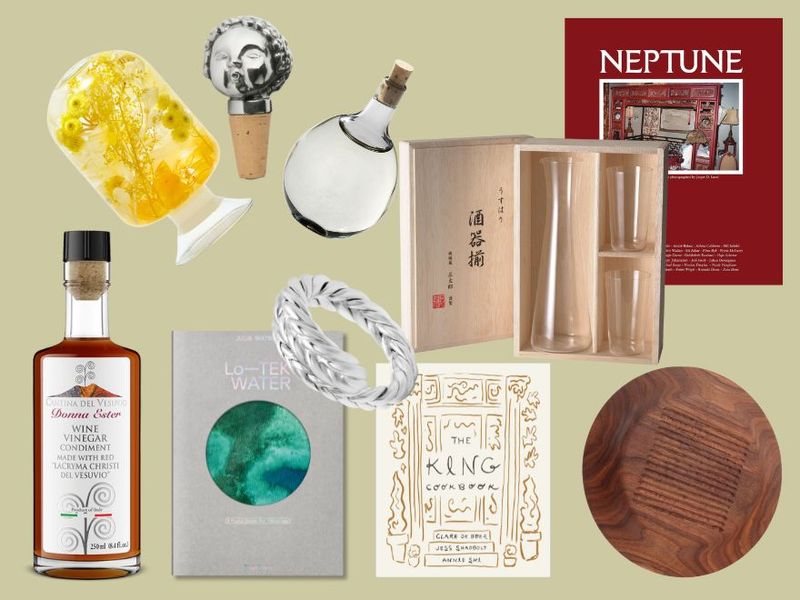
The best gifts, at least in our humble opinion, add aesthetic value, sensory pleasure, and/or meaning to their recipients’ lives. Each of our editorial team’s picks this year, from a red-wine vinegar made with grapes ripened in the Amalfi Coast’s volcanic soil, to a cedar enzyme bath spa treatment, to a Japanese hand-blown glass sake set, proposes to do just that. To compile this list, as always, we looked far and wide for the kinds of under-the-radar things that embody the slow, considered, “fewer, better things” ethos of The Slowdown, with an emphasis on the carefully crafted and the handmade. Enjoy, and happy gifting.
Svenskt Tenn Cherub Wine Stopper
Visions of this pewter-and-cork cherub stopper are dancing in my head as a divine offering for the wine enthusiasts in my life. First designed in 1927 by sculptor and graphic artist Marie-Louise Idestam-Blomberg, and now returned to the collection of Sweden’s century-old pewter-forward company Svenskt Tenn, I love how much personality it would bring to a friend’s bar cart. Remember to store at room temperature (the stopper, not the bottle) for optimal longevity. svenskttenn.com; $180 —Olivia Aylmer, senior editor
Neptune Papers Issue 9
I’m such a fan of Neptune Papers, Daytona Williams’s tasteful art and design publication. The latest issue, which features interviews with the likes of Acne Studios founder Jonny Johansson, art dealer Gavin Brown, artist Jamie Wyeth, and none other than New York City king of the deli Eli Zabar, is a standalone piece of literature that gives coffee table books a run for their money. neptune-papers.com; $42 —Dalya Benor, contributing editor
Osmosis Day Spa Sanctuary’s Cedar Enzyme Bath
What better way to start the new year than a little pamper session? Situated on five secluded acres in California’s Sonoma County, Osmosis Day Spa Sanctuary is the only spa in North America that offers this centuries-old Japanese fermentation bathing ritual, which involves immersing your entire body in a warm mixture of soft ground Port Orford Cedar (native to Oregon and one of the most fragrant evergreen woods in the world), rice bran, and a biological catalyst specially imported from Japan. Boasting health benefits including improved circulation and metabolism, joint- and muscle-pain relief, and pore purification, this is one of the ways I like to treat my West Coast family and friends. osmosis.com; $155 for one, $255 for two —Emily Jiang, contributing editor
The King Cookbook
Ever since it opened, in 2016, Clare de Boer, Jess Shadbolt, and Annie Shi’s New York City restaurant King has remained among my favorite places to dine, and now, with the new The King Cookbook (Flatiron Books), I’m excited to at last be able to make some of its pleasingly unfussy yet decidedly decadent dishes at home. macmillan.com; $39.99 —Spencer Bailey, editor-in-chief
Blunk Plates
Handcrafted by Inverness, California–based carpenter Sam Lillestol, these five walnut plates are based on original creations by the sculptor and artist JB Blunk (1926–2002). The proceeds benefit the JB Blunk Estate, overseen by Blunk’s daughter, Mariah Nielson, who continues to shepherd her father’s vision and legacy into the future through thoughtful Blunk Space exhibitions, placing his work in conversation with pieces by contemporary artists and makers. To me, these plates would make a perfect pairing with dishes from the aforementioned King Cookbook. blunkshop.com; $1,650 (set), $330 (individual) —S.B.
Norlha Yak Wool Scarf
A warm neck is my secret to surviving wintery days and chilly airplanes. Every Norlha scarf accomplishes that in style. Made on the Tibetan Plateau of ethically sourced khullu, the under down of young yaks, these impossibly soft yet extremely durable cashmere wraps are the handiwork of this visionary Tibetan-owned B-corporation that has created life-changing opportunities in these magnificent but harsh hinterlands. norlha.com; from $150 —Cynthia Rosenfeld, editor-at-large
Fischersund No. 23 Solid Perfume
Here’s a fun fact about Icelandic musician Jonsí, the vocalist behind Sigur Rós: His family also owns an apothecary in Reykjavik called Fischersund. I’ve been visiting since they opened their shop in 2017, and their scents have become part of my morning ritual. I love gifting this solid perfume—not only because the gender-neutral fragrance sticks around all day, but also because of its poetic, incredibly Icelandic scent description: “Smoke in the air and tarred telephone poles, / Anis seeds and black pepper, / tail freshly mowed grass and tobacco leaves. / Dead flowers bow to the ground. / In the breeze, the feminine fountain / pine tickles the top of your skull. / A beached whale is about to explode.” fischersund.com; $64 —Erika Owen, marketing and audience development advisor
Style Jieum “Pieces of Time” Floral Sculptures
These aptly named “Pieces of Time” floral sculptures from Korean studio Style Jieum draw inspiration from Victorian-era herbariums by carefully preserving natural elements such as silver tea tree, blue delphinium, and even a miniature spruce in hand-blown glass. I’m partial to the dome showcasing immortelle, a Mediterranean herb otherwise known as the “everlasting flower”—a reminder that, on the other side of winter’s quiet hibernation, yellow flowers await. stylejieum.com; $85 —O.A.
Photographer’s Formulary Cyanotypes Dry Kit
As someone who loves film photography and manual image-making processes, cyanotype has long piqued my interest. For the unacquainted, cyanotype, also known as solar printing, is an early photographic printing process that produces a cyan-blue negative print by exposing a sensitized surface (like fabric or paper) to sunlight. The Reddit threads I’ve consulted point to this particular kit by Photographer’s Formulary, which was first developed in 1997 by Dr. Michael Ware. (The original cyanotype process itself was invented by Sir John Herschel in 1842; this kit is a modern formulation that’s more stable and user friendly.) This will probably be my “gift to myself” this year, and it would make a great present for your crafty or photo-savvy friend. stores.formulary.com; $24.95 —E.J.
McGrath Custom Engraved Silvered Vanity Tray
This year’s edition of Kaitlin Phillips’s annual gift guide got me thinking about engraving. How chic it is to give someone a gift with a custom inscription of your choosing! This elegant silver tray, by New York City design firm and gallery McGrath, reminds a precious loved one of your clever witticisms every time they throw their keys down. mcgrath.nyc; $475 —D.B.
Usuhari Sake Set
The U.S. outpost of the Japanese craft-and-design emporium Cibone, in Brooklyn’s Greenpoint neighborhood, has become a go-to for me when it comes to gift-giving. I greatly appreciate the delicate, clean-lined simplicity of this hand-blown sake set in particular. It’s the kind of quiet gift that tells someone you appreciate them for their refined, subtle taste. cibone-us.com; $110 —S.B.
Cantina del Vesuvio Wine Vinegar Condiment
Years ago, I took a cooking class while on a trip in Italy, and the host was part of a family that owned a winery on the Amalfi Coast. Using grapes ripened in volcanic soil, they craft memorable wines, but it was the red wine vinegar that stopped time for me. Something about the ruby-red brightness of the flavor captured the spirit of this home high on the hills in Capri above the tourist-heavy streets: roosters singing an end-of-day song, music flowing from a balcony a few doors down, and the heat of September’s sun. store.cantinadelvesuvio.it; $37 —E.O.
Lo—TEK. Water: A Field Guide for TEKnology
Australian-born author, researcher, and landscape designer Julia Watson’s latest book makes for an edifying gift for just about anyone concerned with the future of our planet. In it, Watson (the guest on Ep. 35 of Time Sensitive, recorded in 2020) investigates Indigenous innovations like floating farms, tidal fish traps, and aquifer recharge systems—technologies that have sustained civilizations for thousands of years by working with nature rather than against it—and considers what wisdom they might offer us today. Co-authored with Indigenous knowledge-keepers, Lo—TEK. Water (Taschen) reframes water as a potent, intelligent force that can be harnessed to help address the climate crisis and shape resilient, adaptable cities and landscapes. taschen.com; $58 —E.J.
Best Friends by Sheri Faux Fur Shag Blanket
“I stole it from my dog,” I will happily admit to anyone who asks where I got the idea to give them a Best Friends by Sheri faux-fur shag blanket. Designed to calm canines by replicating their mother’s natural coat, the small ultra-soft throw worked so well to lull Kismet, my rescue Cockapoo, to sleep while looking so fetching—pun intended—that I bought the bigger one for my bed, too. bestfriendsbyshericom; $19.99–29.99 —C.R.
Tess Lorenz Belt With Goose Buckle
Tess Lorenz, a new luxury brand started by the eponymous California-based designer, along with her mother, sources their fabrics from the best mills around the world—in the U.K., France, and Italy—with a mission to “revive heritage craftsmanship for the modern wardrobe.” This Italian calfskin leather belt includes the most unexpected surprise: a tiny, delicate goose embellished on the buckle—a reminder that humor pairs well with even the most refined outfits. tesslorenz.com; $320 —D.B.
Kindred Black Skin Care
Kindred Black houses its beauty and skin-care line in gloriously hued, hand-blown glass vessels that double as otherworldly objets d’art. Their “slow beauty” ethos extends beyond their exquisite packaging and prioritizes botanical ingredients that have been used for millennia. I’m keen to give the tepezcohuite-and-ground-coffee exfoliating soap bar as a restorative cold-weather treat for East Coast friends. As a gift to self, I’d opt for either the multipurpose peppermint oil or the Sonoran body oil, made with golden jojoba, wild harvested creosote, and whole lavender in a striking cobalt-blue bottle. kindredblack.com; $28–195 —O.A.
Carina Hardy Braid Double Wrap Flex Ring
I’ve been ogling Carina Hardy’s subtle yet impactful designs since visiting the Bali-based jeweler’s atelier during this year’s Ubud Open Studios. Her brand-new Braid collection—hand-carved by local artisans entirely out of recycled silver—reflects the delicate craftsmanship for which the Balinese are rightly renowned, yet feels eminently wearable anywhere for my friends, both female and male. Especially the Braid Double Wrap Flex Ring, which can be adjusted individually. Without sounding corny, I appreciate what Hardy’s design symbolizes: separate strands, gracefully woven together, like friendship itself. carinahardy.com; $375 —C.R.
Haptic Lab Snake Path Quilt Coat
Putting on this jacket feels like succumbing to a cozy day under a blanket on the couch, but in a far more Brooklyn-cool kind of way. Designer Emily Fischer’s background in architecture can be seen in the shapes—simple but incredibly impactful. Each quilt is made by a group of textile artisans in Noida, India, the result of a 13-year collaboration between Fischer and the group. I gifted this to my partner years ago, and it remains a reason to get excited about the dipping temperatures. hapticlab.com; $350 —E.O.
Our handpicked guide to culture across the internet.
Guest-edited by architect Frida Escobedo, Pin-Up magazine’s latest issue, themed “Domesticity,” brings together critical work by Escobedo’s friends and colleagues (including Lina Ghotmeh, the guest on Ep. 129 of Time Sensitive) with her own research on domesticity and its theoretical implications and material challenges. [Pin-Up]
Ibrahim Mahama (the guest on Ep. 36 of Time Sensitive) is the first African artist to top Art Review’s annual “Power 100” list. (Impressively, he also just received the inaugural “Established Artist” Art Basel Award in Miami this week.) [Art Review]
British artist and set designer Es Devlin’s “Library of Us” installation at Faena Hotel Miami Beach for Miami Art Week consists of a 20-foot-tall illuminated, revolving triangular bookshelf stacked with 4,200 books—Devlin’s favorite 2,500, plus some duplicates—rising from a shallow reflecting pool ringed by a reading table and roughly 60 stools. [The New York Times]
Aperture’s Winter 2025 “The Craft Issue” spotlights Theaster Gates (the guest on Ep. 143 of Time Sensitive) as well as photographers who make pictures in slow, analog ways—by building camera obscuras, creating photograms, or working in traditional darkrooms—to create highly distinctive works of art. [Aperture]
In a recent interview, mycologist and author Merlin Sheldrake discusses what mycelial thinking can teach us about building flexible ecological, social, and structural systems that are facilitated by mutuality and exchange. [Emergence Magazine]