Dries Van Noten, Kenzi Shiokava, Gleneagles Hotel in Scotland, and more.
Good morning!
This has been a particularly eventful week here at The Slowdown. This past Monday and Tuesday, to celebrate the release of Explore: The Leading Hotels of the World (Monacelli), the third in a multivolume series of titles we’re editing, curating, and producing, I joined several hoteliers—including Malibu Beach Inn’s Gregory Day, Nayara Resorts’s Leo and Ruthy Ghitis, and Espacio, the Jewel of Waikiki’s Gerald Glennon—and several members of the press for a summit at the Sonnenalp Hotel in Vail, Colorado. As with the Design and (currently sold-out) Culture books, the series’ first and second titles, Explore honors the standout properties that exemplify the book’s theme within LHW’s collection of more than 450 hotels across 80 countries. In the case of Explore, that means everything from off-piste adventures and world-class sports facilities to transformative well-being experiences and cutting-edge spa treatments. In our latest “Three Things,” below, Olivia highlights the Explore book’s contents and, farther down, in our “Escape” column, we excerpt a piece of mine from the book, on the great, grand Gleneagles Hotel in Scotland’s Perthshire countryside.
We also went live on Wednesday with our Time Sensitive Season 13 finale, a “site-specific” conversation with Dries Van Noten, recorded inside the exquisite 15th-century Palazzo Pisani Moretta on the Grand Canal in Venice, Italy, now home to the new Fondazione Dries Van Noten. To sit down with Dries in this special place devoted to craft, beauty, and making—ideas that have animated his life’s work for more than 40 years—was to spend time inside a world shaped by deep attention. The palazzo itself is a living expression of the values Dries has long championed: patience, care, skill, and an enduring respect for the human hand. Moving through the foundation’s inaugural exhibition, “The Only True Protest Is Beauty,” it felt as though Dries’s many interests had converged into a single, richly layered environment.
A journey through Dries’s way of seeing, our conversation explores how Dries has always resisted easy categories. Throughout his career, he has blurred distinctions between fashion and craft, and between refinement and experimentation. Fittingly, we discuss everything from his Antwerp upbringing and 38 years at the helm of one of fashion’s most admired independent houses to beauty as an essential force in one’s life and his conviction that, in our frenzied, fragmented world, craft offers a gateway to greater meaning and human connection.
Thinking about both this LHW book series and my interview with Dries, I’m struck by the idea that a life’s work is measured not only by what we create, but also by what we help sustain. The Explore volume is ultimately about encountering places where culture, tradition, landscape, and hospitality are being actively carried forward. These hotels aren’t just destinations; they’re custodians. The same could be said of the cultural institution Dries is now building in Venice.
—Spencer
“Beauty is something that we need. It can be the sun hitting something in your bedroom the moment you open your eyes, and you say, ‘Wow, I have already seen enough beauty for today, that gives me enough energy to get through the ugly world.’”
Listen to Ep. 156 with Dries Van Noten at timesensitive.fm or wherever you get your podcasts
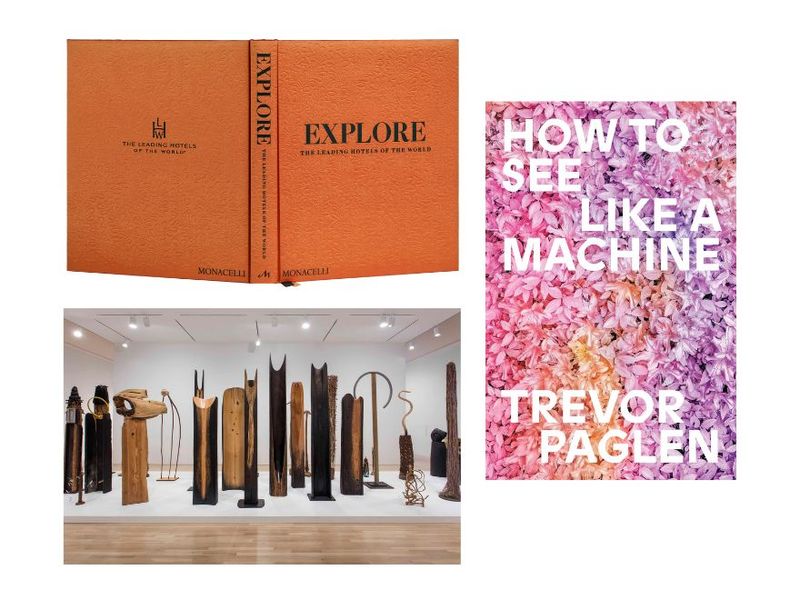
Explore: The Leading Hotels of the World
Whether scuba diving in the Seychelles, skiing in the Swiss Alps, bathing in Tuscan hot springs, or ohm-ing during “horse yoga” in Indonesia, countless dream adventures—and the extraordinary hotels that help make them a reality—await in the pages of Explore: The Leading Hotels of the World (Monacelli). This opulent, orange-hued compass in book form celebrates LHW’s nearly century-long sense of adventure, showcasing more than 80 properties drawn from its 450-plus collection across 80 countries. Three inserts, spotlighting Hawaii, Sicily, and Thailand, offer hand-crafted “Day Trips”; in the back-of-book Index, more savvy editors’ recommendations and “Pro Tip” advice—contributed by the likes of sound therapist Sara Auster; yoga teacher Eddie Stern (the guest on Ep. 43 of our Time Sensitive podcast); and Prior founder David Prior, host of the new podcast Traveling Through—can be found. Designed by award-winning graphic designer Michael Bierut (Ep. 81) with Yve Ludwig, Explore showcases the incredible heights that hospitality has evolved to since A.D. 705, more than 1,300 years ago, when the oldest documented hotel, a Japanese ryokan, was constructed. As Spencer writes in the book’s introduction, “Humans have been explorers from time immemorial.” —Olivia Aylmer
How to See Like a Machine by Trevor Paglen
In the mid-2010s, artist Trevor Paglen (Ep. 49) and his team built a computer vision software framework called Chair that, beyond object detection and tracking, could also generate images with no referent in the real world. “I thought that if image synthesis ever got more convincing, it might end up as a button in Photoshop,” Paglen says. He had no idea that those images were precursors of what we know today as generative A.I., which can conjure images and videos from a simple prompt, be it the pope in Balenciaga or political leaders as deities. In his new essay collection, How to See Like a Machine (Verso), Paglen dives deep into today’s visual culture in an attempt to understand what images are and what they do. He explores the worlds of computer science, semiotics, and political economy before moving into what he calls “the realm of high strangeness”: stage magic, UFOs, psyops, electronic warfare, and C.I.A. mind-control experiments. As Paglen assures in the book’s introduction, these questions are far from trivial or esoteric: “At stake in all of this is something much greater than our relationship to images. It is our relationship to reality itself.” —Emily Jiang
“Kenzi Shiokava” at the Museum of Contemporary Art Chicago
For the late Brazil-born, Los Angeles–based Japanese artist Kenzi Shiokava (1938–2021), wood possessed a spiritual potential, or what he called “inner movement,” a concept that guided and energized his intuitive practice for five decades. Opening today and on view through Jan. 31, 2027, Shiokava’s self-titled first posthumous solo exhibition, at the Museum of Contemporary Art Chicago, brings together more than 50 of his totemic wood sculptures derived from discarded pieces, paired alongside his playful assemblage works of small salvaged objects (an action figure, a plastic pear). A comprehensive monograph dedicated to Shiokava accompanies this overdue survey of the sculptor, who held deep respect for and curiosity about his materials’ past lives, sculpting them with care in his studio, a refurbished auto-body shop in Compton, California. In a 2019 video interview for Otis College of Art and Design, where he earned an MFA in 1974, an exuberant 80-year-old Shiokava said, “In wood, I can see the possibility.” Through each of his reverently carved pieces, the possibilities do indeed appear endless. —O.A.
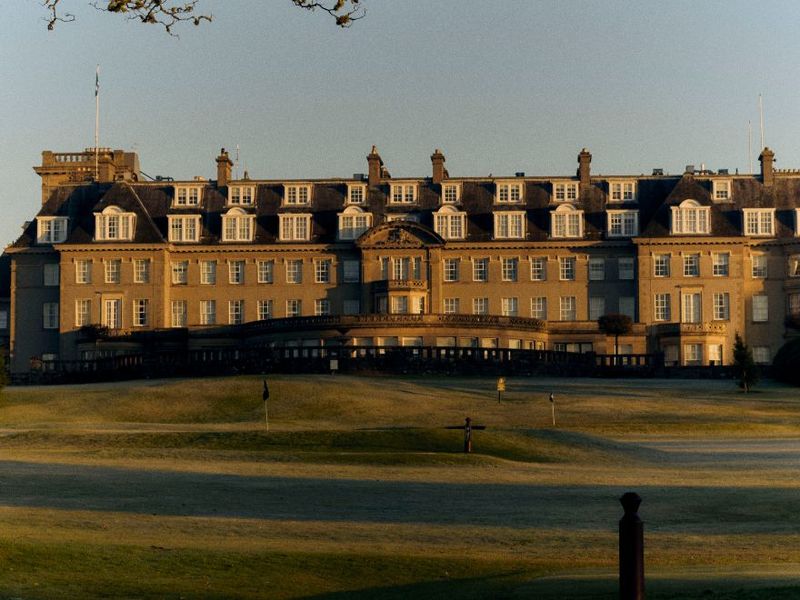
One sunny, bluebird-sky afternoon, winding along the A823 motorway through Scotland’s rugged Ochil Hills, much of the roadside was carpeted in an annual springtime delight: the vivid yellow flowers of a thorny evergreen shrub called gorse. In the far-off distance, a grand gray-stone structure appeared, Oz-like. The sensation of going from black and white to Technicolor overcame me. I was, I quickly realized, on what could be called the Yellow Gorse Road and soon to enter the merry old land of The Gleneagles Hotel, a palatial, five-story, 233-room, 1,500-employee, exceedingly extravagant compound.
This 850-acre paradise—or “Glorious Playground,” to use Gleneagles parlance—features three of Scotland’s top golf courses, including the Jack Nicklaus–designed PGA Centenary Course; eight tennis courts and three padel courts; an equestrian arena with 22 horses and ponies; archery, air rifle, and clay-pigeon shooting ranges; a falconry school that’s home to nearly 40 birds, including 23 Harris’s hawks, two tawny eagles, two golden eagles, two Barbary falcons, two gyrfalcons, two peregrine falcons, a great horned owl, a Eurasian eagle-owl, and two kestrels; a gundog school with five labradors, two spaniels, and a flat-coated retriever; a ferret school, where families learn how to handle, hold, and leash-walk the animals; a 20,000-square-foot spa with 20 treatment rooms, an outdoor onsen, two swimming pools, a thermal suite, and a fitness studio; a beauty salon; a shopping arcade; and 10 bars and restaurants. Among the hotel’s standout suites are the 1,640-square-foot Royal Lochnagar Suite with panoramic views of the landscape beyond; the two-bedroom Tower Suite, perched within the hotel’s original tower structure; and 17 Whisky Suites.
At this resplendent, over-the-top hospitality operation, it quickly becomes clear that the key to Gleneagles is its flora and fauna. Literally: The backside of the keycard—colored in the hotel’s trademark Highland green—features an illustration inspired by gorse, fern, and thistle plants that grow across the region. A subtle nod to how essential native plants are to the hotel, the keycard is a fitting metaphor and an acknowledgement that, at Gleneagles, the land comes first. This century-old legacy establishment—nestled in the Perthshire Lowlands, in a sweep that the 18th-century Scottish novelist and poet Sir Walter Scott once called “the fairest portion of the northern kingdom”—could truly exist nowhere else but here.
Guests are never short of things to do at Gleneagles, yet it’s also the type of place where one would be completely content doing absolutely nothing at all. During my stay—and I should clarify here, I’m not a golfer, something roughly 12 to 15 percent of the hotel’s guests come here to do—I played tennis one day, padel another; took a falconry lesson, followed by a “Walk With Hawk” excursion; practiced archery; got an 80-minute “Highland Healer” massage; visited a fold of Highland cattle, then picnicked nearby; and went on an off-roading journey, during which I came across a herd of more than 100 red deer, moving in an impressive swarm across a hillside. And still I had hours and hours to relax and think and be.
I also ate and ate and ate. Gleneagles is practically a village unto itself, and its restaurants offer something for everyone: One day, my wife and I enjoyed a leisurely afternoon tea at Glendevon featuring decadent stacks of both savory and sweet snacks such as a haggis sausage roll, a sirloin sandwich, and a traditional Dundee cake, served alongside 11 tea offerings, including the Centenary Gleneagles Breakfast Tea from the Shire Highlands of Malawi; that evening, we settled into a cozy corner table at the two-Michelin-starred restaurant Andrew Fairlie for an exquisitely executed tasting menu and wine pairing, with nuanced French-Scottish dishes including caviar with razor clams, buttermilk, and dill; home-smoked Scottish lobster with warm lime and herb butter; and—the showstopper—a roast loin of roe deer with truffle sauce.
To stay at this trademark Scotland establishment is to experience what I call the “Gleneagles glow.” For me, time slowed. Almost immediately, I felt calm and present and open. By the end of my stay, I was filled up, and not just from the delicious food. I left feeling rested and rejuvenated. I left ready for my next adventure. I left already looking forward to one day driving back along the Yellow Gorse Road and returning to this Perthshire Oz.
This is a condensed and edited excerpt of a text by Spencer Bailey, published in the new book Explore: The Leading Hotels of the World (Monacelli), with editorial direction by The Slowdown.
Our handpicked guide to culture across the internet.
Nitsuh Abebe elucidates how, beyond food, the entire world has become “ultraprocessed,” quoting a doctor who has even described the hours wasted staring at your smartphone as “ultraprocessed time.” [The New York Times Magazine]
In a recent episode of Sneak Peek, a video series from the new Apartamento TV, artist Theaster Gates (the guest on Ep. 143 of Times Sensitive) reflects on how his ceramics practice and 22-year-long relationship with the town of Tokoname, Japan, informed his curatorial approach to his recent “Chawan Cabinet” presentation in Milan. [Apartamento]
Artists Rashid Johnson (Ep. 25) and Firelei Báez talk about “archipelagic thinking,” cynicism, the dangers of uniformity, and the importance of getting lost. [Cultured]
British writer and cultural critic Olivia Laing (Ep. 138), a decade after their book The Lonely City was first published, meditates on the weaponization of loneliness, which they say is “an exploitable vulnerability that lies behind much of the violent extremism that proliferates online.” [The Guardian]
Curator and art historian Hans Ulrich Obrist (Ep. 146) interviews Refik Anadol and Efsun Erkılıç about their ambitions as the founders of L.A.’s Dataland, which claims to be the world’s first museum of A.I. art. [Art Basel]