In this week’s newsletter, Ghetto Gastro’s Jon Gray invites us to Gourmega’s communal table, we visit artist Alma Allen in Mexico City for Time Sensitive’s 150th episode, and more.
Good morning!
I’m a big believer in kismet, and this month has brought a lot of it. Last week, I was in Atlanta for the very first time as part of the Our World in Design symposium at the High Museum of Art, organized by the architect Michael Murphy (the guest on Ep. 57 of Time Sensitive) and a gathering about, to use Murphy’s words, “the spaces that make us human, the legacies we leave behind, and the future we want to build.” Conveniently, the event coincided with the opening of the High’s pitch-perfect Isamu Noguchi retrospective “I Am Not a Designer” (through Aug. 2), curated by Monica Obniski and Marin R. Sullivan—a show whose themes and ideas tied seamlessly into the conversations onstage.
Everyone knows I’m a Noguchi obsessive—Murphy even referred to me onstage as a “Noguchi scholar,” perhaps in reference to this piece I wrote about Noguchi as a memorial-maker a few years ago—so to be there in Atlanta and see that show was certainly special enough already. But Noguchi nerds will know that the capital of Georgia is also home to his Piedmont Park “Playscapes,” which turn 50 this year and, to my delight, still shine. It was beyond a joy to visit (and swing and slide at) this extraordinary public site. Noguchi proselytized the power of play, and being there really did make me feel like a kid again.
To add yet another layer of significance to this, the event took place on April 16, which happens to be my mom’s birthday. She died 37 years ago in a plane crash and, without going deep into this story (you can read more about it in this People magazine article from last year), I’ll just say it felt poetic—or I’m not even sure there’s a proper word for this—that this event would take place on her birthday, with the themes of humanity, legacy, and the future coalescing throughout the day. I left Atlanta feeling enlivened.
Speaking of full-circle kismet, this week also marks our Time Sensitive podcast’s 150th episode, a “site-specific” conversation with the self-taught American artist and sculptor Alma Allen in his family’s Mexico City home—a well-timed conversation that arrives at a heightened moment, just as he’s about to present his work at this year’s much-discussed U.S. Pavilion for the 61st edition of the Venice Biennale. For me, this episode is both timely and timeless, a dialogue partly about the noise and debate around his selection for the pavilion, but also, more importantly, about the primordial nature of his art-making. It’s exactly the kind of storytelling we seek to bring to the fore here at The Slowdown.
Just to take a brief moment to reflect: I’m struck by how expansive Time Sensitive has become, beyond what I ever imagined when we launched back in 2019. After years of hosting this show, one thing I’ve come to realize—and continue to find endlessly fascinating—is that no two people perceive, experience, or describe time in precisely the same way. Universal as it is, time is incredibly personal. And because time is abstract, it often leads to deep, introspective reflections instead of canned talking points. It really is, in my view, the best, most illuminating lens into how various creative people live, think, and work—a way of exploring daily routines, yes, but also memory, long-view outlooks, meditation, and mortality.
Even this newsletter comes as a full-circle moment. For our latest “Interview With,” below, the writer and poet Chanice Hughes-Greenberg talks with Ghetto Gastro’s Jon Gray about the culinary collective’s latest project, the restaurant Gourmega, on Houston Street in Manhattan, conceived with his fellow co-founders Lester Walker and Pierre Serrao. Some early Time Sensitive listeners may recall that Jon was the guest on Ep. 2 of the show, so the timing of this conversation also feels like kismet. I ate at Gourmega on its opening weekend, and every one of the “Afro Asiatic Americana” dishes awed and wowed. Time slowed in those two hours, with my wife and I fully immersed in the alchemical combinations of diasporic ingredients—and the spot-on sake and wine pairings—from start to finish.
—Spencer
P.S. For any readers in Paris, I’ll be speaking with Kavita Parmar, the paradigm-shifting founder of Xtant and Ioweyou, at the Fondation Cartier next Wed., April 29, as part of its Homo Faber Conversations with the Michelangelo Foundation for Creativity and Craftsmanship. You can learn more or reserve tickets here.

“The way I approach making art is not dissimilar to improvisational music. I work with my hands over and over and over again until I find the thing that I’m making in the thing.”
Listen to Ep. 150 with Alma Allen at timesensitive.fm or wherever you get your podcasts
Fondazione Dries Van Noten
In 2024, after nearly 40 years at the helm of his namesake brand, Belgian fashion designer Dries Van Noten stepped down from his role and entered retirement—sort of. Work on his Fondazione Dries Van Noten in Venice, Italy, perhaps his most ambitious project yet, commenced shortly thereafter. Co-founded alongside his work and life partner, Patrick Vangheluwe, and housed in the 15th-century Palazzo Pisani Moretta, the 43,000-square-foot arts foundation—which opens to the public today—revolves around the belief, as stated in its manifesto, in “craftsmanship as an act of cultural identity.” The inaugural exhibition, “The Only True Protest Is Beauty,” nods to a lyric by songwriter Phil Ochs and considers beauty as a potent, if unlikely, force of provocation and transformation. On view today through Oct. 4, the show is in many ways a response to the tumultuous times we’re living in. “We’re interested in beauty not as an answer, but as a question,” Van Noten says. “When beauty allows for ambiguity, slowness, and contradiction, when it disturbs rather than resolves, then it becomes a subtle form of protest.” —Emily Jiang
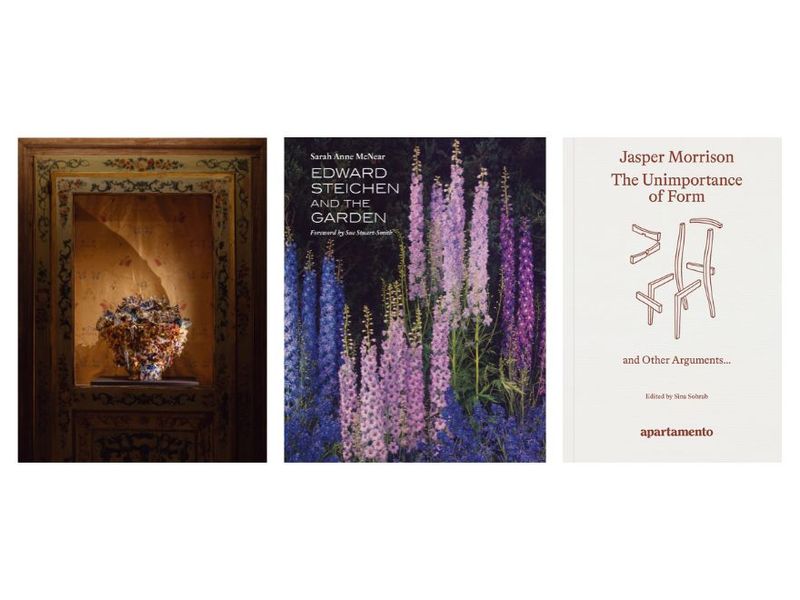
Edward Steichen and the Garden by Sarah Anne McNear
Luxembourgish-American photographer, painter, and curator Edward Steichen (1879–1973) was at one point known as the greatest living portrait photographer, famous for his gown images in a 1911 edition of the French magazine Art et Décoration—the first-ever modern fashion photographs to be published—and for his contributions to Vogue and Vanity Fair as chief photographer from 1923 to 1938. A slightly lesser-known aspect of his life was his devotion to nurturing plants and gardens for more than 60 years, and in particular his development of original varieties of delphiniums. Steichen’s innovations as a horticulturist were so venerated, in fact, that they landed him an exhibition at New York’s Museum of Modern Art in 1936, the museum’s first and only dedicated flower show. In the recently published Edward Steichen and the Garden (Yale University Press), author and curator Sarah Anne McNear explores this meditative, largely solitary practice of Steichen’s and how it flowed into and out of his artistic expression. Alongside paintings and photographs by Steichen are works by fellow artists who painted in his garden, including modernists Arthur Beecher Carles and John Marin and painter and poet Katharine Rhoades. In tandem with the book’s launch, an exhibition by the same name, curated by McNear, opened at the George Eastman Museum in Rochester, New York, and is on view through Sept. 6. —E.J.
Jasper Morrison: The Unimportance of Form, Edited by Sina Sohrab
Somewhere between 1979 and 1982, British product and furniture designer Jasper Morrison went from merely seeing an “elegant structure”—as he refers to it in his handwritten biography, marked by the occasional scribble—to, at 23 years old, attempting to make some of his own. In the decades since, Morrison’s pieces have gained appreciation for their extraordinary ease, usefulness, and beauty derived from the so-called ordinary. Through the new book The Unimportance of Form and Other Arguments, edited by Madrid-based industrial designer Sina Sohrab and the second title in the publisher Apartamento’s reading series, a new window opens into the playful, nimble thinking behind Morrison’s design ethos. This compendium of 31 texts—early musings, autobiographical reflections, and notes for an unwritten novel among them—includes his inquisitive 1991 essay from which the book derives its title, originally published in the Italian design magazine Ottagono. As Morrison wrote then, critiquing the ways designers are often seen as “givers of form” in his industry: “Like most things it’s not that simple and in this case there can be no textbook approach to a particular problem; solutions are always arrived at in unexpected ways.” His words, now imbued with a well-earned patina, still ring true. —Olivia Aylmer

For Jon Gray, the Bronx-born and -bred co-founder of the culinary collective Ghetto Gastro, gathering people together for a meal is about more than good food; it’s a form of communal exchange and celebration. With Gourmega, the outfit’s newly opened 14-seat supper club in New York’s Greenwich Village—located within what in the mid-17th century was a settlement known as “Land of the Blacks”—Ghetto Gastro is centering the city’s mosaic history and culture through a thoughtful nine-plate tasting menu. With an interior designed by architect Mariam Issoufou, Gourmega was conceived as a platform for amplifying the Black diaspora, building community, and fostering conversation through design elements such as a shared table made up of interlocking circles. The restaurant operates on a zero-waste model through a partnership with Rethink Food, which provides meals for food-insecure New Yorkers, and all of its proceeds will support the nonprofit’s mission.
Here, Gray dives into Gourmega’s origin story, highlights its culture-remixing menu, and shares how he sees it as part of Ghetto Gastro’s evolution.
How long has Gourmega been in the making? What was the generating idea behind it?
Initially I was thinking about Gourmega as a café. I was at a benefit gala last spring with Matt [Jozwiak], the founder of Rethink Food, and he asked me, “What are you interested in doing next?” I was thinking about physical space, because Ghetto Gastro had just come off the heels of launching our consumer package goods at Target. If you interacted with Ghetto Gastro before, it was at one of our events where we controlled the environment, whereas when we launched at Target, we didn’t control that environment. Prior to Gourmega, most Ghetto Gastro events were private, invite-only events that we were doing with brands, so they weren’t super accessible. The thought was to do something where we could create a vibe that could make people feel welcome and engage with us in a new way.
Matt said, “Why don’t you do it at Rethink?” Rethink Food had a great location on West Houston Street with a storefront that wasn’t being utilized. I thought, This could be interesting. They trusted me, and we were able to execute because of that. The space is also connected to a community kitchen; it operates throughout the day and then Gourmega activates the space at night. The café concept didn’t make sense because café hours are daytime hours, and the main thing is for the kitchen to create around 3,000 meals a day for hungry New Yorkers. So, I thought, let’s make it a nighttime supper club, and we’ll introduce the café in a second or third phase as a weekend operation.
How did the menu come together? Does it draw inspiration from previous Ghetto Gastro recipes?
I’m really interested in the cultural collision of equatorial cuisine. When I think about Afro-Atlantic and Black people and where we ended up throughout the world—coming from Africa, looking at the United States, the Caribbean, Central America, South America—I’m also thinking how, a lot of these places where we existed, Asian people came from, as well. The menu is celebrating the techniques that we’ve learned or foods we’ve enjoyed and put our own remix on.
Some of the dishes on the menu right now are very Afro-Asiatic. When I go to my doctor, Dr. Lin, who is Chinese, he’ll say, “Before you eat anything, have something warm to bring the body to a nice homeostasis.” That’s why we start with the Pot Likka, which is a reduced collard green broth with uzazi peppercorn. It gives you this numbing sensation on the front of your tongue.
Then we go into what we call Roll Play. I have an obsession with temaki hand rolls; they’re one of my favorite things to eat. We did ours with red rice instead of traditional sushi rice. We use coconut vinegar to cook the rice, and then we add this red spice reduction. The red rice is looking at the Afro-African rice culture from jollof and how that traveled to Spain with the Moors, and also to the American South with New Orleans and jambalaya. Even in Mexico you have red rice and beans. So it’s looking at how this African tradition traveled throughout the world.
Then we go into the shrimp, it’s called Sue Me? Nah, I’ll Su Ya! That’s just for the haters that try to bring lawsuits to the gang. It’s suya butter, shrimp head, and a scotch bonnet sauce. It’s refined, but we also like to have a rustic approach. We’re not cooking for a certain audience—we’re cooking for ourselves. Then we are going to do a piragua, or Puerto Rican shaved ice, which is a New York City summertime tradition. That’s the palate cleanser.
We’re going to change the menu seasonally. We refined and worked on the menu for this season and, as the weather gets warmer, we’ll get a little bit lighter and brighter. We’re already working with local farmers; in the next few seasons, we’ll be able to have farmers grow things specifically for us.
What are you hoping guests reflect on and feel when they visit Gourmega?
The original name of the concept was Queen. I was thinking about African queens because King Street is a block away, and the restaurant King is nearby. The thought was to be in conversation with the area. I gave Mariam [Issoufou] that brief, and her team came back with this crazy history that I hadn’t even known about Greenwich Village. It was home to 300 acres of farmland owned by free Blacks. It was a bridge between what was happening with colonialism, the middle ground between Five Points and Lenape land. There was this mingling of culture, and these Black-and-tan clubs where Indigenous folks and Black folks would drink, sing, party, be merry. There were Black schools, Black farms, Black churches. Being on that hallowed ground, we definitely wanted to enlighten people about this history and use it for creativity.
We have the “Nappy Hour,” which helps make Gourmega more accessible to folks who don’t want to sit through or spend the money on the full tasting menu. From 5 to 6 p.m., we give them three menu items. It’s an hour-long experience, so walk-ins can catch the vibes before we open for dinner service, at 7. We wanted to create it for the people we come from, a community of artists, creatives, people coming from the trenches. We don’t want to make it out of reach.
Can you talk about the defining elements of Gourmega’s design, especially the choice to have a communal table?
For us, it’s about rejecting hegemony and patriarchy, and the idea of the head of the table. We’re celebrating these cultures that eat family style and taking it back to the roots. The circle of tables represents eating around the fire with family. Everybody at the table is equal. We wanted to celebrate this idea of community, especially in the age of hyper-digitalization and A.I. We want to be able to do the things that we know computers and machines can’t do, and that’s to gather and facilitate spaces for convening and building.
We’ve got Mariam on the design and the architecture. Our brother from Nigeria, Nifemi Marcus-Bello, designed these Benin bronze wall plaques with Yoruba scarification that you see on the women in the tribe that represent fertility, nourishment, wealth, and health. Cheyenne Julien did the mural in the bathroom, paying homage to the pleasure gardens during the Black-and-tan club era, and we have Rashid Johnson [Ep. 25] with the bronze painting coming in. We’ve also got Hugh Hayden with his African mask copper pots.
Going back to the partnership with Rethink Food and sharing space in the kitchen, is the idea to prepare meals for them as well?
Rethink Food operates in a few other cities around the country, but the mission started with New York. I’ve been on the board since they started doing meals in the Bronx during the pandemic. Right now we’re sharing kitchen space with them, and soon we’ll be preparing the meals. We’re going to end up doing around 3,000 to 4,000 meals a week.
What are you most excited about in the New York City food scene right now?
This explosion of interest in Black food. You often see people relegate certain cultures to the idea of luxury. For a while, people thought tacos needed to be cheap—same thing with soul food or African food. Look at what Kwame Onwuachi is doing with Tatiana, Fariyal Abdullahi with Hav & Mar, Paul Carmichael with Kabawa. Charlie Mitchell at Saga. Camari Mick—shout-out to chef Camari, she designed our pastries for Gourmega. Even Bryan Ford, with Diljān Bakery. It’s our time.
You’re hosting your dream dinner party at Gourmega. Who are the guests?
I definitely want Nikki Giovani. I want Nefertiti in there. I’ll give you some of the inspirations for [the original concept] Queen: Queen Nzinga, Angela Davis, Assata Shakur. I’ll throw in my friend Dream Hampton. I’ll throw in my girl JT, from City Girls, make it intergenerational. Michelle Obama, Eartha Kitt, Nina Simone, big vibes. Phyllis Hammond would be fire. Ayana Elizabeth Johnson, who’s a marine biologist, I think she’d bring some knowledge to the game. The dinner would be all Black women: Thelma Golden from the Studio Museum in Harlem, Lorna Simpson, Mickalene Thomas. Gourmega really is for the queens.
This interview was conducted by Chanice Hughes-Greenberg. It has been condensed and edited.
Our handpicked guide to culture across the internet.
Thessaly La Force recently profiled the “spritelike” architect and furniture maker Mira Nakashima (the guest on Ep. 101 of Time Sensitive) about what the future holds for George Nakashima Woodworkers once she’s no longer able to oversee it. [Harper’s Bazaar]
Architectural Digest also just paid a visit to Mira at the company’s compound in New Hope, Pennsylvania, for an ethereal video tour, with Mira sharing the stories behind many of their furniture pieces and other objects, as well as illuminating certain parallels between her father’s work and that of Isamu Noguchi. [YouTube]
New York Times architecture critic Michael Kimmelman (Ep. 14) praises LACMA’s new Peter Zumthor–designed David Geffen Galleries, describing the feeling of entering the building as akin to his experience of visiting a Zumthor-designed chapel outside Cologne alone a few winters ago, where “the silence felt visceral.” [The New York Times]
Dutch furniture designer Maarten Baas’s new permanent installation for Amsterdam’s Schiphol Airport, “The People’s Clock,” features nearly 1,000 participants who physically embody time’s movement by forming the hands of a clock. [Instagram]
The late Robert Wilson’s (Ep. 96) spellbinding reimagining of Herman Melville’s Moby Dick, with original music by British singer-songwriter Anna Calvi, makes its U.S. premiere at the Brooklyn Academy of Music on Wed., April 29, as part of Van Cleef & Arpels’s Dance Reflections initiative. [BAM]