In this week’s newsletter, we mine musician and author Melissa Auf der Maur’s analog archive of ’90s rock history, meditate on daily tea rituals with Maria Geyman, and more.
Good morning!
Aaaand we’re back: Season 14 of Time Sensitive is here, with Ep. 157 featuring the Dutch fashion designer Iris van Herpen as our kickoff guest. This episode marks another milestone for the show, too: It’s our debut video episode, available in full on YouTube (you can still, of course, listen to the audio versions on timesensitive.fm, Apple Podcasts, or Spotify).
Any longtime listeners of the show will know that I’ve held back from bringing video into the mix. The tone changes when a camera is in the room. People, no matter how hard they may try, become a bit more performative when being filmed. Their answers change. Some become more reserved and careful in their replies, others more showy and bombastic. It’s difficult to say exactly what happens when a camera is on, but the conversation is simply no longer the same. The 20th-century sociologist and social psychologist Erving Goffman called this a “front-stage/backstage” distinction: Once someone, whether the host or the guest, knows that they’re being watched, the “backstage” self can become a “front-stage” performance. It’s for exactly this reason that I’ve always appreciated the “backstage” quality of Time Sensitive.
After some hemming and hawing, though, I finally relented and decided we should experiment with the form. It was essential to me, however, that we do so in a “Slowdown” way: simple, beautiful, and intimate. Helpfully, we already had a setup with Carl Hansen & Søn furniture and Flos lights that made our studio video-ready. And who better to experiment with on camera than Iris van Herpen, whose entire practice is predicated on pushing new technologies and forms forward while never losing sight of the craft and humanity at their center. Her work is so deeply visual and physical—concerned with movement, material, the body, natural phenomena, and the often astonishing processes behind how her garments are made—that there’s something particularly meaningful about being able to see her as she speaks about it. There’s a quiet precision to Iris, too, in the way she talks, thinks, and moves through the world, that feels of a piece with the work itself. If bringing cameras into Time Sensitive inevitably changes the nature of the conversation, Iris makes a compelling case for what might also be gained.
Going forward, at least for now, we’re not planning to film every episode this way. This is decidedly not a pivot to video. Instead, we’ll be selectively choosing episodes in which to bring cameras in, offering a different form of access and the possibility of experiencing the show in a filmed format. Personally, I feel it’s more exciting to mix up the form depending on the guest rather than stick to some standardized approach. The medium should serve the conversation, not the other way around. Not everyone makes sense to put on camera; some episodes are meant to be listened to, not watched. I like the idea that we can leave room for both.
Fourteen seasons and 157 episodes in, it feels good to still be experimenting—to continue asking what Time Sensitive can be without losing sight of what has made the show what it is. While the form may shift from episode to episode, our intention remains the same: to create the conditions for deep, unhurried conversations worth revisiting, and to give our guests the time and space to reveal something unexpected or enlightening along the way.
—Spencer

“I’m trying to create this new sense of time by focusing on this unknown world of the future and to imagine that in relation to everything that’s happened within craftsmanship in the past. It’s really about bringing those different timelines together.”
Listen to Ep. 157 with Iris van Herpen at timesensitive.fm or wherever you get your podcasts, or watch the episode in full on YouTube.
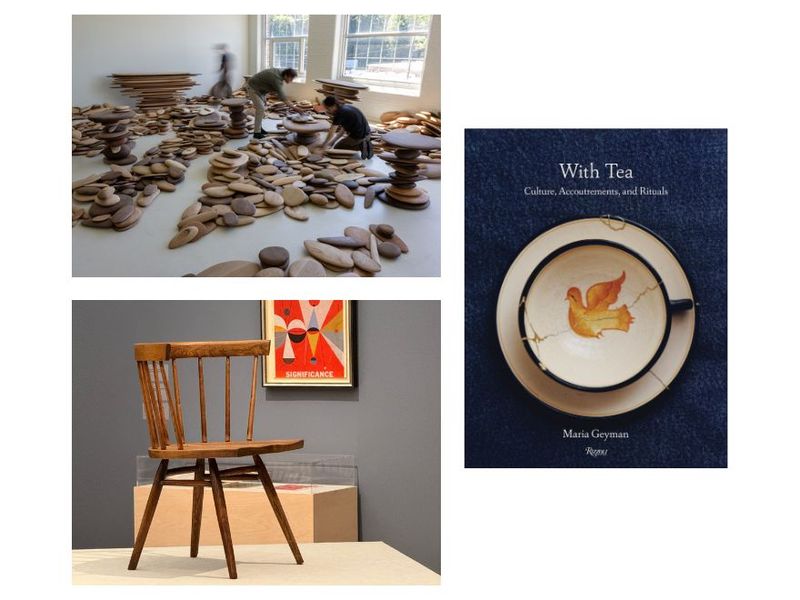
“Badlands” at Sarah Myerscough Gallery
One day, after skipping rocks on a river, sculptor and furniture designer Christopher Kurtz found himself rethinking the countless fragments that he had amassed in his Hudson Valley studio for more than two decades. The subsequent creation of a wood “stone” led him to a deeper inquiry: How do human touch, intent, detours, and time’s passage shape his materials? For “Badlands,” his just-opened solo show at Sarah Mysercough Gallery in London, on view through Nov. 7, Kurtz has fashioned his own landscape from thousands of these carved stones, reminiscent of the vast, unruly surroundings of his childhood in western South Dakota, where his family ran a sign-painting business. In the downstairs gallery space, Kurtz encourages visitors to move through and participate in shaping this craggy terrain, adding yet another collaborative layer to the lifespan of these once superfluous offcuts of walnut, cherry, and ash, among other origins. The accompanying exhibition catalog includes original essays from curator and scholar Glenn Adamson (the guest on Ep. 50 of Time Sensitive) and physicist Sara Imari Walker (Ep. 136), the latter of whom Kurtz first encountered when listening to her on Time Sensitive last year. —Olivia Aylmer
With Tea: Culture, Accoutrements, and Rituals by Maria Geyman
A vintage tea cup from Milan, its cracks carefully repaired with gold powder and urushi resin by ceramicist Miwa Neishi, covers Masha Tea founder Maria Geyman’s serene debut book, With Tea (Rizzoli). One of several featured family heirlooms, along with her great-grandmother’s silver sugar holder and the cake server from her wedding, it offers a fitting first impression of Geyman’s philosophy, rooted in carving out daily moments of ceremony and beauty without overcomplication. In her own thoughtfully crafted blends, Geyman prefers just three herbs or fewer (“That’s the sweet spot for me,” she says), which seamlessly translates to her book’s three-part structure. She explores tea culture around the world, shaped by her Soviet diasporic heritage and travels to India and Japan; at home, prepared for oneself or in good company; and through the lens of health, informed by her background as a naturopathic doctor. Geyman’s reflections—fueled by grounding holy basil tea during her writing process—and recipes for sour cherry strudel and licorice-tea ice pops, steep to even fuller life with photography by Fujio Emura, captured at New York hospitality institutions like The Hotel Chelsea and The Lowell, and playfully surreal watercolor scenes by jewelry designer and artist Alice Waese. —O.A.
“Noguchi to Asawa” at the Barnes Foundation
Though artist Ruth Asawa’s signature looped wire sculptures often elicit a sense of awe and levity in viewers, her biography reveals a starker reality: She first became familiar with this material when she was held behind barbed wire at a Japanese internment camp during World War II. This kind of critical context is the crux of “Noguchi to Asawa: Designing Postwar America,” opening tomorrow and on view through Jan. 10 at the Barnes Foundation in Philadelphia. Curated by Cindy Kang and designed by architect Stephanie Goto, the presentation explores the work of six Japanese American artists affected by the years of internment: Asawa, Isamu Noguchi, architect and furniture designer George Nakashima, sculptor Leo Amino, graphic designer S. Neil Fujita, and fiber artist Kay Sekimachi. Made after Noguchi returned to New York from the Poston camp in Arizona, the sculpture “My Arizona” (1943) reflects on his seven months of incarceration; “Milk House Coffee Table” (1944) by Nakashima was made from teak planks that a friend had kept for him while he was interned in Idaho. Through these pieces and others like them, “Noguchi to Asawa” provides the crucial backstory of much of postwar American art and design, making clear that these works rest against a much larger historical continuum that cannot go ignored. —Emily Jiang
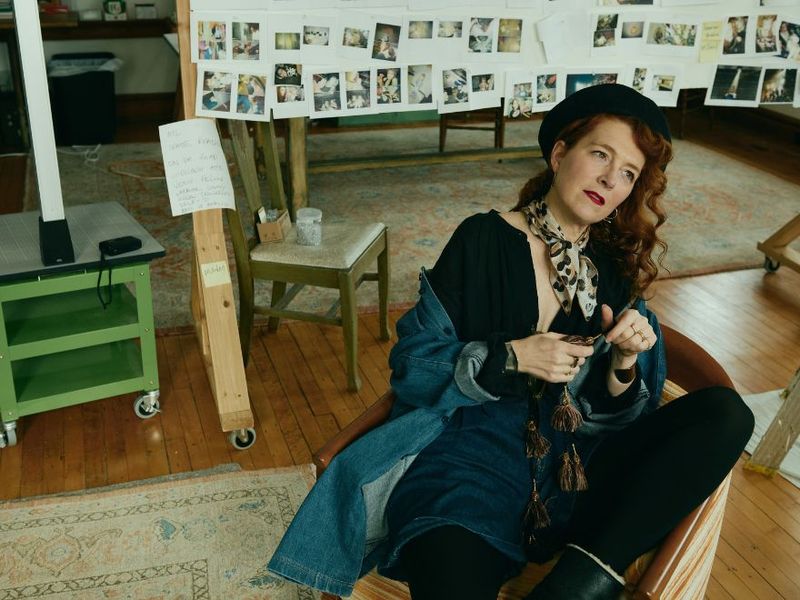
By her own admission, Montreal-born and -raised musician, artist, and author Melissa Auf der Maur often preferred life on the periphery. Yet, in the summer of 1994, she catapulted to the red-hot center of ’90s alt-rock history when she agreed to contribute her steady, enigmatic presence as the bassist in Courtney Love’s band, Hole, still reeling from the sudden deaths of Love’s husband, Kurt Cobain, and her bandmate Kristen Pfaff. Later, Auf der Maur would also join The Smashing Pumpkins at the personal invitation of founder Billy Corgan. Equipped with her trusty palm-size Nikon camera during those seismic days, steeped in chaos and possibility, she made pictures that have now resulted in a rare visual time capsule of an era where analog ruled. Her new book, My ’90s Rock Photographs (DelMonico/D.A.P.)—co-published and accompanied by an exhibition at Toronto’s Art Gallery of Ontario, on through June 6, 2027—compiles her vivid collection of more than 200 photographs and firsthand commentary, plus a conversation with R.E.M.’s Michael Stipe. It builds upon her vivifying memoir, Even the Good Girls Will Cry, published this past March on her 54th birthday, with a documentary centered on her archive in the works.
Here, Auf der Maur speaks with The Slowdown about finding herself behind the lens, recentering our humanity beyond the digital avalanche, and the beauty in never being too cool to care.
From your earliest days in Hole, and as a young artist charting your path in Montreal, you had this sixth sense to document what you were living through. Tell me about your instinct to capture both larger-than-life moments and your everyday, on-the-road reality.
My camera and my diary began in the same place, which was a very shy, scared, seeking little girl. Unfortunately, it took me this long to understand that all I’ve been trying to do is exist. [I’ve been] having some of the biggest breakthroughs in my therapy zone, because I’m 54 and my daughter is 14, and 14 would have been around when I started to desperately seek myself. The first time I was ever in a darkroom, seeing a photo that I took coming to life and the magic of those chemicals, I felt alive for the first time. I understood that I had agency. I took that photo of that alleyway or of myself in a mirror. I made it exist, not somebody else.
I was living in the shadows of this remarkable set of parents [Nick Auf der Maur and Linda Gaboriau], a very chaotic, nontraditional, bohemian, and experimental world. I didn’t understand where I began and where anybody ended. I’ve always been blended into the overwhelming world outside of me. It took me until my fifties, writing this book and reflecting on my photography, my journaling, and, at 19, finding my bass, which was my root to a heartbeat in the universe, but also to the feet on the ground, and to the other humans outside of me. Once I found my calling of music and these crazy mentor types, in the form of Billy, and later adopted by Courtney, I understood more through the lens of my parents, who were journalists. They told me they had narrated their generation. My father fought for homeless people and incarcerated people and drug addicts. He wanted to help people who didn’t have a voice. I was so overwhelmed by the narrative of what my parents were doing that I had to find my story, or else I would just drown in theirs. The journaling and the photography became me mirroring what they did, but to my generation.
How did your camera help you to make sense of your experiences—both then, in the eye of the storm, and now, with some distance and perspective?
When I joined a band of basically orphaned, broken people in rock bands, I needed to capture their life for them. I needed to capture my life for me. I needed to do what my honorable parents did, which was talk about their generation and how the youth and counterculture reflect the world that we’re living in. My contributions are me trying to give you and future generations a sober, clear, documented, insightful, romantic, spiritual perspective of what the fuck happened at the last moment of the last millennium that delivered us to this unthinkable…
I have an obligation to reflect what I saw happen during our time, 1991–2001, when we were just raw vessels and raw nerves. My [memoir] ends on the roof of the Chelsea Hotel, watching the [twin] towers fall, and I acknowledge that it’s the end of the world as we know it. I’m deeply aware that there are very, very dark forces at work. That is our gateway and opportunity to be better, stronger, cooler, more loving, more artistic, more beautiful. My camera gave me a purpose, and it protected me. In some ways, it was an escape hatch to survive.
Your latest book’s cover shows you and your Hole bandmates, all looking a bit dazed, almost bewildered. When you time travel to that moment, what do you recall? Why did this photograph feel like the one you wanted to set the scene?
This is Lollapalooza 1995. I would often take a picture of the band right before we went on stage. Courtney wouldn’t normally wear this much makeup. I love the fact that she looks like a caricature doll, Miss World, of herself. Patty [Schemel] and Eric [Erlandson] in the middle, to be honest, were always a little sideswept or overwhelmed. Very sensitive people, self-effacing, especially Eric, who, being the only boy in the band, didn’t get a lot of attention. Patty, who was my best friend in the band, who at this point in the story is slipping back into her addiction, even though she had gotten clean after Kurt died and Kristen died. She struggled. I remember this photo, this moment, through my own innocence at that time, where I was just trying to help us all exist. I hope the picture represents the innocence. It’s really amazing we all survived.
I was very engaged, alive. I was the only one at Lollapalooza, other than [Sonic Youth guitarist and vocalist] Lee Ranaldo, taking pictures of everything. When I ran into Beck recently, I hadn’t seen him in twenty years, and I brought him a picture of him from Lollapalooza. He said, “Oh right, I remember you always had a camera. It’s so cool that you weren’t too cool to care.”
Recently, I guested at Lollapalooza with The Smashing Pumpkins, thirty-two years after they last headlined, and thirty-one years after Hole headlined. Someone posted a picture of me and Courtney on that day, her hugging me with my bass. I did the math, and I was like, “Oh my god, I was Olivia Rodrigo’s age, and she was younger than Charli XCX.” When I look at Olivia backstage, who also guested with The Smashing Pumpkins at Lollapalooza [this year], I see her and I feel so protective. I gave her my phone number and said, “I’m here. Anything I can ever do to help make sure you take care of yourself.”
At the heart of your book is this idea of preserving the last analog decade. What do you see as the enduring value of prioritizing a slower, less immediate way of being?
It is so simple. It is literally just sustaining the act of being human. Sustaining a timeless way of existing, which is at threat and already compromised. The reason why I’m so psyched that I have a camera and a bass—very contemporary tools—is that I was able to capture being human with a type of technology that youth still have access to. In fact, more access than ever. It’s me showing what I hope to be a timeless, contemporary, youthful way of expressing yourself and connecting with people. I waited twenty-five years to unpack and understand this. Sometimes, that’s how long it takes to see who you are, what is happening, and where the world has gone.
Why do I want to show people cool, magical moments in rock music? We had less corrosion to that sacred, quiet place inside. The noise outside—not just the traumatic things happening in the world, but the digital onslaught and your time being preyed on—all of this is threatening the clear, quiet voice inside, which is actually all you need to be okay. That doesn’t mean people you love aren’t going to die; you’re not going to be heartbroken. All this horrible shit is going to happen. But if you have a clear connection to the quietest, strongest, clearest sense of self, you’ll have to be okay. You will be okay.
This interview was conducted by Olivia Aylmer. It has been condensed and edited.
Our handpicked guide to culture across the internet.
Editor Carola Long writes an ode to fashion designer Paul Smith (the guest on Ep. 109 of Time Sensitive), who recently celebrated his 80th birthday. [Financial Times]
For Dwell’s One Last Thing column, our very own Spencer Bailey shares with journalist Lauren Gallow his deep appreciation for a rare 1930s Noguchi-designed Radio Nurse baby monitor he acquired earlier this year. [Dwell]
On Sept. 23 at New York Life Gallery, artists and photographers Trent Davis Bailey (Ep. 97) and Diana Markosian will discuss how they excavate grief, loss, and familial archives through their pictures. [Luma]
Critic Joshua Barone contemplates cellist Yo-Yo Ma’s exemplary existence, not just as one of the most famous musicians alive, but as a “sincerely committed humanist” who “sees people as … deeply connected to one another and to nature at large, in an age of algorithms nudging us into echo chambers.” [The New York Times]
In this new profile of Rachel Comey (Ep. 72), friends and collaborators including Waris Ahluwalia and Kara Walker commend the designer’s longevity and community spirit as her independent fashion label turns 25. [Harper’s Bazaar]