Experimental composer Anthony Braxton, Sufi teacher Emmanuel Vaughan-Lee, and more.
Good morning!
Olivia here. The other weekend, I spent a Sunday in Peterborough, New Hampshire, on the verdant grounds of MacDowell, the first artist residency program in the U.S., founded by composer Edward MacDowell and pianist Marian MacDowell, his wife, in 1907.
I was there to meet Anthony Braxton, the prolific Chicago-born composer, multi-instrumentalist (saxophone, clarinet, and flute), and educator, this year’s recipient of the 66th MacDowell Medal. Since 1960, this award has gone to artists who have left their indelible imprints on the past century of culture and, in turn, need little introduction, including Alexander Calder (1963), Isamu Noguchi (1982), Nan Goldin (2012), Toni Morrison (2016), and Yoko Ono (2024). The festivities also mark the one day each year on which the public can explore this sprawling New England campus and wander, as I did, through its 31 open studios and living spaces, home to current working artists-in-residence. Each bears the distinctive, handwritten names and dates of the 10,000 some-odd artists who have previously passed through, drawn to MacDowell’s promise of solitude and shared creative sustenance.
During the festivities, a few of Braxton’s ardent admirers introduced him, including two Pulitzer Prize winners: Argentine and American writer Hernan Diaz and composer and multi-instrumentalist Tyshawn Sorey, a protégé and former student of Braxton’s. Each spoke to the inadequacy of encapsulating Braxton’s vast, free-form career, let alone attempting to do so in his presence. As I quickly discovered when preparing to talk with him for this week’s “Interview With,” below, it’s a tall, perhaps impossible order.
One could spend many months in deep, joyful research of Braxton’s boundaryless output, purely for the pleasure and discovery of it. If you’re new to his work, I recommend starting with For Alto, his seminal 1968 release that marked the first album of saxophone solos and set him on a track to take ahead-of-his-time risks, no matter if his peers or the music press understood. After that, seek out some live recordings, perhaps his quartet performing at the Montreux Jazz Festival in July 1975, then delve into his meditations on music, philosophy, and metaphysics. (An extensive collection of his recordings, scores, and other ephemera is now available through the Library of Congress.) Wherever you choose to enter Braxton’s kaleidoscopic oeuvre, prepare to feel a bit destabilized and out of your depth, in the best, most thrilling way possible.
At this phase of his life’s journey, Braxton is fully embracing student mode, continuing to gravitate toward the unknown. Referencing his time teaching Sorey at Wesleyan University in his speech, he recalled, “By the time I left, and by the time he left, I was the student, and this guy was the teacher. I learned a lot from him.” Sorey, who chaired this year’s Medal selection panel, eventually got behind the drums (listen here at 44:50), using the various tools at his disposal (sticks, both sides of a brush, and his fingers) to produce a series of visceral sounds that were reminiscent, at turns, of riffling through a pile of seashells, distant thunder, and light rain tapping a windowpane.
To be in the audience was to eavesdrop on a musical conversation the two have been engaging in since they first met in 2009. As Sorey’s solo reached its apex, all was hushed amazement. That is, until clapping hands—Braxton’s—broke the stillness, one lifelong student of music humbly cheering another. “We should all be grateful to stand under the same patch of sky together with Mr. Anthony Braxton,” Diaz said during his remarks. As Braxton’s burst of applause now turned toward him, continuing on, it was clear we were.
—Olivia
“For me, it’s all about this emotional conduit with the music. The players are the real magicians, and I just want to create an environment and a system that is going to create as close of a connection to the emotional content in the music as possible.”
From Season 13: Listen to Ep. 149 with artist and audio engineer Devon Turnbull at timesensitive.fm or wherever you get your podcasts
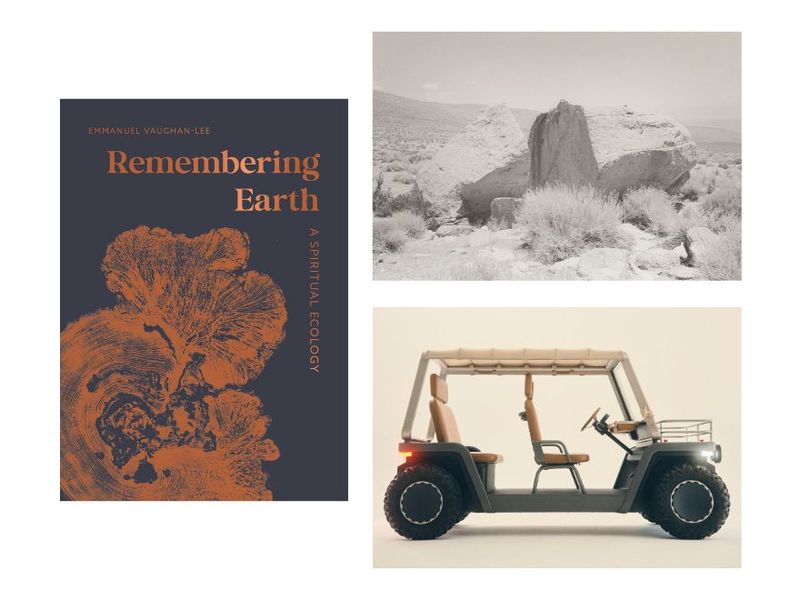
Remembering Earth by Emmanuel Vaughan-Lee
The child of two mystics—including his father, Llewellyn Vaughan-Lee, whose 2013 book, Spiritual Ecology: The Cry of the Earth, was seminal in establishing the namesake field—filmmaker, composer, Sufi teacher, and Emergence Magazine founding editor Emmanuel Vaughan-Lee has spent his life sharing and reckoning with his belief that humans’ spiritual disconnection from the Earth lies at the root of every crisis we face. In his new book, Remembering Earth: A Spiritual Ecology (Shambhala), he diagnoses modern society with a “great forgetting” of our primordial relationship with the sacred, ailing planet we inhabit and explores the ways we can—and must—work to rekindle it. Later, he introduces practices within the six areas of the breath, the heart, walking, listening, time, and prayer to help foster this connection. The result is not just a summation of his life’s teachings, but also a call to remembrance, both of the work his father began and of the ancient ground beneath our feet. “I feel more strongly than ever that stories are alive,” he writes, emphasizing that “they can play a vital role in helping to heal the divide between spirit and matter, and that the good ones have the potential to teach us how to love the Earth again.” —Emily Jiang
Rock Clock by Sean McFarland
Along the edge of Round Valley, in the Eastern Sierra Nevada, resides a megalith of Mesozoic granite that formed deep within the earth millions of years ago. After surfacing and being brought to its current location by glaciers, it was cleaved in half by the repetitive freezing and thawing of water within it. Dubbed the “Rock Clock” by artist and photographer Sean McFarland, the fractured boulder is a rich piece of geologic history known as a glacial erratic. Essentially a time capsule, the rock is, in his words, “displaced and delivered, sitting now among sage, saltbrush, and the drift of wildflowers and butterflies.” Out now in a limited run from Deep Time Press, McFarland’s new book by the same name presents 13 arresting black-and-white photographs taken at intervals as he circumambulated the earthly object. Entirely handmade, the book is housed in a custom slipcase along with an accompanying poster and features a cover with blind debossing by Leah Koransky. Following its initial debut in Los Angeles in May, it will be presented at the San Francisco Art Book Fair from July 23 through 26, which will coincide with the artist’s release of five deluxe editions, each containing a framed gelatin silver print from the series. —E.J.
Amble One
Founded by José António Uva, owner of the São Lourenço do Barrocal hotel in Portugal’s Alentejo countryside; industrial designer Julian Hoenig; designer Michael Tropper; and entrepreneur Adrien Roose, the new Lisbon-based EV company Amble has revealed its debut product, Amble One, a reimagined open-air electric buggy. Designed to cruise on terrain that regular cars aren’t cut out for—desert dunes, winding coastal paths, rugged dirt roads—the four-seater’s electric motor is a silent workhorse, offering an effortless ride even on steep or bumpy climbs. Its lightweight aluminum frame and recycled polymer body make the Amble One well-suited for sun, wind, or rain, and attachable accessories such as baskets, straps, mirrors, and rear cargo mean it can adapt and evolve along with a driver’s needs. First deliveries will begin in late 2027, with a street-legal version to follow in 2028. The underlying ethos of Amble One, Hoenig says, can be found in the company’s name—a word meaning to move without urgency, fully engaged with one’s surroundings, enjoying the world outside. “Amble One is built to embody that idea in its open, simple design,” he says. “No doors to close you in, no unnecessary screens to pull you away.” —E.J.
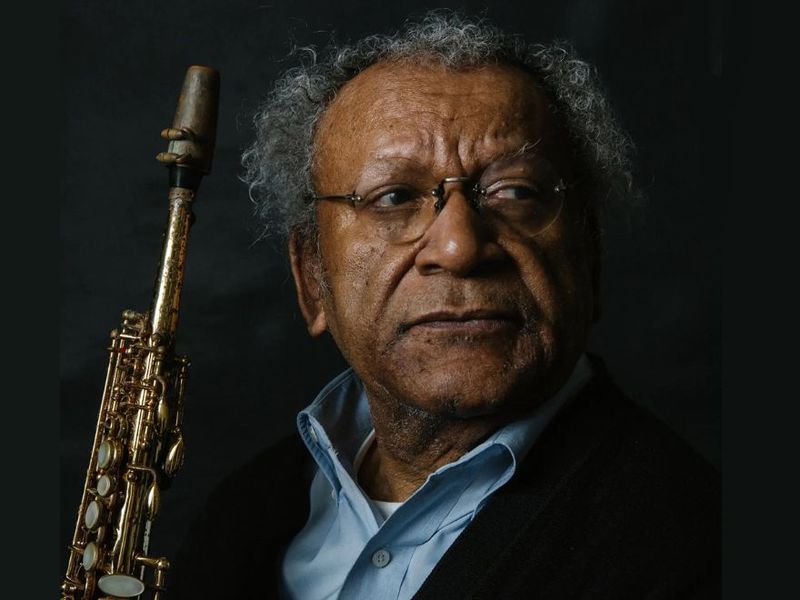
Whether playing, composing, or listening, Chicago-born multi-instrumentalist Anthony Braxton approaches music with a beginner’s mindset. Over his nearly six decades at the forefront of countless avant-garde experiments in sound, Braxton, who turned 81 last month, still sees himself as a student of music, as he told the enraptured crowd gathered to celebrate him at MacDowell’s 66th Medal Day, on June 28. While Braxton respects the eclectic array of traditions that shaped his ear—whether Bach, John Coltrane, or American jazz pianist Mary Lou Williams—he’s never chased certainty or finality in his lifelong search for cosmic and sonic knowledge. “I’m not from the zone that says I have all the answers,” he says. “In fact, I don’t even want the answers.”
Following the ceremony, we spoke with Braxton about carving out his improvisatory path and perpetually seeking new sounds. As he recalled reuniting with several former students that day, he nearly shed a few tears.
What was something that opened up the world of music for you early on and made you want to contribute?
I discovered Frankie Lymon & The Teenagers. I’ll never forget it. “Why Do Fools Fall in Love?” I bought every record that he put on. I remember thinking, “How could life be any better than this?” I went to see the movie Blackboard Jungle (1955), with Sidney Poitier, and inside of the story, Bill Haley & His Comets began to play rock and roll. I remember thinking, “God help me, how could something be better than this?” I got all the music that I could find from both of these guys.
Then I began to listen to The Dave Brubeck Quartet. Paul Desmond on alto saxophone. This guy turned my life upside down. Before The Dave Brubeck Quartet or Paul Desmond, I wanted to be like Miles Davis, play the trumpet. I really loved the music and started putting the microscope on it. Something was moving forward, and I wanted to better understand what it was. I’d go to my mother’s church. It was actually very beautiful. But I remember, even now, thinking, “I don’t know about this…” [Laughs]
Which part?
I believe in God, I believe in spirituality. But how do you talk about something and you don’t want to disrespect it? There are so many different kinds of spiritualities and schools. I already understood that I believed in God, but I had to get some work done, to better understand the Creator. That was starting around 5, 6, or 7. By the time I was 15, I’d gone through different areas of spirituality and organizations, and I respected it in every way.
And time—time fools you. You think it’s going slow, but it’s going faster. You think it’s going faster, but it’s going slower. As you begin to understand that there are all kinds of times taking place at the same time, things suddenly get more beautiful and more complex.
Can you expand on what you said in your speech earlier today about feeling like you’re the student at this point in your life?
One of my students here, Ted Reichman, he plays accordion and piano; he’s a super virtuoso, a brilliant young man, teaching in Boston at the New England Conservatory of Music. He’s one of the leaders of the music department. Now he’s calling the shots. I almost started crying. I almost fainted when I saw this guy. He’s a real man, a real musician, a real educator. He’s trying to help you understand what knowledge is and how you need to learn how to work with yourself—that’s the first component. You need to understand yourself, and from that point, you can begin to explore options that you weren’t always well aware of.
Who are some of the young artists and musicians you’re paying attention to and excited about right now?
I had maybe six of my students come today. I can’t believe these guys still remember me, and I remember them. They will go forward and help our young people. [Reichman] is doing it already, because he has an incredible heart. Tyshawn [Sorey], he’s another one of my students. It’s like, “Wait a minute, Tyshawn, what are you doing there with that? Show me what that was.” I’m learning a lot from my students. They want to let Braxton know that these people have moved forward and they’re doing their best work. When my young guys and girls come to see me, it helps me to know that I did my best. Eighty percent of my students come to visit me, won’t go away. So I try to get them to [tell me], what are you doing with this? What’s the new news?
I’m curious about musicians whom you’ve had a longer relationship with over time—John Cage, Coltrane, Duke Ellington, Jimi Hendrix. When you listen to their music now, do you find that you’re hearing things in a different way from when you first encountered them?
What you just described is the perspective that is correct for me—to learn from my students and my educators. And laugh together. It’s not all serious, toughy-tough talk or technological talks, but being together and laughing at how beautiful life is, and how you can get to where you want to get if you make a decision you want to do it.
My generation is rightfully fading out, but before you’re gone, you do your work. You don’t just stop and wait to die. You do the best you can do. When the time comes—the time is going to come, because that’s how it’s set up. Would you want to be alive forever? I don’t want to be in this situation forever.
What role does slowness and unstructured time play in your life now?
Cosmic forces and God have been the components that helped me to stay on the right track. I talk to the Creator, just like I talk to you, and I try to learn from people who are doing things. Life is really something, and if you don’t bring things inside of you, you’ve wasted an incredible opportunity, because it’s here, but it’s not going to always be here. Something will change, because change is part of how things work. It’s actually very beautiful if you’ve done your homework, or if you’ve gotten stronger and stronger.
Anthony, thank you so much for making time. It’s a big day for you. Congratulations.
I am surprised at all of this. As for you, no goodbyes. We will see one another in time, crossing one another. And maybe, if we’re lucky—if I’m lucky—we can have a nice conversation and laugh at all that we’ve gone through and all we went through to get even better, rather than slow up.
This interview was conducted by Olivia Aylmer. It has been condensed and edited.
Labeling our Time Sensitive podcast “brain food,” writer Ammar Kalia hails the show “a master class in gleaning fresh wisdom.” [The Guardian]
Post Company: Character Studies (Monacelli), a new monograph illuminating the Brooklyn- and Jackson, Wyoming–based firm Post Company’s craft-forward design projects—with editorial direction by The Slowdown and texts by writer Lila Allen, as well as a “Postscript” essay by Spencer—is available for pre-order before its Sept. 30 release. [Phaidon]
The inaugural print issue from spirituality- and mysticism-centric literary magazine Kismet, themed “Clouds of Unknowing,” includes captivating new fiction from British novelist Sophie Mackintosh, cultural critic Wayne Koestenbaum, and Icelandic author Bergþóra Snæbjörnsdóttir. [Kismet]
Malcolm Gladwell (the guest on Ep. 125 of Time Sensitive) and Barack Obama are teaming up with The History Channel for an eight-part podcast, Reconstruction: The Unfinished Promise, which unpacks the tumultuous 12-year period following the Civil War. [Variety]
Architect Lina Ghotmeh (Ep. 129) discusses how her upbringing in Beirut, a city that has endured wars and periods of instability, has led her to “try to design spaces that are repositories not just of memory, but also of hope.” [Abitare]